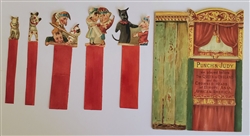
Raphael Tuck paper toy theater Punch and Judy as Played Before the Queen of England, ca. 1893–1901. Complete with all five original puppets—an exceptionally rare survival in Extra Fine condition.
 |
|
Alternative Views:


|
 |
 |
 |
|
[Tuck, Raphael & Sons.]
Punch and Judy as Played Before the Queen of England (Paper Toy Theater with Five Original Puppets)
London, Paris & New York: Raphael Tuck & Sons, ca. 1893–1901. First Edition.
Die-cut, embossed chromolithographed paper toy theater measuring 6 x 4.25 inches when folded flat; unfolds to a three-dimensional standing stage box (6 x 2.5 x 1.75 inches / 15 x 6 x 4 cm). Complete with five original articulated puppets, each with extended handles for manual operation through the slot beneath the curtained proscenium. Theater structure assembled via original interlocking tab system; features a lift-up curtain flap and full chromolithographic decoration on all sides. Imprint reads: "No. 1 – Publishers to Her Majesty the Queen / Raphael Tuck & Sons, London, Paris & New York / Designed at the Studios in England and Printed at the Fine Art Works in Germany."
This interactive toy theater was the first and rarest in Tuck's six-part Stage Series, and this example is exceptional for retaining all five original puppets—most known examples are missing figures or structural components. The puppets are manipulated by sliding and lifting the extended tabs through a stage slot, allowing for performative movement. According to Blair Whitton’s Collector's Guide to Raphael Tuck & Sons (1991), only four puppets had been recorded for this model, making this complete set especially notable.
Condition: Extra Fine. All components clean, bright, and undamaged. One structural tab has been discreetly reinforced with archival tape. No other repairs or losses. A remarkably well-preserved and complete example of a delicate and highly ephemeral 19th-century paper toy.
Logo on the theater states: Easel logo with TRADE MARK ARTISTIC SERIES then “No. 1 “ “PUBLISHERS TO HER MAJESTY THE QUEEN /RAPHAEL TUCK & SONS, LONDON, PARIS & NEW YORK / DESIGNED AT THE STUDIOS IN ENGLAND AND PRINTED AT THE FINE ART WORKS IN GERMANY”
Collector’s Corner:
This remarkable Punch and Judy toy theater is pictured on pages 30–31 of Collector's Guide to Raphael Tuck & Sons: Paper Dolls, Paper Toys & Children's Books by Blair Whitton (Hobby House Press, 1991). While Whitton notes that the set included four puppets, the present example confirms that at least five were originally issued—making it an important reference copy for collectors and researchers.
This piece was the first in a six-part series of paper theaters published by Raphael Tuck & Sons, all designed for interactive play:
-
Punch & Judy as Played Before the Queen of England
Features a proscenium stage with articulated puppets for live-action storytelling.
-
The Happy Family
Depicts a boy and girl beside a circus train car filled with animals such as a cat, rabbit, monkey, pig, and lemur.
-
The Lovely Ella (Will Appear), Daring Deeds in the Lions’ Den
Shows a girl performing inside a circus ring flanked by a lion and bear.
-
Romeo & Juliet
A classical stage featuring two figures from Shakespeare’s play.
-
Walk Up! Walk Up!
A circus-themed stage with wrestlers, jugglers, and strongmen.
-
The Marvellous Menagerie
A train-car cage exhibit with exotic animals, including the “Roaring Lion,” “Cuddling Bear,” and “Man-Eater” tiger.
No examples of these toys are currently known to be for sale or held in library collections, and they rarely appear at auction. This series is recorded on the TuckDB Ephemera site (Set ID 1651), the most comprehensive public database of Tuck productions: https://tuckdbephemera.org/sets/1651
About the Artists:
The illustrations for the series were created by brothers Harry Payne (1859–1927) and Arthur C. Payne (1856–1933), known for their collaborative work in military and theatrical scenes. Arthur often painted the backgrounds, while Harry rendered the figures. Together they produced numerous oilette postcards and paper toys for Raphael Tuck & Sons, helping define the visual identity of the firm’s late-Victorian output.
 Product Code: C-111
|
|
|
|
|
|
 |
|
 |
|
|