The Cinema Book – The Little Green Man of the Sea
[London: Brown Novelty Company, 5a Gleneldon Road, Streatham, S.W.16, 1925.]
Description: Original half-cloth with color-illustrated front board. Small quarto (10.25 x 8.5 in.; 26 x 21.5 cm). [26] + [4] pages including advertisements. Twelve layered color prints followed by five pages of publisher ads. Novelty book in which Little Jack dreams of meeting a sea-dwelling creature who reveals the wonders of marine life.
The book creates the illusion of motion through a lenticular process using a device called a “Cinemascope,” consisting of red and blue cellophane lenses. When moved rapidly, these lenses animate the layered color images on the page, bringing scenes to life.
Condition: Good. All pages present and well bound. Original cinemascope viewing envelope included with the original device: red cellophane is mostly intact; blue is complete. Moderate rubbing at corners. Interior clean and bright with minimal wear. See photos for condition details.
Why is this book important?
According to Ian Alcock, writing in Movable Stationery (Vol. 29, No. 3, 2021), movable book experts now advocate for Brown to be credited as the originator of the modern pop-up. Although often overshadowed by S. Louis Giraud in the history of pop-up books, Theodore Brown was the true innovator behind the early mechanical designs of the Daily Express Children’s Annuals and later Bookano Stories. As confirmed by surviving prototype models and patents found in Brown’s personal archive, it was Brown—not Giraud—who engineered the groundbreaking paper mechanisms that defined the modern pop-up book. Brown’s techniques, ideas, and engineering innovations form the basis for the pop-up structures still used today.
VintagePopupBooks would like to point out that this book is now recognized as a direct precursor to the Bookano series, offering rare, early evidence of Brown’s inventive genius—well before his contributions went uncredited in the pop-up books that followed. It is also one of the earliest known examples of a children’s book that uses layered color printing and a viewing device to simulate motion—bridging the worlds of optical science and interactive storytelling
Surviving copies that retain the original Cinemascope viewing device—especially with intact red and blue cellophane—are exceptionally scarce, making this a valuable and complete example of Brown’s optical innovation.
Collector's Corner:
Theodore Brown (1870–1938) was a British inventor, writer, and optical enthusiast known for combining entertainment with scientific curiosity. Based in Streatham, London, he founded the Brown Novelty Company and published a range of visual novelties and illusion-based books in the 1920s. The company, though short-lived, specialized in books and optical toys that merged storytelling with visual trickery.
The Little Green Man of the Sea is the first and only known entry in Brown’s “Cinema Book for Boys and Girls” series. Released around 1925–1926, it marked a creative leap in interactive children’s publishing. Brown employed layered red-and-blue color printing in tandem with a viewing device—the Cinemascope—to animate the illustrations. When the viewer was rapidly shifted over the images, figures seemed to move in lifelike ways. One advertisement in the book showcases "Dayzite" illusion plates, and cleverly includes a side-by-side rendering of how a page would appear through the lenses.
The concept of red-green motion simulation had been previously explored by Brown in his Pocket Kinematograph, an affordable novelty that used a sliding red-green viewer to create similar visual effects. Brown’s work built on the cultural enthusiasm for early cinema, echoing contemporary advances in stereoscopy and illusion.
Brown was a friend of William Friese-Greene and well connected to film historians like Will Day. His passion for optical experiments extended beyond books: he published Magic Motion Picture booklets, 3D postcards, magic lantern slides, and patented a stereoscopic transmitter. He wrote extensively for The Boy’s Own Paper and The Children's Encyclopaedia, educating young readers on optics and visual effects.
His paper engineering expertise also extended to designing the mechanical pop-ups found in the Bookano books and Daily Express Annuals—many of which featured moving scenes. Though credit was long given to co-publisher Louis Giraud, Stephen Herbert’s Theodore Brown’s Magic Pictures: The Art and Inventions of a Multi-Media Pioneer (1997) asserts that Brown was the principal designer of these complex structures.
As a young engraver in Salisbury, Brown opened a small studio for making photographic calling cards and quickly developed an interest in stereoscopy. By the 1890s, he had devised systems for projecting 3D images and began selling his inventions. These included shadow play devices, animated lantern slides, lenticular postcards, the Pocket Kinematograph, and other illusions that created moving effects through color filtering or cut-out dimensional scenes. He experimented with children’s mutoscopes, paper optical toys, and flick-books before evolving into complex novelty publishing.
Brown also developed early systems for microscopic and animated film projection using discs, including the Spirograph (1905–1907) and the Kinoplastikon, which blended live stage acting with projected film to create ghostlike spectacles—an update of Pepper’s Ghost. He also fabricated the Kinokam camera and contributed to early stereoscopic cinema theory in writings like Stereoscopic Phenomena of Light and Sight (1903).
He served as editor of the Optical Magic Lantern Journal in 1901, and helped shape its transition into the Optical Lantern & Cinematograph Journal, one of the era’s most respected cinema publications.
Brown lived with his wife, Bessie Moore, and spent time in Salisbury, Bournemouth, and London. He died in 1938, and Bessie passed in 1951. They are buried in Devizes Road Cemetery in Salisbury. His work, once overlooked, continues to inspire 3D designers and paper engineers today.
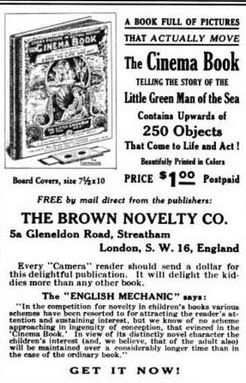
The Cinema Book was Advertised in Camera: A Practical Magazine for Photographers 1926 - page 320
References:
Alcock, Ian. “Giraud v Brown: Wizardry in the Origins of the Modern Pop-Up.” Movable Stationery, Vol. 29, No. 3, 2021. This well-researched article explores the long-debated question of authorship behind the early Bookano pop-ups, arguing persuasively that Theodore Brown—not Louis Giraud—was the true designer of their mechanical innovations. It highlights Brown’s crucial contributions to paper engineering and his lasting influence on the genre.
The Optilogue blog offers a detailed article on this book and Theodore Brown’s career: https://theoptilogue.wordpress.com/2022/09/16/theodore-brown-and-the-little-green-man-of-the-sea/
The blog also discusses early stereoscopy and red-green illusion in children's books: https://theoptilogue.wordpress.com/2021/06/30/revealed-the-worlds-first-3-d-film-show-part-2/
Stephen Herbert’s biography of Brown: Theodore Brown’s Magic Pictures: The Art and Inventions of a Multi-Media Pioneer (London: The Projection Box, 1997). Summary quoted from book listing: https://www.amazon.co.uk/dp/0952394146
Brown’s stereoscopic transmitter is described in the Science Museum’s collection database: https://collection.sciencemuseumgroup.org.uk/objects/co8205509/theodore-browns-stereoscopic-transmitter
Details on Brown’s multimedia innovations: https://www.stephenherbert.co.uk/theoprofile.htm
Review and advertisement in Camera: A Practical Magazine for Photographers (1926, p. 320).
Book listing and abstract on Amazon with biographical summary: https://www.amazon.co.uk/dp/0952394146
Camera: A Practical Magazine for Photographers (1926), page 320, includes an advertisement for Brown’s Cinema Book and its Cinemascope novelty feature.