Wereldburgers En Hunne Ontmoetingen: Afwisselend Prentenboek met Leerzame Bijschriften (Movable Transformation Book)
[World Citizens and Their Encounters: Alternating Picture Book with Instructive Captions]
Haarlem: I. de Haan, [ca. 1878]. Lithography by Emrik & Binger.
Square 12mo (19 × 17 cm); [12] pp. Original color pictorial paper-covered boards.
A rare Dutch movable transformation book featuring four double-sided, three-part slice plates yielding eight different metamorphic scenes. Each illustration is divided horizontally into interchangeable sections, allowing the figures to transform into humorous composite characters through the movement of integrated paper strips.
Note: All movable elements are integral to the binding, with no separate cards, tabs, or removable figures. Some early auction and catalog descriptions incorrectly interpreted the layered transformation design as involving loose or interchangeable parts. The mechanism instead belongs to the tradition of bound metamorphic transformation books and represents a sophisticated example of late nineteenth century Dutch paper engineering.
As described by the Digital Library for Dutch Literature (DBNL), Wereldburgers en Hunne Ontmoetingen contains eight full-page color illustrations depicting figures such as an Indian, a fisherman, a Chinese man, and Puss in Boots. In each image, horizontal cuts below the head and above the legs permit alternate sections to slide into view, transforming the central figure by exchanging heads or lower bodies. The resulting combinations are intentionally comic, although, as DBNL notes, “it is inevitable that you sometimes see a torso twice.”
Condition: Very Good. All plates present and complete. Some tearing at slice points, as typical (see photos), but no repairs. Binding sound; spine worn but intact.
Collector’s Corner – I. de Haan’s Magic Picture Books
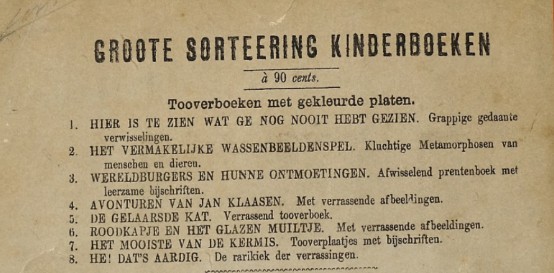
In the 1870s, Dutch publisher I. de Haan of Haarlem issued a series of transformation books known as Tooverprentenboeken or “Magic Picture Books.” These quarto-format publications, typically sold for 90 cents, were noted for their vivid color printing on quality paper and were distinguished by imaginative metamorphic elements such as flip-up flaps and die-cut holes. Unlike publishers like Trap, who favored pull-tab mechanisms, De Haan specialized in visual surprises that echoed the spirit of fairground curiosities. While the thematic content was uniquely Dutch, the underlying print designs may have originated in England or France. The series set a new standard in Dutch movable publishing, standing in contrast to the mass-market productions of price-driven firms like Jan Vlieger, and elevated De Haan’s position beyond that of a mere retailer to a leading innovator in children’s bookmaking.
The back cover of Wereldburgers en Hunne Ontmoetingen advertises several companion titles, each priced at ninety cents in the late 1870s. Bibliographic records confirm that there were at least thirteen titles in I. de Haan’s celebrated series of Tooverprentenboeken (Magic Picture Books).
These titles relied on fixed, bound mechanical structures such as triptych slice plates, flip up flaps, and hole plate overlays rather than detachable insert figures.
Avonturen van Jan Klaassen
(The Adventures of Jan Klaassen)
Flap book format with six color illustrations
Roodkapje en het glazen muiltje
(Little Red Riding Hood and the Glass Slipper)
Text by S. J. Andriessen, issued with four flap lithographs around 1875
Het vermakelijke wassenbeeldenspel
(The Entertaining Wax Figure Show)
Created by H. J. Overbeek in 1877, employing horizontally sliced metamorphic plates to create changing facial transformations
Hier is te zien, wat ge nog nooit hebt gezien
(Here Is Seen What You Have Never Before Seen)
Published circa 1877, using flap overlay transformations depicting grotesque people and animals
Het mooiste van de kermis
(The Finest of the Fair)
Fairground themed transformation book with captioned round opening lithographs
Hè! dat’s aardig. De rariteiten der verrassingen
(Well! That’s Delightful. The Curiosities of Surprises)
Transformation magic book continuing the series’ metamorphic mechanical style
De gelaarsde kat. Verrassend tooverboek
(Puss in Boots. Surprising Magic Book)
Metamorphic transformation book in the characteristic Tooverprentenboeken format
Wereldburgers En Hunne Ontmoetingen: Afwisselend Prentenboek met Leerzame Bijschriften (Movable Transformation Book shown above)
[World Citizens and Their Encounters: Alternating Picture Book with Instructive Captions]
History of I. De Haan:
Jan de Haan was born Isaac de Haan in Amsterdam in 1829. He learned the book trade at the Amsterdam bookselling and publishing establishment of Gebhard before establishing his own bookshop and bookbinding business in Krommenie in 1852. A circulating library and publishing business were subsequently added. De Haan published works on a variety of subjects, including religious and political matters, schoolbooks, and children's and juvenile literature, the latter including translations and adaptations from French and German.
Although generally known as Jan de Haan, he had been born Isaac de Haan, explaining the “I.” in the publishing imprint I. de Haan. His publications continued to appear under this imprint throughout the firm's most important period of activity.
In April 1871, De Haan left Krommenie for Haarlem, where he acquired the established bookshop of G. Burck. The business was located at Groote Houtstraat 137 and expanded beyond bookselling and publishing to include a substantial music department, a circulating library, and a periodical-reading service.
It was particularly in Haarlem that De Haan developed his reputation as a publisher and distributor of children's and juvenile books. He initially aspired to create a publishing list of original Dutch children's literature, but such books were expensive to produce and offered uncertain financial returns. He therefore increasingly drew upon material produced or previously marketed by other firms while continuing to develop his own children's publishing activities.
De Haan became closely associated with the important Haarlem lithographic firm Emrik & Binger. The relationship was more complex than that of publisher and contract printer: Emrik & Binger itself produced and controlled substantial quantities of illustrated material and relied upon publishers and booksellers such as De Haan to bring it to market. In 1875 De Haan took over the sale of the Nieuwe Nederlandsche Kinderprenten, previously marketed by the Amsterdam publisher G. L. Funke. These inexpensive illustrated sheets, together with picture books produced by Emrik & Binger and other firms, became a significant part of De Haan's business.
Emrik & Binger, founded in Haarlem in 1857 by Charles Binger and Ozer Emrik, developed into one of the largest suppliers of illustrated prints in Western Europe. The firm retained the right to exploit its lithographic printing material, allowing illustrations produced for one market to be reused with different texts for others. As a result, closely related picture books could appear internationally under different publishers' names. In many such cases Emrik & Binger functioned effectively as the originating producer, while firms such as De Haan brought the books to market. By around 1900, Emrik & Binger was exporting its products to some twenty countries, with only a relatively small portion of its extensive production sold in the Netherlands.
De Haan ultimately marketed more than 200 picture books and 147 different inexpensive children's prints. Among his most interesting publications for the history of movable books were transformation and novelty books, including works issued as Toover-Prentenboeken (“magic picture books”), in which folding or movable portions of the illustrations produced changing scenes.
In 1879, Jan's eldest son Pieter joined the business, which thereafter continued as De Haan & Zoon, Boek- en Muziekhandelaars. The established I. de Haan imprint nevertheless remained closely associated with the firm's publications.
The business changed dramatically following Pieter de Haan's death in July 1900, at the age of forty-four after an illness of several months. In August 1900 Jan sold the book and music business of De Haan & Zoon to Adriaan van der Heide, while the firm's children's-book publishing stock and rights were transferred to Gebroeders Koster of Amsterdam.
Jan de Haan moved to Utrecht in April 1902, where he continued publishing activities for a short time. In 1903, the Hague publisher and kiosk operator Arie Segboer took over the sale of the Nieuwe Nederlandsche Kinderprenten, bringing to an end the period in which this important series had been associated with De Haan's Haarlem business.
I. de Haan occupies a notable place in nineteenth-century Dutch children's publishing not only because of the size of his picture-book and print trade, but also because his career illustrates the close relationship between publishers, booksellers, lithographic printers, and distributors during the period. His association with Emrik & Binger was particularly important in bringing inexpensive color-printed children's books and prints to a broad Dutch market, while his movable and transformation books form an especially interesting part of the history of interactive children's publishing.
References
Buijnsters, P.J., and Leontine Buijnsters-Smets. Lust en Leering: Geschiedenis van het Nederlandse Kinderboek in de Negentiende Eeuw. Nijmegen: Vantilt, 2001. Quoted in Digital Library for Dutch Literature (DBNL)
Buijnsters, P.J., and Leontine Buijnsters-Smets. “I. de Haan in Haarlem.” In Lust en Leering: Geschiedenis van het Nederlandse Kinderboek in de Negentiende Eeuw. Nijmegen: Vantilt, 2001, pp. 279–280. DBNL text edition
“Boekhandel van I. de Haan, te Krommenie.” Advertisement. Algemeen Handelsblad (Amsterdam), December 3, 1855.
“Boekhandelaar I. de Haan, te Krommenie.” Advertisement relating to Dr. Kern’s Handleiding bij het onderwijs der Nederlandsche taal. Nieuwe Rotterdamsche Courant, September 21, 1864.
“Almanak voor de Jeugd 1871.” Advertisement issued by I. de Haan, Krommenie. Algemeen Handelsblad (Amsterdam), December 25, 1870.
“Boekhandel van I. de Haan, te Haarlem.” Advertisement. Opregte Haarlemsche Courant, April 24, 1871.
Letter from I. de Haan to A.C. Kruseman, Haarlem, September 6, 1885. BKVB, sign. BKr 1-70.
Van Charante, N.A. Kinderleven, Schetsen en Novellen voor de Jeugd. Krommenie: I. de Haan, 1856.
Tine’s bezoek aan de Wereldtentoonstelling te Parijs [Tine’s Visit to the World Exhibition in Paris]. Haarlem: I. de Haan, [1878]. Chromolithography by Emrik & Binger.
De Zoete, Johan. “Haarlemse drukkers en uitgevers van kinderboeken en -prenten.” Berichten uit de wereld van het oude kinderboek, no. 72 (December 2011), pp. 4–6. Stichting Geschiedenis Kinder- en Jeugdliteratuur. https://www.hetoudekinderboek.nl/sites/default/files/Berichten_72_dec_2011.pdf