Many Thanks toPompeo Vagliani, president of The INTERNATIONAL CENTRE ON INTERACTIVE BOOKS in Italy. Much of our information comes from the POP-APP website and in the book Guida alla mostra Pop-App. ( https://www.pop-app.org/la-mostra-di-torino/) as well as data from the exhibition held in 2019 in Turin Italy (https://www.pop-app.org/la-mostra-di-torino/). The International Centre on Interactive Books is one of the top sources for information on movable books anywhere in the world. It is a research hub established within the Tancredi di Barolo Foundation in Turin, continuing the legacy of the Foundation’s scientific and exhibition initiatives, including the 2021 international conference, Pop-App. They are doing some amazing things and their contribution to our understanding of the history of movable books. The Centre focuses on the study, preservation, and promotion of animated books with historical and contemporary significance, particularly emphasizing cataloging, restoration, and cultural enrichment. It undertakes interdisciplinary projects such as research, exhibitions, conferences, and publications, collaborating with public and private institutions both in Italy and abroad. The Centre also oversees the peer-reviewed, open-access journal JIB – Journal of Interactive Books and operates a permanent exhibition space within the MUSLI – Museum of Schools and Children’s Books, utilizing the Foundation’s extensive bibliographic and archival collections.
The Animated Book in Italy Between the 19th and 20th Centuries
Early Italian Movable Books
Movable-book production in Italy was concentrated in several important publishing centers, particularly Milan, Florence, Turin, Verona and Padua, and Bologna. Eliana Angela Pollone’s doctoral dissertation, Il libro animato italiano tra il 1850 e il 1950 (2022), provides the most extensive modern reconstruction of this production, documenting both recreational children’s books and the scientific, educational, and hybrid formats that accompanied the development of the Italian movable book.
As Pollone also observes, Italy’s path toward fully mechanical books passed through a long phase of hybrid formats—die-cut shape books, hole books, cut-outs, toy theaters, and simple transformation devices—many produced for schools or domestic instruction before true mechanical picturebooks took hold.
Unlike Germany and England, which pioneered mechanical books earlier in the nineteenth century, Italy entered the market somewhat later. Milanese and Florentine publishers only became truly active in the final quarter of the century. This delay is significant, as it meant Italian publishers were drawing on already well-developed international models while simultaneously creating works suited to their own cultural and educational priorities.
Many of these firms did not work in isolation. Italian movable books often reveal strong cross-border influences, with firms such as Drucker (Verona/Padua) and Gussoni (Milan) adapting or translating German productions for the Italian market. At the same time, houses like Bemporad in Florence issued both Italian originals and translations of foreign titles, sometimes side by side in their catalogues. This shows how Italy was woven into the international network of movable book publishing, rather than standing apart from it.
Fratelli Treves, Milan
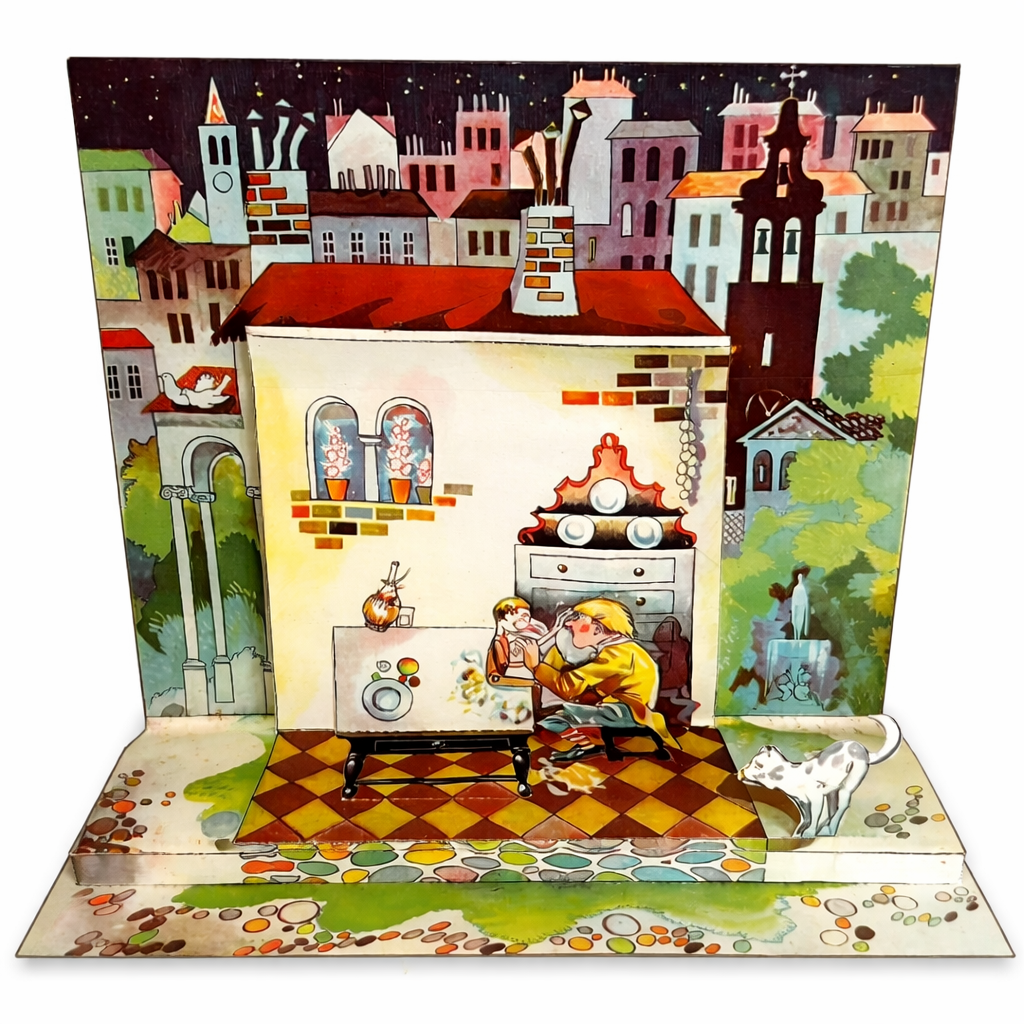
Among the earliest milestones of Italian movable-book publishing stands Fratelli Treves’s Gioppino in cerca di fortuna: Teatrino in versi. Personaggi movibili. Otto quadri a colori, generally dated to about 1890. Italian scholarship has repeatedly identified the volume as probably the first animated children’s book conceived and produced in Italy, rather than an Italian-language issue assembled from imported German or French plates. That distinction is important. During the same period publishers such as Hoepli and Vallardi were already bringing sophisticated foreign movable books into the Italian market; Gioppino, by contrast, appears to have represented Treves’s attempt to create a recognizably Italian mechanical picturebook of its own.
The book’s unusually descriptive title tells us a great deal about its conception. It calls itself a teatrino in versi—a “little theatre in verse”—with movable characters and eight colored tableaux. Issued in quarto format in illustrated publisher’s boards, it contains eight chromolithographed scenes animated through a comparatively elaborate system of levers, pivot points, and rotational movements. Each mechanical scene is accompanied by verse dialogue and a smaller musician vignette, so that text, image, and movement work together as parts of a miniature performance. No illustrator, lithographer, printer, or mechanical designer has yet been identified, and no contemporary price or advertisement has been located in the sources presently known.
This theatrical conception separates Gioppino from an ordinary illustrated story to which moving parts have simply been added. The reader effectively becomes the operator of a miniature puppet theatre: pulling the tabs sets the characters into motion while the accompanying verses supply their spoken parts. In that sense, the book compresses stage, actors, script, and performance into a single codex. It belongs to the same broad nineteenth-century fascination with paper theatres and miniature performance that produced works such as Hoepli’s Quattro grandi teatri of 1884, but its conception is different. In a conventional paper theatre the child constructs or manipulates separate figures; in Gioppino, the theatrical action is permanently engineered into the printed page.
The choice of Gioppino as protagonist makes the book particularly Italian. Known in Bergamasque dialect as Giopì de Sanga, Gioppino developed during the nineteenth century as the popular puppet hero of Bergamo and its surrounding territory. Unlike the older Bergamasque masks Brighella and Arlecchino, he was understood as a distinctly local folk figure: coarse, comic, poor, shrewd, fond of food and drink, and quick to use his stick in defense of himself or the weak. His most recognizable physical feature is the group of three swellings or gozzi beneath his chin, a grotesquely comic trait rooted in the historical prevalence of goitre in the Alpine population.
Gioppino therefore brought with him a cultural identity that an imported clown or generalized comic figure could not. By placing a familiar Bergamasque burattino inside one of the most technologically fashionable forms of European children’s publishing, Treves effectively joined a traditional Italian performance culture to the modern mechanical picturebook. The importance of Gioppino in cerca di fortuna consequently lies not simply in the nationality of its imprint, but in the way its subject, theatrical structure, language, and mechanics combine to produce a distinctly Italian object.
The story follows Gioppino as he leaves home in search of his fortune, becomes involved with a brigand, and eventually finds himself imprisoned. This simple adventure plot is ideally suited to mechanical illustration: encounters, confrontations, gestures, and comic reversals can be translated directly into physical movement. The eight animated scenes operate almost as successive stage sets, while the verse dialogue reinforces the impression that the child is not simply reading about Gioppino but performing his adventure.
This relationship between puppet theatre and movable-book engineering is particularly significant in the Italian context. Bergamo possessed a strong and continuous burattino tradition, and Gioppino became one of its defining figures. The tradition survived through generations of performers and was later preserved particularly by the puppeteer Benedetto Ravasio (1915–1990); today the Fondazione Benedetto Ravasio and Museo del Burattino continue to document and promote it. The later rediscovery of Treves’s book by institutions devoted to both puppetry and movable books is therefore especially appropriate: Gioppino in cerca di fortuna physically occupies the intersection between those two histories.
Its relationship to foreign movable books is also revealing. By the 1880s Milan already had an active market for imported mechanical picturebooks. Hoepli published Italian editions of German works, particularly those associated with Lothar Meggendorfer, while Vallardi used German plate sets bearing marks such as those of Schaller & Kirn. Italian publishers could translate the text and modify details for domestic readers while leaving the underlying foreign paper engineering largely intact.
Treves appears to have taken a different route with Gioppino. No foreign source for the book has been identified, no German plate numbers or publishers’ monograms have been recorded, and no direct mechanical prototype is presently known. The illustrations draw upon Italian puppet iconography, and no foreign textual source for the verse has yet been identified. Contemporary scholarship consequently treats it as an exception to the predominantly import-dependent first phase of Italian movable publishing. One Italian exhibition catalogue explicitly contrasts Treves with Hoepli, Vallardi, and Rosenberg & Sellier, describing Gioppino as what was “perhaps the first animated book conceived and produced in Italy.”
That wording—“perhaps”—is worth retaining. We can confidently say that Gioppino is regarded by current Italian scholarship as the earliest known substantially indigenous Italian mechanical children’s book, but the precise manufacture of its mechanisms remains undocumented. Nothing yet identifies the printer or paper engineer, and it is impossible to exclude the use of imported materials or technical expertise. What distinguishes the book is that no foreign edition or plate source has yet emerged, while its text, imagery, protagonist, and theatrical conception are demonstrably rooted in Italian culture.
Its status is made even more striking by the fact that Treves apparently did not develop a series from it. The firm was already one of Italy’s major literary and children’s publishers, with illustrated periodicals and juvenile book series forming a significant part of its catalogue, yet no sustained program of mechanically animated books followed Gioppino. The volume therefore remains an isolated experiment rather than the first installment of a Treves mechanical line.
Surviving copies are correspondingly scarce. The title has appeared in exhibitions and collections associated with the Fondazione Tancredi di Barolo and the Museo del Burattino, and it was included in the 2019 Pop-App exhibition devoted to the history of movable books. Commercial appearances are infrequent: a Turin antiquarian catalogue offered a copy in 2016, while the Paris auction house Alde sold another in 2020, noting restored pulls and marginal browning—typical vulnerabilities of mechanically operated nineteenth-century books.
The book’s continuing historical importance was recognized again in 2023, when Libri Aparte of Bergamo produced a modern facsimile in conjunction with an exhibition at the Fondazione Benedetto Ravasio / Museo del Burattino. The reproduction was issued as a non-mechanical leporello and was accompanied by an essay by Pompeo Vagliani of the Fondazione Tancredi di Barolo. The project is fitting: more than a century after its publication, Gioppino in cerca di fortuna continues to be studied simultaneously as a document of Italian puppet culture and of the beginnings of indigenous Italian movable-book production.
Rosenberg & Sellier
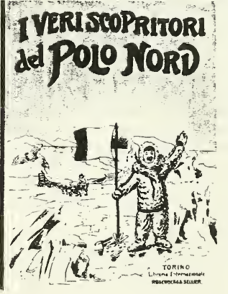
Around 1910 the Turin publisher Rosenberg & Sellier issued I veri scopritori del Polo Nord. Viaggio animato di tre monelli italiani, a lively and humorous libro animato that taps into—while gently parodying—the turn-of-the-century fascination with polar discovery. Unlike the scenic-tableau formats popular elsewhere in Europe, the Italian edition employs lever-driven mechanical scenes, in which pull-tabs activate individual figures integrated into the narrative. Motion here is not ornamental but structural, carrying the action forward as the three “monelli italiani” embark on a fantastical Arctic adventure that ultimately proves to be a dream brought on by overeating sweets.
Although the book’s cover composition closely echoes that of the French Une Excursion au Pôle Nord (Raphaël Tuck et Fils, 1899)—including the central figure of an adult Inuit planting a flag—the Italian edition diverges in every essential respect. The French book belongs to a distinct international group of scenic books, later adapted for the American market as A Trip to the North Pole: A Story of Adventure in the Arctic (Saalfield, 1910; “Printed in Bavaria”) and again for the Dutch market as Een Pool-Reisje. Een verhaal vol avonturen in de Poolzee (Belinfante, ca. 1913). All three employ hinged, three-dimensional pop-up tableaux with rising backgrounds and foreground elements. Their protagonists are adult explorers “from all countries,” and their plots follow a conventional Arctic quest rather than a comic dream narrative.
Rosenberg & Sellier’s book, by contrast, is neither a translation nor a mechanical adaptation of the Tuck/Saalfield/Belinfante lineage. The visual borrowing on the Italian cover appears limited to the iconographic template, with the French flag replaced by the tricolore and the Arctic setting retained for recognizability. Once opened, however, the Italian book reveals an entirely different mechanical conception and a different story world, one oriented toward nationalizing children’s adventure during a period when Italian publishers frequently reshaped foreign motifs to reinforce notions of identity and citizenship. The presence of “tre monelli italiani” as protagonists, coupled with the distinctive lever-action engineering, strongly indicates a locally conceived production rather than a licensed import.
This is significant for movable-book history in Italy. I veri scopritori del Polo Nord documents how printers beyond the established Milanese centers were experimenting with mechanical illustration around 1910, adopting foreign visual cues while developing their own technological and narrative strategies. The absence of documentary links between Rosenberg & Sellier and the Tuck/Saalfield networks further supports reading the Turin edition as an original Italian contribution to the genre, one that stands apart from the scenic-book tradition circulating in northern Europe and the United States.
Image of the original Italian edition comes from Movable Stationery, Volume 7, No. 3 (1999)
Rosenberg & Sellier was, moreover, not merely an occasional publisher of such books. The Turin firm developed a small but coherent program of mechanical children’s publishing from the late nineteenth into the early twentieth century, including the lever-operated Quadri viventi books and related “animated” publications.
A particularly revealing example of the firm's international practice is its adaptation of Armand Bourgade’s French movable book Boum-Boum du Cirque d’Été, published by A. Capendu. Rosenberg & Sellier reused essentially the same circus cover imagery but transformed the work for Italian children as Gran Circo Equestre! The famous French clown Boum-Boum disappears from the title and is replaced by “Toni-Senza-Timore.” The Italian cover is recast as a mock circus bill—“Giovedì prossimo alle 20 ore”—advertising a “Spettacolo per bambini” and, significantly, describing the movable illustrations themselves as “quadri viventi.” It even instructs the child to move the pictures “in basso e in alto.” The cover’s series designation can now be understood more precisely: Pollone identifies Toni-Senza-Timore / Gran Circo Equestre! as the fourth title in Rosenberg & Sellier’s numbered Quadri viventi sequence, published in 1904
This Italian Boum-Boum is especially valuable because it demonstrates that Rosenberg & Sellier did not follow a single model of foreign adaptation. In one instance, Gran Circo Equestre!, the firm retained the recognizable French artwork and mechanical conception while extensively localizing the title, theatrical language, and identity of the performer. In another, I veri scopritori del Polo Nord, foreign visual motifs appear to have served only as a starting point for a substantially different Italian narrative and mechanical treatment. Rosenberg & Sellier thus emerges less as a passive translator of foreign movable books than as an intermediary that selected, repackaged, rewritten, and sometimes fundamentally transformed imported material for Italian children.
The firm’s broader mechanical list reinforces this interpretation. Between roughly 1895 and the first decade of the twentieth century, Rosenberg & Sellier issued a series of small-format movable books employing lever mechanisms and multiple animated plates. Su e giù [Up and Down] (c. 1895) remains bibliographically elusive. Tira e ammira [Pull and See] (c. 1896) contains a sequence of comic animal episodes in prose and verse. Guarda, si move! [Look, It’s Moving!], issued around 1901–1904, presents familiar fairy tales including Little Red Riding Hood, Ali Baba, Cinderella, Sleeping Beauty, and Puss in Boots. The later Fra nani e giganti, an adaptation of Gulliver’s Travels, represents another phase of the program. Differences in illustration and construction suggest that Rosenberg & Sellier drew upon more than one source for its mechanical plate sets.
Pollone’s research also identifies Piero Baronio as the author behind the texts of all five numbered Quadri viventi titles. A lawyer, poet, and children’s writer from Valsesia, Baronio does not always appear by name on the books themselves; in Toni-Senza-Timore, for example, the text is attributed pseudonymously to “l’Amico ‘Salto’.” Contemporary advertising in the Giornale della libreria, however, consistently assigns the series texts to Baronio. This strengthens the case for understanding Rosenberg & Sellier’s movable books not as anonymous imported novelties but as deliberately localized Italian productions in which foreign visual or mechanical material could be paired with newly written domestic texts.
The physical uniformity of the series is equally revealing. All five titles were issued in small quarto format with cardboard boards and cloth spines, four chromolithographed movable plates placed on right-hand pages, and pull-tab mechanisms operating concealed metal pivot pins. The price remained fixed at 2.40 lire across the numbered run. Such consistency suggests that Rosenberg & Sellier had established a repeatable production model for its children’s mechanical books rather than issuing occasional experiments.
Their movable book production continued beyond the five numbered volumes. I veri scopritori del Polo Nord appeared around 1910–1912 without a Quadri viventi series number, while Pollone records a previously little-known later title, Nuovo circo Bisini (1928), with four lever-operated circus plates. The latter is particularly intriguing because the character “Toni” reappears in two of its movable scenes, nearly a quarter-century after Toni-Senza-Timore. This recurrence suggests that Toni may have functioned as a recognizable house character within Rosenberg & Sellier’s children’s movable output.
This sustained commitment was unusual in Turin. Pollone identifies Rosenberg & Sellier as the only Turin publisher to maintain a continuing program of recreational animated books specifically for children; other Turin firms that experimented with movable formats concentrated largely on scientific and technical works. Rosenberg & Sellier therefore occupies a distinctive position in the history of Italian children’s movable publishing: not simply as a translator or distributor of foreign novelties, but as a house that maintained a coherent mechanical children’s list over more than three decades.
Taken together, these books reveal a Turin publisher participating actively in the transnational economy of movable-book production. Rosenberg & Sellier did not simply import finished foreign books. It appears to have moved along a spectrum—from close visual and mechanical adaptation, through substantial localization, to works whose Italian narratives and mechanisms became effectively independent productions.
Much of Italy’s first wave drew on imported models from Germany, France, England, and the Netherlands. Milanese houses—especially Ulrico Hoepli and Antonio Vallardi—brought foreign novelties into the Italian market from the 1870s onward, often for the Christmas gift trade.
Pollone’s research also underscores how deeply Italian production was embedded in transnational networks, with many so-called “Italian” movables originating as multilingual co-editions using German-made plates or mechanisms.
Hoepli (Milan)
Hoeplibecame the primary Italian conduit for Lothar Meggendorfer. Storielle buffe (1884) is the first Italian edition of a Meggendorfer movable, followed by Sempre allegri, bambini (1886). Contemporary notes and surviving copies show that several Hoepli “Meggendorfer” issues reuse German artwork and plate numbering—strong evidence that plates (and often assembly) were produced abroad, with Italian text adapted or reset for the domestic market.
Beyond Meggendorfer, Hoepli’s children’s list explored multiple mechanical and theatrical formats. Quattro grandi teatri (1884) offered paper theatres with movable “actors” (Excelsior, Pulcinella, Aida, Circo Renz). In the animal vein appeared Bestie in gabbia (1890s), a movable “zoo” album with built-up cage effects, and Bestie mobili domestiche e feroci (1890s), a related title marketed explicitly as “mobili.” Around the fin-de-siècle Hoepli also issued Pierino Porcospino vivente (c. 1898), a Struwwelpeter-type novelty presented as “living/animated.” Into the new century, Pupazzi vivi e allegri (c. 1910) gathered eight rhymed movable tableaux often attributed (in trade and collector literature) to Meggendorfer, showing the house’s continued investment in German-style picture engineering with Italian packaging.
A distinct mechanism appears with Gira, gira… Novellette per bambini (1898–1899), Hoepli’s “revolving pictures.” Likely inspired by Ernest Nister, it pins two segmented discs (volvelle) at center; a perimeter ribbon turns the upper disc so its segments slide under radial slits, dissolving one image into another. As far as current research shows, this is the only Italian disc-based movable of the first wave (c. 1880s–1910), making it a technical outlier within domestic production. About a decade later, the disc idea is “domesticated” for education by other publishers: Che ora è? Il libro delle ore, dei giorni, dei mesi e delle stagioni appears first with Marzocco and then with Franceschini, swapping the hidden disc for an exposed clock on the cover with two rotating cardboard hands—same spirit of interactive motion, different goal
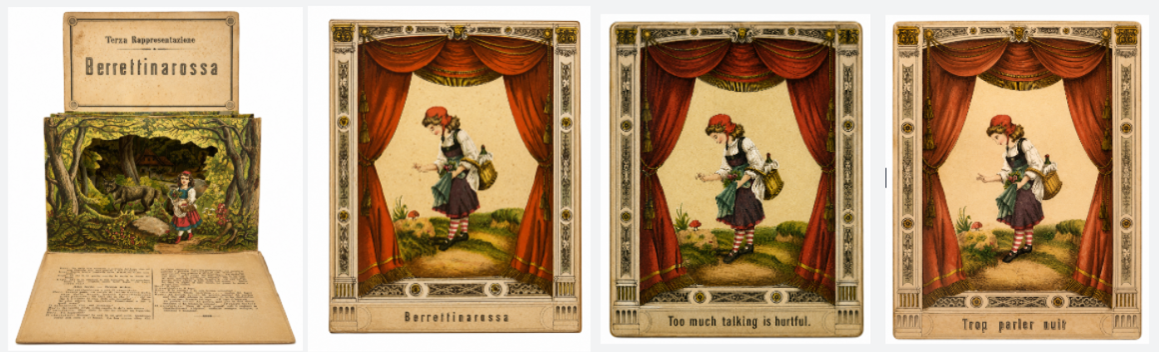
Hoepli also published the italian editons of theater "pop-ups" first published in Germany as Theater-Bilderbuch by Gustav Loewensohn of Fürth. Around 1883, Loewensohn produced the original theatrical dioramas using chromolithography and collaborated with publishers across Europe. The same four scenes were translated and issued in multiple languages. The Italian editions are from Ulrico Hoepli’s documented series Bambini in Teatro: Quattro Teatrini. I. Robinson Crusoe2. Il gatto stivalato 3 Berrettina rossa 4. Fior dell’Aurora
Bambini in Teatro: Quattro Teatrini was alos published in France by Capendu and can be seen at: https://www.vintagepopupbooks.com/Theater-Bilderbuch-by-Loewensohn-and-Capendu-p/l-02.htm Note: The English editions, issued around 1883, were often exported and lack printed publication data. They are noted in both Russell’s Bibliography (1881, Vol. 4; 1894, Vol. 16) and are attributed to Löwensohn. In En Vallardi (Milan)
Vallardi was among the first Italian houses to issue “figure animate” for children. By the mid-1880s it had launched Favole con figure animate (before 1885), a small album of La Fontaine–style moral tales with transformation effects; the companion Libro II carries Carl Schaller’s “CS” monogram and S&K (Schaller & Kirn) marks, clear evidence that the Italian editions reused German plate work while bearing a Milan imprint. In the same years Vallardi popularized a simple, home-market “turn-and-laugh” device under the title Volta e ridi—booklets in which every three leaves the middle one is cut down to flip the image between outcomes as you turn, a quick optical gag designed for children. By the 1890s Vallardi was issuing Italianizations of recent German hits: La zia allegra and Lo zio burlone (both 1898) adapt Lothar Meggendorfer’s 1891 pair (Die lustige Tante / Der fidele Onkel) for the domestic market, typical of the cross-border supply chain that fed Italian novelty books at the fin de siècle. Around 1907 the low-priced series Trasformazioni ridicole offered six tiny mix-and-match booklets at five centesimi each—an explicit push to make mechanical play affordable (titles include Trasformazioni istantanee and La signorina…).Taken together, these lines—import-based “figure animate,” local flip-leaf gags, six-plate ziehbilder, and penny-priced transformations—show Vallardi systematically testing mechanisms (transformations, layered ziehbilder, mix-and-match) while leveraging German plate suppliers to seed an Italian taste for mechanical picturebooks
Paravia’s contribution to Italian movable children’s publishing was relatively small in number, but unusually broad in form. The Turin house never developed a sustained recreational series comparable to Rosenberg & Sellier’s Quadri viventi, yet it experimented repeatedly with books that required the child to manipulate, unfold, transform, or mechanically animate the page. This activity should be understood against Paravia’s much larger engagement with scientific and educational movables: the firm was a major participant in the Turin production of anatomical and technical flap books, and its children’s novelties formed a smaller recreational branch of an established culture of interactive publishing.
The most ambitious of these children’s mechanical books appears to have been Nel mondo dell’allegria. Sei tavole in colori con movimenti meccanici, generally dated to about 1886–1890. As the title makes explicit, the volume contained six color plates with mechanical movements and belongs to the ziehbilder, or pull-tab, tradition. In contrast to Paravia’s simpler shaped or folding books, Nel mondo dell’allegria represents a deliberate venture into fully mechanical picture-book production.
Paravia was simultaneously exploring less complex but still highly interactive formats. Bambinate rimate (1888) was a shaped, die-cut children’s book in which the physical contour of the volume contributed to its play value. Around 1900 the firm issued Nella luce del sole, a leporello or accordion-fold book that replaced conventional page turning with the gradual unfolding of a continuous visual sequence.
The most unusual of these experiments was La storia di Gano (c. 1900), an early Italian hybrid toy-book. A sculpted three-dimensional head projects through a die-cut opening, remaining fixed while the surrounding pages change. As the child turns the leaves, successive printed costumes align with the same head, effectively redressing the character again and again. The book therefore combines elements of the transformation book, dressing toy, picturebook, and three-dimensional novelty within a single object.
Taken together, these publications show that Paravia was not simply issuing occasional novelties but testing multiple interactive formats—mechanical pull-tabs, die-cut shapes, windows, transformation effects, three-dimensional elements, and accordion folds. Italian scholarship places these experiments within the firm’s broader educational culture, in which printed matter was increasingly designed not merely to be read but also to be handled, examined, and manipulated.
Paravia’s movable production was also connected to the international trade in mechanical books. Like Vallardi, Treves, and Hoepli, the firm participated in relationships with German publishers such as J. F. Schreiber and Otto Maier, arrangements that could allow Italian houses to translate or adapt texts for domestic readers while retaining the engineering of imported plate sets. This places Paravia within the wider transnational network through which German mechanical-book technology entered the Italian market at the end of the nineteenth century.
The educational background of the house is important here. Paravia was also a major producer of visual teaching materials, including quadri murali or classroom wall charts. Fabio Targhetta’s research has shown that Paravia, together with Vallardi, became one of the dominant Italian suppliers of such visual aids, supported by extensive promotion and close relationships with the educational establishment. The company’s children’s interactive books therefore belong to a broader publishing philosophy in which visualization, manipulation, and learning through objects overlapped.
Paravia’s significance lies less in the size of its children’s movable list than in its variety. Where Rosenberg & Sellier developed a recognizable series built around a relatively consistent lever mechanism, Paravia moved experimentally between different physical forms. Its surviving books show how, in the Italian market of the late nineteenth and early twentieth centuries, the boundaries between picturebook, school aid, toy, transformation book, and mechanical movable remained remarkably fluid.
************************************
Lothar Meggendorfer and Italy
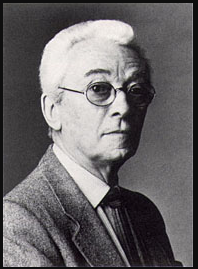
The centenary of Lothar Meggendorfer’s death in 2025 prompted renewed Italian research into the German artist’s publishing history and influence. The Pop-App International Centre on Interactive Books launched a project devoted particularly to the Italian editions of Meggendorfer’s works issued from the late nineteenth century onward, with special attention to the role of the Hoepli publishing house and to Pasquale Fornari, who translated and adapted texts for Italian readers.
The project developed beyond bibliographical research into an interdisciplinary collaboration with the Gioachino Rossini State Conservatory of Music in Pesaro. Drawing on materials supplied by the Pop-App Centre and on Meggendorfer’s distinctive combination of image, movement, narrative, and implied sound, the Conservatory’s Department of Music Education coordinated a program during the 2025–2026 academic year involving original musical composition, performance, historical research, and the creation of a guided public presentation.
The work in progress was presented in Turin on December 11, 2025, during the inaugural day of the Pop-App Museum, as part of the round table “Animated Books and Multimedia.” The Conservatory project concluded publicly on May 23, 2026, during its Open Day. It was coordinated by Roberta De Piccoli, Professor of History of Music for Teaching at the Rossini Conservatory and coordinator of the Centre’s music-book collection.
This renewed attention to Meggendorfer is particularly relevant to the history of Italian movable books. His works reached Italian readers through publishers such as Hoepli at precisely the period when Italian houses were beginning to participate more actively in the European market for mechanical picturebooks. The current research therefore offers an opportunity to reconstruct more precisely how German originals were translated, adapted, marketed, and received in Italy rather than treating the Italian editions simply as secondary versions of foreign books.
International sourcing and licensing. From the 1870s to the early 1900s, Italian houses frequently licensed foreign plate work rather than re-engineering mechanisms from scratch. Agreements with firms such as J. F. Schreiber and Otto Maier typically allowed Italian publishers to translate text, tweak themes for local classrooms or tastes, and issue under domestic imprints while preserving the original engineering. Common adaptation steps included: (1) Italian translation laid onto existing art; (2) light localization of captions or cultural references; (3) co-publishing or distribution under an Italian brand (as with Vallardi’s Favole con figure animate and Volta e ridi).
Imported English designs in Italy. It wasn’t only Meggendorfer: Raphael Tuck’s mechanical books also reached the Italian market. Giovanni Gussoni’s Lieti Meriggi (Milan, Ditta Giovanni Gussoni, c. 1890–1905) is an Italian edition of Father Tuck’s Mechanical Series: Friends in the Country, with four tab-operated chromolithograph plates (approx. 8 × 10.5 inches). This appears to be the only documented movable by Gussoni and a rare survival.
Gussoni, Giovanni.
Lieti Meriggi. Milan: Ditta Giovanni Gussoni, circa 1890–1905. Italian edition of Father Tuck's Mechanical Series: Friends in the Country, featuring four tab-operated chromolithograph movable plates. 8 x 10.5 inches. (Only movable book on online records for Gussoni, Giovanni - also only copy we have seen surface) Viewable on vintagepopupbooks.com https://www.vintagepopupbooks.com/Father-Tuck-pop-up-book-p/t-28.htm
Peepshows and optical views
By the mid-19th century, the Vallardi shop in Milan wasn’t just selling prints and books—it was also in the optical-amusements trade. Surviving vedute ottiche (optical views) turn up with a printed label for Giuseppe Vallardi, Milano, Contrada S. Margherita, matching the address used in early Vallardi trade catalogues. Hyde also shows several with unnamed publishers.
These optical prints sat within a broader European craze: street mondo nuovo peepshows and paper tunnel books that created depth and day-night transformations for paying audiences. Museum surveys (and the V&A’s Gestetner collection overview) give clear definitions and many examples; Italian histories place Vallardi among the Milanese dealers who distributed such material.
Early Vallardi catalogues explicitly locate the firm at Contrada S. Margherita all’angolo del vicolo dell’Aquila n. 1101, the same address seen on optical-view labels—useful when authenticating cases and wrappers. Scholarly notes on Vallardi’s 1820s–1840s output also reference vedute ottiche within the shop’s print trade.
Collector tip: On Vallardi-labeled optical pieces, look for a printed or pasted ticket reading some variant of “Giuseppe (or Pietro e Giuseppe) Vallardi, Milano, Contrada S. Margherita. A couple of examples are Presepio scenico (Nativity scene) — Pietro e Giuseppe Vallardi, Milano, c. 1825–1830. Pocket telescopic peepshow with multi-layer cut-outs; early Vallardi imprint. and
Presepe da viaggio (Traveling nativity) — Giuseppe Vallardi, Milano, mid-19th century. Cased telescopic view; case label typically reads “Giuseppe Vallardi, Milano, Contrada S. Margherita.”
Further reading / images: Ralph Hyde’s Paper Peepshows: The Jacqueline & Jonathan Gestetner Collection (ACC, 2015). The V&A and the Museo del Precinema (Padova) provide concise, image-rich introductions to peepshows, mondo nuovo, and optical views.For additional illustrated examples, see the Luisella Terzi album selections at pop-app.org/albumanimati_luisellaterzi/ and the Sammlung Druckwerk feature on ziehbilder (Nel mondo dell’allegria).
1920s–1940s: Growth and Influence
Italian production ramps up after 1922: Bemporad and, soon after, the Franceschini family begin issuing homegrown animated titles, while Hoepli develops a high-quality theatrical line—its “Libri Teatro”/Libroteatro designs by scenographer Mario Zampini—drawing on the visual language of German and American pop-ups of the 1930s–40s.
While the Fascist regime initially didn't heavily restrict translations, a policy in 1937 required publishers to notify the Ministry of their intent to translate foreign works, marking the beginning of tighter control over cultural imports.
Highlights: Il Gatto con gli stivali (Puss In Boots) (Florence: Bemporad, 1937), illustrated by Ezio Anichini, brings lever-driven theater to a classic tale. It sits alongside Deposito Edizioni’s lever series “Grandi albi movibili per i bambini. Le fiabe più belle” (1931–1933)—five titles announced (Cinderella, Puss in Boots, Little Red Riding Hood, Puccettino/Tom Thumb, Beauty and the Beast)—each with two animated plates and a moving-parts cover, all by Anichini. A few years later Bemporad re-issued the line in simplified form (no lever covers, altered interior color) and appears to have released only three of the five; the missing volumes were likely casualties of the 1938 racial laws that forced Bemporad’s ownership change and rebranding as “Marzocco.” The corporate rename to “Marzocco” was formalized on October 17, 1938, and after the war the imprint reappeared on July 24, 1946 as “Casa editrice Marzocco, già Bemporad.” This is why 1942–43 titles sometimes appear on Marzocco while others carry Franceschini imprints in the same period.
Although many Americans know Pinocchio through Disney’s 1940 film, the story originated in Italy, first appearing in 1881 as a serialized tale by Carlo Collodi in the children’s magazine Giornale per i bambini, Pinocchio. Albo movibile (Florence: R. Bemporad & Figlio, [1922]) marked the first Italian movable tied to Collodi’s tale: a lever-driven “albo movibile” after Attilio Mussino’s drawings, shortened for young readers, Italian-printed, with pull tabs operating internal levers. Often cataloged undated, it is generally placed at 1922. In the 1930s and 1940s—after this Bemporad Pinocchio—a distinctly Italian production stream took shape alongside continued adaptations of foreign works, now including imports from the United States. By the late 1940s two models dominated: Renato Franceschini, who worked chiefly with Italian artists (Fernando Baldi, Cesare Calvino, Attilio Mussino, Mario Zampini, later Sergio Manunta); and the Istituto Geografico De Agostini (soon simply “De Agostini” after World War II), which leaned more heavily on foreign sources, especially the American paper engineer Julian Wehr.
Within that arc, a new Italian-made Pinocchio arrived from Casa Editrice R. Franceschini: Pinocchio animato. Grande albo delle Avventure del famoso burattino del Collodi (Florence, 1943), a large-format children’s edition built around eight pull-tab color plates (rotogravure printing). The book was a technically sophisticated and expensive production, involving many skilled trades. Lorenzo Franceschini had laid the groundwork—first as printer, then as editor at Deposito Edizioni—writing to Bemporad in December 1931 with a plan for mechanical picture books and an abridged Pinocchio. That deal never closed, but under the Deposito Edizioni mark he issued the Anichini-illustrated “Le fiabe più belle” series noted above; a 1938 advertisement adds Tom Thumb to the slate. Renato then realized the Pinocchio project: presswork finished 28 October 1942 after coordination among at least eight workshops (printers, binders, etc.); Illustrator Attilio Mussino supplied new drawings designed for the mechanisms. Pinocchio was first issued in early 1943 in two print runs with minor differences: one of 5,000 copies for Marzocco, and another of 10,000 copies credited to “Deposito Edizioni Franceschini.” Its immediate success led to a reprint as early as August of the same year, this time under the imprint “Casa Editrice Renato Franceschini” (later styled “R. Franceschini & F.o”).
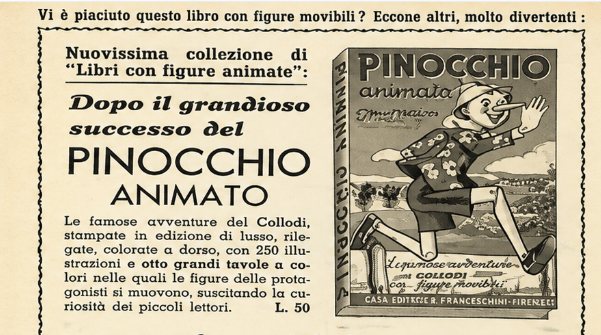
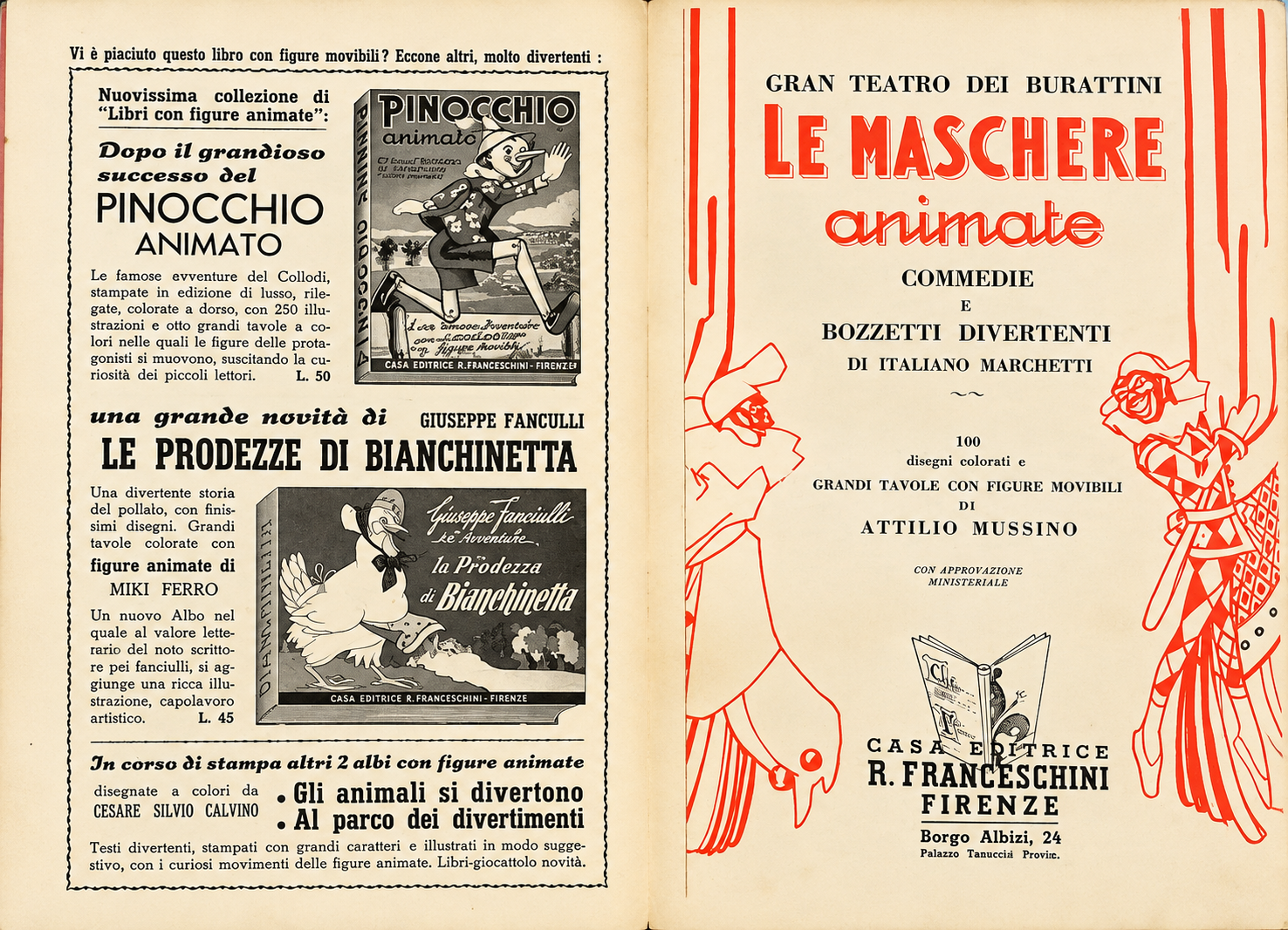
Image: Contemporary publisher's advertisement for Pinocchio animato, printed on the verso of the title page of Attilio Mussino's Le Maschere animate (Florence: Casa Editrice R. Franceschini, 1944). The advertisement prominently declares, “Dopo il grandioso successo del Pinocchio animato” (“Following the tremendous success of Pinocchio animato”), specifically celebrating the commercial success of Franceschini's movable edition rather than Collodi's original story. Promoted as part of the publisher's new collection of movable-picture books (Libri con figure animate), the deluxe edition is described as containing 250 illustrations and eight large color plates with movable figures, priced at 50 lire. This contemporary advertisement provides valuable evidence of the book's commercial success and continued promotion following its initial publication and reprinting in 1943. The same contemporary advertisement also promoted Le prodezze di Bianchinetta (The Exploits of Little White), by Giuseppe Fanciulli, with movable illustrations by Miki Ferro. Two further titles, Gli animali si divertono (The Animals Have Fun) and Al parco dei divertimenti (At the Amusement Park), illustrated by Cesare Silvio Calvino, were announced as forthcoming. Together, these advertisements document Franceschini's efforts to develop a broader series of Italian movable-picture books following the commercial success of Pinocchio animato.
By 1951, the title had gone through twenty editions, making it the firm’s most prolific and enduring movable book. First‑issue tells for collectors: the debut sits in the “Grand Album” line, has a gold‑ground cover, contains eight pull‑tab color plates, and totals 98 unnumbered pages; many early copies also credit “Cav. Renato Franceschini, Via Italo Balbo 5, Firenze” on the back. The 1943 colophon lists multiple specialized suppliers—color work in Milan, rotogravure in Milan, text composition/presswork in Bologna and Florence, assembly and several binderies in Florence, and paper mills in Verona/Milan and Turin—which helps explain small state differences across impressions.
French issue: Pinokio vivant — Comtesse de Gencé’s classic translation, published in Florence by Éditions R. Franceschini & F.°, undated (c. 1943–44), using the same Attilio Mussino illustrations and pull-tab mechanisms as the Italian Pinocchio animato. For collectors, it’s essentially the French-language counterpart, with identical plates and French text throughout.
Parallel to Franceschini’s 1943 Pinocchio animato, Rino Albertarelli’s Le avventure di Pinocchio (Edizioni Cavallo, 1944) stands as one of the most ambitious Italian animated editions of Collodi’s classic. This substantial volume contains the complete text of Le avventure di Pinocchio accompanied by more than one hundred finely rendered black-and-white vignette drawings and eight large, full-color plates enlivened with intricate paper mechanisms. Each plate features a precisely engineered volvelle, or rotating disc, allowing parts of the illustration to move when the reader turns the tab. Italian bibliographic research also records an earlier Cavallo publication from 1942: a smaller-format Pinocchio entirely structured around a volvella mechanism, with a rotating disc on each page. Collectors may therefore encounter two distinct animated Pinocchio editions from Cavallo—the compact 1942 rotating-disc version and Albertarelli’s 1944 large-plate edition.
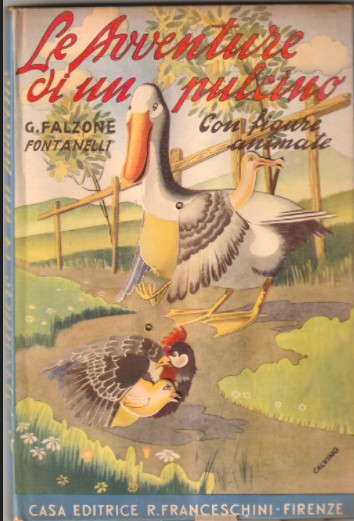
Pinocchio animato was not an isolated production. Within Franceschini’s movable-book output of the immediate postwar years, Le avventure di un pulcino e di altri animali (Florence: R. Franceschini & Figli, c. 1947) occupies an intermediate position between large-scale prestige movables and simplified novelty titles. Less elaborate than Pinocchio animato yet technically more complex than the contemporaneous Fiaba Illustrata series, the book combines a mechanically animated front cover with interior pull-tab plates (tavole animate). Contemporary and later sources note the presence of a movable duck-themed cover and lever-operated interior scenes, confirming Franceschini’s continued engagement with paper engineering beyond flagship publications. The volume has been dated to circa 1947 by Pietro Franchi, on the basis of publisher advertising and comparison with Il parco dei divertimenti (1946) and Gli animali si divertono (1948). The title illustrates how Franceschini adapted established mechanical techniques to smaller narrative formats for younger readers, while retaining Italian authorship and illustration through the collaboration of Giannino Falzone Fontanelli and Cesare Calvino.
From the collection of Vintagepopupbooks.com
Pinocchio animato was not only a lavish, multi-company production but also the flagship that launched a whole line of prestigious, mechanically-illustrated children’s books under the Franceschini imprint. Franceschini’s movable‑book output spans the early 1940s to around 1950 , with reprints/new titles through1955, featuring richly illustrated editions with mechanical elements, often under the “Grand Album” banner and distinctive gold covers. Collectors will also encounter a sister branding on some simpler titles for younger readers—the “Collezione Dorata Franceschini”—which keeps the gold‑ground look but simplifies the mechanics or format. These titles include (among others) Le Maschere Animate (1944), a collection of humorous tales illustrated by Attilio Mussino; Biancaneve e il Principe Azzurro (1948), featuring five movable tableaux in an adaptation of Snow White; Don Chisciotte Animato (1950), with six movable tableaux; and Che ora è? (1943), a time-teaching book with movable golden clock hands.
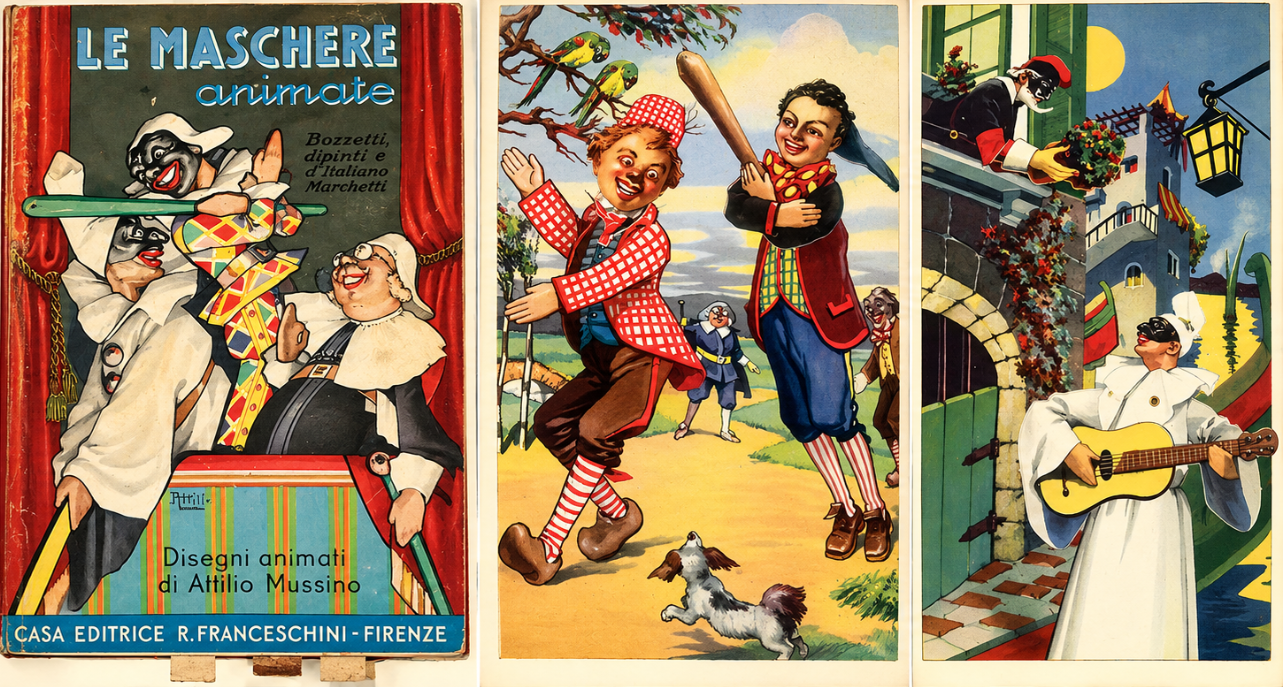
Image: Le Maschere animate (The Animated Masks). 1944. First edition. Gran Teatro dei Burattini (Great Puppet Theater). Comedies and humorous sketches by Italiano Marchetti, with illustrations by Attilio Mussino. Published by Casa Editrice R. Franceschini, Florence, Italy. Illustrated movable book featuring six animated color plates.
The Pop-ups Arrive:
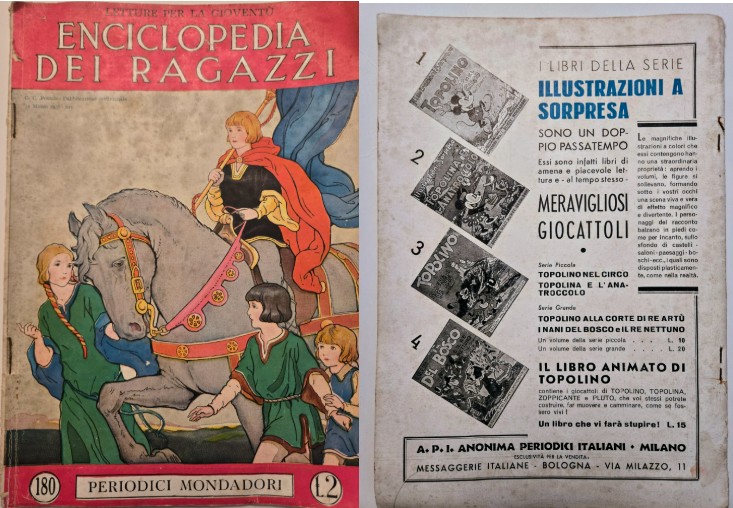
It was through four Disney titles adapted from the American editions by Blue Ribbon/Lentz that pop-ups first reached Italy, issued by Mondadori as early as 1935. These included ( As shown in ad above) Mickey Mouse and the Duckling, Mickey Mouse at King Arthur’s Court, Mickey Mouse in the Circus and the Woodland Dwarves, and King Neptune. At the time, however, these books did not introduce the now-standard international term “pop-up.” Copyright restrictions prevented its use, so title pages and advertising materials avoided the expression, and Mondadori instead adopted the label “sorprese illustrate” (“surprise illustrations”). Within the period under consideration, these four volumes not only represent Mondadori’s sole venture into the format but also stand as the principal example of imported pop-ups available on the Italian market.
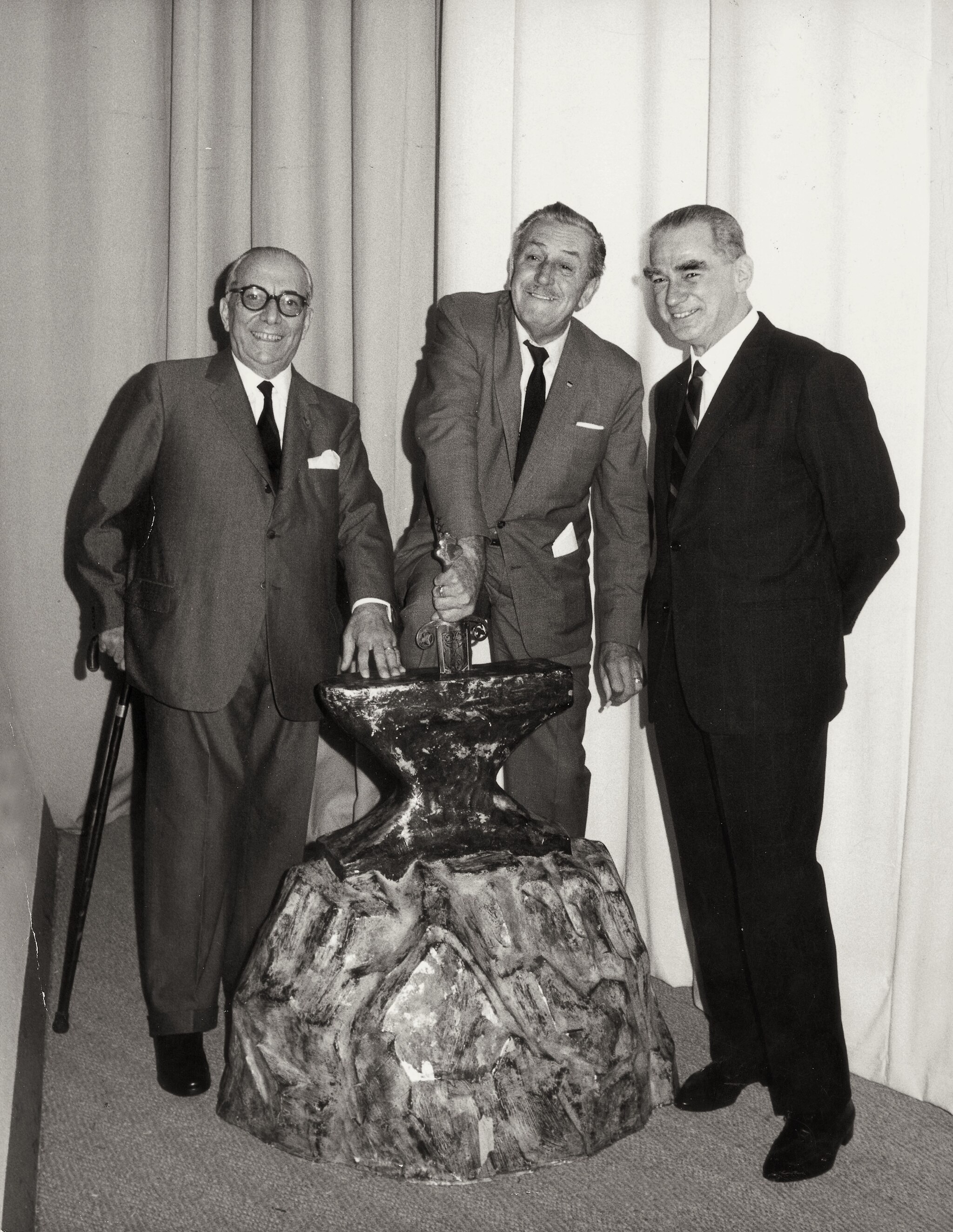
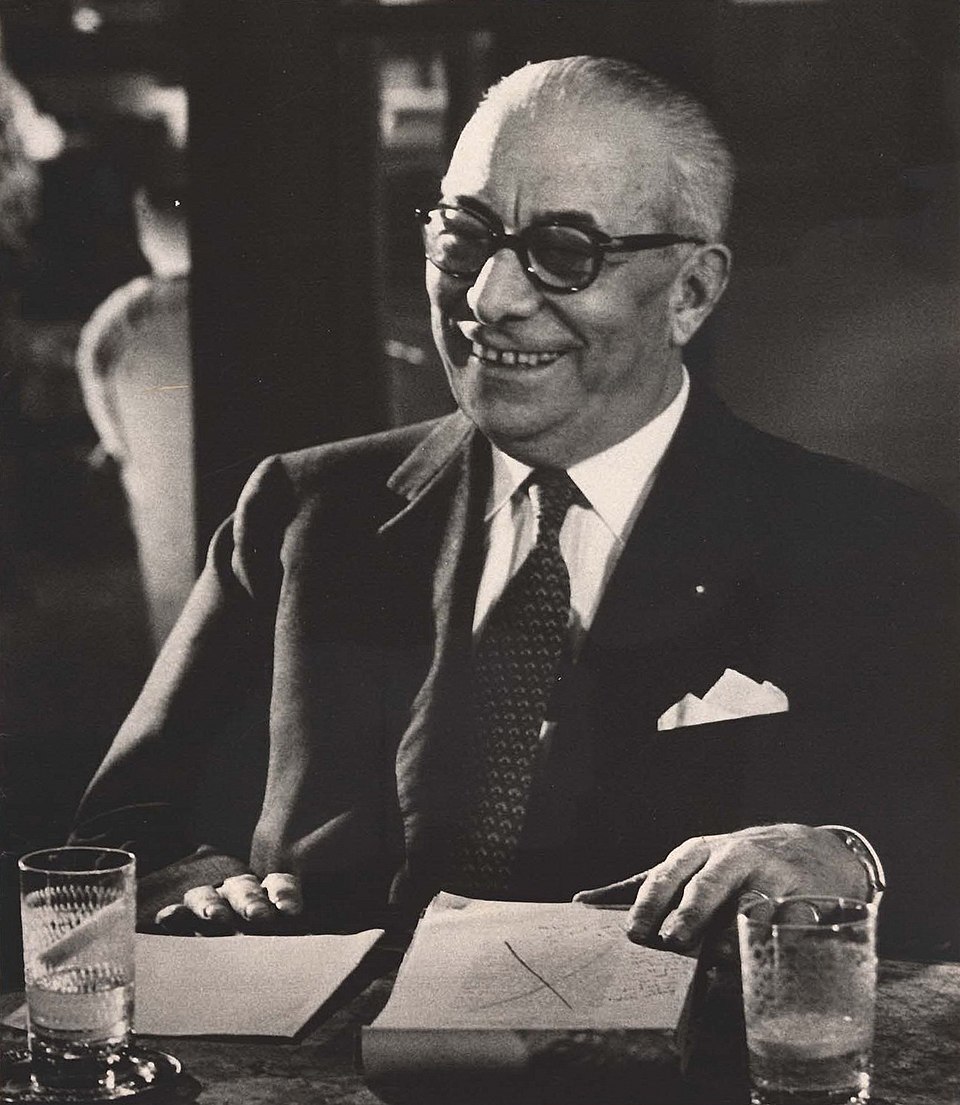
Mondadori, a cornerstone of Italian publishing, has long been renowned for producing Italian editions of international literary works. In 1935, Arnoldo Mondadori orchestrated a landmark agreement with Walt Disney, culminating in a personal meeting with Walt and Roy Disney at Mondadori's home in Meina. This collaboration resulted in one of the largest international deals signed by Disney at the time. Mondadori published the Italian editions of Disney's Blue Ribbon pop-up books. These publications, titled the "Illustrazioni Sorpresa" series, introduced Disney's beloved creations to generations of Italian readers
Image Below shows Italian publisher Arnoldo Mondadori with Walt Disney.in 1961 - Image attributed to Archivi Mondadori, CC BY-SA 4. via Wikimedia Commons
In the 1930s Italian Disney Mickey pop-editions were published by Mondadori under the title Illustrazioni Sorpresa, part of the Edizioni WALT DISNEY-MONDADORI.
Vintagepopupbooks.com includes in its movable book reference collection a 1938 weekly publication by Periodici Mondadori.
The verso advertises their series of pop-up books (Illustrazioni a Sorpresa). The titles include
Mickey Mouse at the Circus (Topolino nel Circo), Mickey Mouse and the Ugly Duckling (Topolino e l’Anatroccolo), Mickey Mouse at King Arthur's Court (Topolino alla Corte di Re Artù), and The Dwarfs of the Forest and King Neptune (I Nani del Bosco e il Re Nettuno).
image from the collection at vintagepopupbooks.com
Arnoldo Mondadori remained a pivotal force in Italian publishing throughout this period. He deliberately built a mass market for translations, bringing popular international literature to Italian readers, and he proved adept at steering through tightening censorship. Rather than dealing with local prefectures, Mondadori often negotiated directly with senior officials at the Direzione Generale per la Stampa Italiana—a strategy that gave him unusual flexibility as regulations hardened.
Against that backdrop, the first fully Italian experiments with the pop-up format surfaced in mid-1930s Milan, in the wake of Mondadori’s imported Disney titles. In 1936 the publisher La Prora issued Le meravigliose avventure della vecchietta Baffina Pimpirimpina (The Wonderful Adventure of Old Lady Baffina Pimpirimpina), appearing just a year after the Disney volumes reached Italy. Written by Dora Felisari and illustrated with verve by Roberto Lemmi, the book pairs richly colored, finely detailed artwork with four strongly three-dimensional stand-up scenes. Conceived as a lavish Christmas gift book—it went to press on December 3, 1936—Baffina Pimpirimpina frames an allegorical adventure in a format that was then still new to Italian readers.
Its origins were likely not accidental. La Prora’s founder, Giuseppe Locatelli, had worked for Mondadori until 1930 as an agent for school textbooks, and the swift appearance of Baffina Pimpirimpina after the Disney imports suggests a conscious attempt to adapt and localize that foreign model. Contemporary critics praised the book’s “sumptuous” presentation, yet rarely mentioned its most innovative feature: the three-dimensional pop-up scenes. The mechanism was not even advertised on the title page, and reviewers tended to celebrate the beauty of Lemmi’s illustrations rather than the engineering behind them. In hindsight, however, Baffina Pimpirimpina stands as a pioneering milestone of Italian pop-up publishing whose novelty was, at the time, curiously underappreciated.
Flap Books: (Terminology: Following Pompeo Vagliani and Jacqueline Reid-Walsh (with Pollone), use “transformation playbooks” to stress play, or “books with flaps with transformation effects”)
The first clearly identified movable flap (as a true mechanism, not just a shaped cut) appears in 1932 in How I Build My Balilla. It’s a hybrid: part advertising portfolio, part interactive “hole book” (pages with die-cut holes you read through).
Other 1930s books use flaps alongside different mechanisms. Example: Little Red Riding Hood (Bemporad, 1937), illustrated by Ezio Anichini, is a lever book that also includes a small door flap; open it and you see Little Red about to enter her grandmother’s house.
It’s also worth noting that while no English-language editions were produced during WWII, as Fascist Italy was an enemy state, no French editions are known to have been issued during the occupation years. A limited number of French-language editions began appearing only after the war, between the late 1940s and 1951. These were printed in Florence but distributed in Paris by Albin Michel—likely a postwar economic arrangement that allowed Italian printers to supply the French market without the cost of re-establishing full production in France. The series included French versions of Pinocchio Animato, Batuffolo, Topino et Grenouille (with the mole in the original text replaced by a mouse), and Les Fables de La Fontaine. In contrast, during the war, German-language editions of at least two titles (Dornröschen and Aschenbrödel) were produced in Nazi Germany. Alì Babà was never translated, likely because it was considered “volksfremd” (foreign to the people) under Nazi cultural policy. Additionally, wartime paper shortages and the need for specialized color printing greatly limited the production and export of Italian movable books during the war years.
During the early to mid-twentieth century, Italian publishers also produced a number of simple three-dimensional children’s books known as libri a rilievo (“books in relief”). Publishers such as Casa Editrice Carroccio of Milan issued illustrated titles during the 1930s and 1940s that employed scenic stand-up pop-up panels rather than complex mechanical devices. Titles such as their Pinocchio pop-up books demonstrate that Italian publishers continued producing three-dimensional picture books during the interwar years and into the period of World War II, reflecting the broader European revival of pop-up picture books during this era.
Pop-up scene from Pinocchio (Libri a Rilievo No. 21), Casa Editrice Carroccio, Milan, 1941:
Post-War Era and Artistic Contributions
Creative Works of the 1940s and 1950s:
Tuscany-Based Publishers:
Tuscany was the other major center for Italian movable book production in the mid-20th century, with Florence carrying forward a rich publishing legacy shaped first by R. Bemporad & Figlio and, later, by the Franceschini family. In the early 1930s, Deposito Edizioni—a Florence imprint linked to Bemporad—issued a series of lever-action fairy-tale albums whose mechanical ingenuity and colorful lithography influenced later Tuscan productions. During the 1940s, Franceschini’s animated Pinocchio editions became benchmarks for Italian movables, The firm produced a variety of richly illustrated and technically sophisticated works, including Le Maschere Animate: I Fantocci di Mastro Girolamo (1944), illustrated by Attilio Mussino with six pull-tab plates, and Il Più Grande Zoo (1944), with eight elaborate pop-up relief scenes—some later repurposed in an undated panorama/leporello format. In the immediate postwar period, Franceschini issued Le Favole di Esopo and Le Favole di La Fontaine (1946), each with pull-tab plates by Fernando Baldi, and experimented with formats ranging from cover-integrated movables (Topino e Ranocchio, 1949) to boxed miniature “libraries” of animal books with movable covers. A couple of examples of their panorama books include the zoo leporello mentioned above and other scene-based fold-outs that condensed stage-set imagery into an accordion display.
Franceschini’s postwar list also shows a willingness to explore playful, non-traditional formats, such as Pippo e Cristina (Florence, 1948), a paper-doll book illustrated by Marina Battigelli. These and other Florentine titles demonstrate how Tuscany’s publishers adapted prewar techniques to the aesthetic and economic realities of the postwar years, ensuring the region remained a vibrant hub for movable book innovation alongside Milan.
Bruno Munari of Milan: In the same years, Bruno Munari introduced an avant-garde, child-centered approach to interaction—exemplified by Il prestigiatore verde (1945)—that would help shape Italian design sensibilities in the postwar era. In 1945, shortly after the birth of his son Alberto (b. 1940), Munari created a landmark group of seven children’s books for Arnoldo Mondadori Editore known as the Libri del ’45 (Books of ’45) series. The original Italian titles were Toc Toc, Gigi cerca il suo berretto, Mai contenti, Il prestigiatore verde, Storie di tre uccellini, L’uomo del camion, and Il venditore di animali. Each title elevated the humble paper flap into the “narrative star” of the page—more than a decorative element, these hinged, liftable pieces were engineered to conceal one state of an image and reveal another, propelling the story through surprise and interaction. The books themselves were sensory invitations, marked by bold die-cuts, strategically placed holes, and large, elegantly simplified designs that encouraged playful discovery. Unusually for Italian movable books of the period, the series was an immediate success abroad: French editions appeared in 1946 from Éditions du Pré-aux-Clercs, and English-language versions, including Knock Knock. Who’s There? Open the Door, Gigi Looks for His Cap, Never Happy, The Green Conjurer, Stories of Three Little Birds, The Man with the Truck, and The Animal Seller, were issued in London by Harvill Press soon after the Italian originals. Today, the Libri del ’45 stand as a testament to Munari’s belief in the magic of paper and the boundless possibilities of design-driven storytelling.
Theater Books by Hoepli:
Hoepli produced a distinctive series of theatrical libro-teatro books in the early 1940s, conceived by scenographer Mario Zampini, whose work epitomized Italian ingenuity in movable formats. While paralleling the creative momentum of American and British pop-up books of the 1930s and 1940s, these productions retained a distinctly Italian character rooted in stagecraft and fine illustration. One notable example is Alì Babà e i 40 ladroni (Milan: Hoepli, c. 1945), designed by Zampini and brought to life by illustrators such as Raimondo Centurione and Felice De Cavero. Composed of six elaborately layered die-cut scenes, the book was engineered to be viewed under light and rotated, producing a striking sense of theatrical depth and shifting shadow.
On the eve of the Second World War, Hoepli also issued a particularly ambitious carousel-style theatre book format. Opening to a full 360 degrees, each volume presented six three-dimensional stage sets with painted panels—often by Centurione—designed to be illuminated from above for dramatic effect. Trade records and museum holdings date these editions to approximately 1940–1942. Unlike mass-market pop-ups, these libri-teatro were luxury collectibles, produced in small numbers. Only a handful of titles are known, including Cenerentola, Alì Babà e i 40 ladroni, and La bella addormentata nel bosco.
De Agostini—formally the Istituto Geografico De Agostini of Novara:
De Agostini’s postwar engine (Novara, 1948–1951). Entering the field late, the Istituto Geografico De Agostini mostly issued imported lever books under its own mark—especially in the “Albi animati” series—and scaled output quickly: 1948: Biancaneve; Il gatto dagli stivali. 1949: Ciuf Ciuf l’allegro trenino; Giorno di festa; Animali viventi. 1950: La bella addormentata nel bosco; Il corvo e la volpe; Pinocchio; Tip e Top; La volpe e la cicogna. 1951: L’acciarino magico; Batuffolo; Cappuccetto Rosso; Giacomino e il gigante; Guignol; Zenzerino; Lo zoo animato.
Beyond its own list, De Agostini also printed for other publishers—German editions for Azed A.G. (Basel) and French runs for Hachette, Les Éditions de Varennes, and J. Barbe (Lyon). Through J. Barbe—who coordinated with Azed and held European rights to Julian Wehr’s U.S. “Blue Book Editions” (Duenewald Printing, New York)—many early De Agostini movables adopted Wehr’s hallmark look: a paper dust jacket that repeats the cover, hard boards (often blue), and a colored spiral binding.
Hachette grouped related titles in its “Les Albums Hop-la!” series: 1949 Blanche-Neige and Les trois petits cochons (Disney); 1950 Histoire de Babar; 1950 Zig et Puce (which De Agostini also issued in Italian after acquiring rights). Les Éditions de Varennes offered a simpler, low-cost line in 1950—no spiral and only two animations per book (Le corbeau et le renard; Le renard et la cicogne; L’histoire de Pinocchio; L’histoire de la Belle au bois dormant). In practice, Varennes functioned as De Agostini’s French vehicle, so the Novara house was often printing for itself under a Paris imprint.
Other Post-War Books of Interest
The Istituto Geografico De Agostini in Novara, best known for its precision cartography and printing expertise, also applied its advanced presses to the production of movable books. Several of these titles were exported internationally, reflecting the firm’s ambition to compete beyond the Italian market. A notable example is Gli animali viventi (1949), a lever-operated animated book with four moving plates adapted from Julian Wehr’s American design. The Italian edition preserves Wehr’s kinetic charm while introducing localized text and, in some cases, altered color palettes, creating a collectible that bridges Italian and American movable traditions.
Marina Battigelli’s Pippo e Cristina (1948), produced for R. Franceschini in Florence, is a paper-doll book complete with clothing and accessories. Battigelli’s lively, fashionable illustrations capture postwar optimism and domestic play culture. Surviving examples in uncut condition are rare, making the book especially appealing to collectors of both paper dolls and Italian movables.
In Milan, the Carroccio publishing house issued the Libri a rilievo scenici series in the early 1940s, a visually rich but little-documented venture comprising twelve numbers. The earliest titles were single fairy-tale booklets with one relief plate, followed by editions that expanded into four stage-set scenes “in forma di teatro” to create miniature, multi-act performances. The final pair of titles, Pinocchio and Orlandino, were produced as leporellos, integrating scenic reliefs into accordion-fold structures. The series demonstrates how publishers adapted format and spectacle to wartime and early postwar constraints.
Renato Franceschini’s L’amore delle tre melarance (1944; reissued 1949) employed his distinctive “floating layers” technique in a simplified scenic design. A single double-page spread uses stacked illustrated planes to create theatrical depth in an economical yet striking presentation.
The 1957 collaboration between Angela Galli Dossena and Max Beer, 4 storie in cellophane, marked a bold experiment in transparency-based design. By incorporating cellophane panels into the illustrations, the book achieved layered, semi-transparent effects that were highly unusual in Italian children’s publishing of the period. This approach anticipated later mixed-media developments in interactive bookmaking.
Kubasta in Italy - 1960's and 1970's:
ARTIA (Praha) was the Czechoslovak state foreign-trade publisher charged with exporting cultural goods and earning hard currency through multilingual “co-editions” with Western houses; by the mid-1960s it was moving thousands of titles in dozens of languages. In Italy, ARTIA licensed/co-published Vojtěch Kubašta’s pop-ups with two Milan imprints in the Del Duca group—Industrie Grafiche Cino Del Duca and Le Edizioni Mondiali—so Italian readers received the original paper-engineering and signature three-dimensional centerfolds with localized Italian text. Telltale imprint lines read “Cino Del Duca Editore — Artia, Praga” (or the Mondiali equivalent), and even on Italian-market copies the manufacturing note typically states “Stampato in Cecoslovacchia / Printed in Czechoslovakia,” reflecting that printing and hand assembly were done in Prague and shipped finished to Milan. The Italian houses handled retail channels and, at times, jacket or price variants; Cino Del Duca’s Italian-French footprint helped spread staple fairy tales such as Pinocchio and Cappuccetto Rosso across Europe in the 1960s, while Le Edizioni Mondiali kept additional lines circulating into the late 1960s–70s, often under ARTIA’s export imprint.
This division of labor mirrored ARTIA’s broader Cold-War strategy: Prague supplied design, printing, engineering, and finished stock; Western partners supplied language adaptation, brand recognition, and market access—Italy via the Del Duca network (parallel to arrangements in the UK with Paul Hamlyn/Bancroft, etc.). Contemporary commentary on Kubašta’s output notes the speed and scale of hand assembly that let ARTIA turn out many thousands of copies per title, and trade listings as well as library records consistently show the dual imprinting (Milan publisher + ARTIA, Prague) that documents this co-edition model.
Italian editions that we have found include:
Cappuccetto Rosso — Cino Del Duca / ARTIA, 1962–1965 (multiple Italian printings)
Hansel e Gretel — Cino Del Duca / ARTIA, 1962; reprinted c. 1968
Cenerentola — Cino Del Duca / ARTIA, 1962
I tre capelli d’oro (The Devil’s Three Golden Hairs) — Cino Del Duca / ARTIA, 1969
I sette corvi — Cino Del Duca / ARTIA, 1966
Il lupo e i sette capretti — Cino Del Duca / ARTIA, 1968
Il pescatore e sua moglie — Cino Del Duca / ARTIA, 1968
Alì Babà e la montagna magica — Cino Del Duca / ARTIA, 1969 (six pop-up scenes)
Tip + Top e il razzo lunare — Le Edizioni Mondiali / ARTIA, 1966
Tip-top-tap e gli aerei — Le Edizioni Mondiali / ARTIA, 1966 (square format; six pop-ups)
La contadina intelligente — Cino Del Duca / ARTIA, 1969
To Close:
By the early 1950s, Italian movable-book production had begun to recover, with publishers once again exporting to France, Germany, and other European markets. Many prewar titles were reissued—sometimes with updated artwork or simplified mechanics—while new designs reflected postwar aesthetics and the economic realities of reconstruction. This modest resurgence paralleled the broader revival of Italian publishing as the nation rebuilt its cultural industries and reestablished its place in the European book trade.
Yet the historical record for Italian movable books remains unusually fragile. As Pollone emphasizes, this field has long suffered from what she terms a form of “bibliographic invisibility.” Movable books were considered ephemera rather than literature, rarely catalogued by libraries, inconsistently preserved by publishers, and often produced in small print runs for holiday gift markets or school use. Even before the devastation of World War II, documentation was patchy and incomplete. Several important publishers—including Carroccio in Milan, Cappelli in Bologna, and Gussoni in Milan—left almost no surviving business records, and today they survive in scholarship primarily as “ghost publishers,” known chiefly through surviving copies rather than through archival documentation.
The situation worsened dramatically on November 4, 1966, when the catastrophic Florence flood destroyed vast quantities of archival material—publisher records, correspondence, printing proofs, catalogues, and reference collections that would have documented Italy’s movable-book industry. As a result, much of what once existed can no longer be traced. Modern reconstructions of early Italian production—such as the painstaking bibliographic work surrounding the Franceschini output—must rely on surviving copies, scattered trade notices, museum holdings, and the dedicated research of scholars and collectors to piece together this rich but partially lost heritage.
Today, the study of Italian movable books depends on assembling these fragments. It is precisely this scarcity that makes the work of contemporary researchers so vital. As Pollone and the Pop-App community demonstrate, recovering Italy’s movable-book tradition requires a combination of archival investigation, comparative analysis, and the collaboration of collectors worldwide. Although much has been lost, what remains reveals a tradition of remarkable technical ingenuity, artistic experimentation, and cultural specificity. By bringing these surviving works back into focus, modern scholarship not only restores a long-overlooked chapter of Italian publishing but also secures Italy’s rightful place within the global history of movable and interactive books.
Bios on selected Italian Publishers:
Antonio Vallardi
Antonio Vallardi (1813–1876) came from a long line of Milanese printers and booksellers. His grandfather, Francesco Cesare Vallardi (1736–1799), had established a printing and bookselling shop in Contrada Santa Margherita in the mid-eighteenth century, a place that quickly became a cultural hub in Milan. The business passed on to Antonio’s father Pietro (1770–1819) and uncle Giuseppe (1784–1861), who operated under the name Fratelli Vallardi from 1812 and gained distinction for publishing books and art prints. He became owner of the company upon Pietro's death in 1819.
In 1843, Antonio founded his own firm, Antonio Vallardi Editore, a few years after his brother Francesco had started a separate venture. His publishing house soon became recognized for academic and linguistic works, as well as high-quality maps and guides. Vallardi’s cartographic output in particular made a lasting mark, supporting both education and travel, and helping to disseminate geographical knowledge throughout Italy.
The Vallardi family retained control of the publishing house into the twentieth century. After various reorganizations in the 1960s, the A. Vallardi mark was acquired by Garzanti in 1970 and eventually became part of Gruppo Editoriale Mauri Spagnol in the 1990s.
Ulrico Hoepli
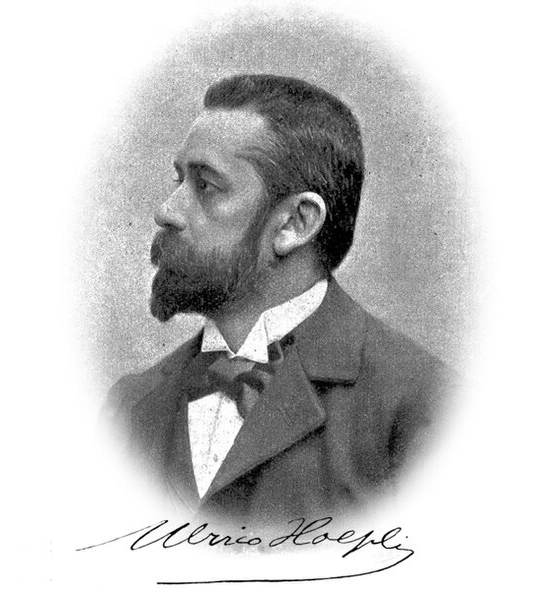
Image: Ulrico Hoepli, photograph by Guigoni & Boffi, Milan (c.1890). Courtesy Wikimedia Commons, CC BY-SA 4.0.
Ulrico Hoepli (Johannes Ulrich Hoepli; Tuttwil, Switzerland, 18 February 1847 – Milan, 24 January 1935) was a Swiss-born, Italian naturalized bookseller-publisher who built one of Italy’s most respected imprints. Arriving in Milan as a young man, he purchased a bookshop in the Galleria De Cristoforis on 7 December 1870, a few steps from the Duomo, and from 1871 developed a full editorial program alongside bookselling.
Over the following decades he fashioned a brand identified with high-quality technical and scientific publishing. In 1875 he launched the Hoepli Manuals, concise handbooks for students and professionals that became a national institution. The house also specialized in dictionaries, atlases, and instructional guides that helped standardize practical knowledge in modern Italy. In 1885 Hoepli was appointed Bookseller-Publisher of the Royal House, cementing his reputation.
Hoepli balanced publishing with civic patronage. In 1921 he founded the Ulrico Hoepli Popular Library to expand access to reading, and two years later, in 1923, he converted his firm into a family limited company. Though he and his wife had no biological children, he ensured continuity by placing “adopted” grandchildren and close relatives in positions of responsibility. He also established the Ulrico Hoepli Foundation in Switzerland to further cultural and educational goals. His most visible gift to the city of Milan was the Ulrico Hoepli Civic Planetarium, designed by Piero Portaluppi and inaugurated on 20 May 1930, which remains one of Europe’s largest planetariums.
Hoepli died in Milan in 1935 at the age of 87, leaving behind both a flourishing publishing house and an international bookstore. In the late 1930s, the Galleria De Cristoforis was demolished and replaced with new buildings, but the Hoepli bookshop was reestablished nearby. During the war years the firm suffered severe losses, including the destruction of its warehouse and bookstore in the bombings of 1943–45. Carlo Hoepli, the founder’s grandson, moved the headquarters to Via Berchet, then later to Via Hoepli, the street named in honor of Ulrico, a short walk from the Duomo. From there, the “Libreria Internazionale Hoepli” grew into a Milan landmark, offering technical works and foreign-language books unmatched in scale.
Under the successive leadership of Carlo Hoepli and later his sons Gianni and Ulrico, the firm rebuilt and expanded in the postwar decades. In 1972 Ulrico Hoepli became president, followed at the turn of the millennium by his son Ulrico Carlo, joined by his own children Giovanni, Matteo, and Barbara—representing the fifth generation of family stewardship. In this period the publishing house phased out in-house printing, concentrated on editorial development, and continually refreshed its hallmark manuals and reference works while adding new fields: engineering, computing and ICT, business, design and architecture, photography, nautical and aeronautics, and modern languages.
Today Hoepli Editore and its six-floor bookstore on Via Hoepli remain family-run, housing more than half a million titles and continuing a 150-year tradition of technical, educational, and cultural publishing rooted in Milan but known throughout Europe.
The historical archive of the Ulrico Hoepli Publishing House is now at the Apice Center of the University of Milan. An example of Hoepli’s production, Bestie vive e burlone: sei grandi quadri mobili e colorati con storielle gaie e ridevoli, may be viewed here: (Issued with the same plates as Allô! Allô! Bostock (Paris: A. Capendu Editeur, 1900))
Rosenberg & Sellier was founded in Turin in 1883 by Ugo Rosenberg and Arturo Sellier, two immigrant booksellers whose international background helped shape the unusually cosmopolitan character of the firm. Ugo Rosenberg had arrived in Turin from Germany around 1880, initially working for the established bookseller and publisher Hermann Loescher before entering business on his own. His grandson later remembered him as a committed positivist with a strong attachment to German language and culture, and as an immigrant who had to work hard to establish himself within Turin society.
Rosenberg and Sellier established an international bookshop, initially oriented toward foreign and specialized literature, and soon began publishing under their own imprint. The house achieved early recognition through dictionaries, including Valentino Grandis and Mario Donati’s Dizionario tedesco-italiano di biologia e medicina (1889) and Ferruccio Calonghi’s Italian adaptation of the Georges Latin dictionary (1891). These publications reflect the firm's early identity as a mediator between Italian scholarship and the wider European book trade.
By 1892, Arturo Sellier had left the enterprise, while Ugo Rosenberg continued the business under the established Rosenberg & Sellier name. Around the turn of the twentieth century, the catalogue expanded beyond dictionaries into scientific and philological works, school publications, and illustrated books for children.
The publishing house remained closely connected with the Rosenberg family. Ugo's son Ernesto Romano Rosenberg inherited the business; family testimony records that he also operated a Rosenberg & Sellier bookshop branch in Naples during the 1920s before returning to Turin in 1932. After Ernesto's early death, his wife Elvira Maddalena Porrera took over the running of the firm and maintained it until their son, Ugo Gianni Rosenberg, entered the business in 1972.
Under Ugo Gianni Rosenberg, the press increasingly concentrated on humanities and social sciences, while retaining its traditional connections with academic research. In 1989 Zanichelli acquired a minority share of the firm, and in 2015 Rosenberg & Sellier became part of Lexis Compagnia Editoriale, which continues the imprint today with a focus on scholarly publishing, international cooperation, and open-access research.
Paravia Publishing House (Turin, Italy)
G. B. Paravia & C. was one of Italy’s oldest and most influential educational publishing houses, with roots reaching back to the seventeenth-century Tipografia Zappata in Turin. In 1802, Giovanni Battista Paravia entered into partnership with the printers Giovanni Sebastiano Botta and Francesco Prato to acquire the existing Zappata & Avondo concern and relaunch it under the Paravia name. Paravia was already an established Turin bookseller, and the new firm combined bookselling with printing at a time when the two trades were still closely connected. Its early output consisted chiefly of religious, medical, legal, and administrative publications, reflecting its ties to both civic and ecclesiastical institutions.
After the death of Francesco Prato in 1812, Napoleonic printing regulations temporarily prevented Giovanni Battista Paravia from continuing as a printer, forcing him to operate solely as a bookseller. Following the restoration of Savoy rule in 1814, the family was able to rebuild its printing activity.
The decisive transformation of the company came under Giovanni Battista’s son Giorgio Paravia. After acquiring Bernardino Barberis’s printshop in 1833, Giorgio gradually broadened the firm beyond devotional and commission printing. The turning point came in the mid-1840s, when he established close relationships with Turin educators involved in school reform. This collaboration produced L’Educatore primario (1845–1848), regarded as the first pedagogical periodical published in Italy, and placed Paravia at the center of the emerging Italian educational publishing market.
From that point onward, pedagogy and school publishing became the defining identity of the house. Paravia issued educational journals, teachers’ manuals, schoolbooks, dictionaries, and other didactic works, collaborating with prominent educators and authors including Domenico Berti, Giovanni Antonio Rayneri, Vincenzo Troya, and Don Giovanni Bosco.
After Giorgio’s death in 1850, control passed to Lorenzo Roux and Innocenzo Vigliardi, a relative of the Paravia family who had already worked in the business. Vigliardi continued the firm’s educational specialization and took advantage of the rapid expansion of schooling in Piedmont and, after Italian unification, the growth of the national school system.
Under Vigliardi, Paravia entered a period of substantial industrial and commercial growth. In 1873, the firm acquired the Stamperia Reale and transferred production to Via dell’Arsenale, while the retail bookshop moved to Via Doragrossa, later Via Giuseppe Garibaldi. The company also expanded into maps, globes, abacuses, and other teaching materials and developed a commercial network across major Italian cities. In 1891, Innocenzo was formally authorized to add the Paravia surname to his own, becoming Vigliardi Paravia, symbolically preserving the continuity of the family name.
By the late nineteenth century, Paravia employed more than 200 people and had become one of Italy’s principal educational publishers. Its catalogue expanded into children’s literature, atlases, dictionaries, and school reference works. One of its most enduring publications was the Campanini-Carboni Latin dictionary, first issued in 1911 and still associated with the Paravia imprint today.
The twentieth century brought both expansion and political entanglement. By the First World War, Paravia controlled roughly 12 percent of the Italian schoolbook market. In 1920 it was reorganized as the Società Anonima G. B. Paravia & C., and during the Fascist period it became one of the firms authorized to distribute the state-mandated libro unico for primary education.
In 1927, Paravia transferred its operations to a new purpose-built headquarters on Corso Vittorio Emanuele II and withdrew from in-house typography to concentrate on publishing. The building was destroyed during the Allied bombing of Turin on 28 November 1942, taking with it much of the historic company archive. The firm relocated temporarily to Pinerolo during the war and returned to Turin after liberation, eventually establishing a new headquarters at Corso Racconigi 16 in 1950. Surviving family papers are now preserved at the Fondazione Tancredi di Barolo.
The Paravia retail bookshop also became a Turin institution. After moving to Via Giuseppe Garibaldi in 1873 and later relocating nearby, it remained associated with the city for nearly a century and a half. When it closed at the end of 2019, it was described as the oldest bookshop in Turin and the second oldest in Italy.
In the late twentieth and early twenty-first centuries, Paravia became part of a series of major educational-publishing consolidations. In 2000, it merged with Bruno Mondadori to form Paravia Bruno Mondadori (PBM). Pearson acquired PBM in 2006, incorporating the Paravia name into its Italian educational division. In 2022, Pearson sold its Italian K–12 learning-content business to the Finnish education group Sanoma, and the Paravia imprint now continues within Sanoma Italy.
Ditta Giovanni Gussoni:
A Milanese typo-lithography, stationer, bookbinder, and publisher active from the 1870s into the early 1900s. The firm specialized in inexpensive printed entertainment and learning aids for families and children—board games (including giochi dell’oca), cut-outs and paper soldiers, toy-theatre sheets and humorous playlets, calendars (including revolving-disc “volvelle” styles), and didactic objects such as hand-finished educational globes. This hybrid mix of ephemera, toys, and schoolroom materials places Gussoni squarely within the Italian tradition of “play to learn” publishing of the period.
Founded in 1874, when Giovanni Gussoni acquired the typographic business of Antonio Ronchi at Via Unione 5, the company soon expanded beyond job printing. In 1883 the retail premises moved to the Southern Porticoes on Piazza Duomo, while the workshop continued to turn out both commercial work and the firm’s own imprints. Over the years the name appears in several trade styles—Tipografia Giovanni Gussoni; Ditta Giovanni Gussoni; Gussoni & Dotti, Editori (seen on late-nineteenth-century globes); and later Stabilimento Litografico Gussoni & Rocca on calendars and advertising pieces—evidence of a house that combined retail, publishing, and contract printing.
Succession followed a family line: after Giovanni, his son Vittorio directed the firm. On April 16, 1907, Vittorio sold the company to Giovanni Serra, who continued operations at least through November 1910. Some institutional catalogues ascribe the foundation to “Giacomo” Gussoni, while trade sources and imprints consistently use “Giovanni,” matching the shop name; this almost certainly reflects the same family concern recorded under variant forenames.
For a study of Italian movable and children’s print, Gussoni is significant not only for its output of paper games and cut-outs but also for items with simple mechanics—slotted assemblies, layered toy-theatre scenes, and rotating calendars—bridging stationery, toy, and educational markets in fin-de-siècle Milan.
Arnoldo Mondadori:
Arnoldo Mondadori, photograph originally published in Epoca magazine (No. 1082, June 20, 1971). Public domain via Wikimedia Commons.
Mondadori, a cornerstone of Italian publishing, has long been renowned for producing Italian editions of international literary works. Known for their meticulous translations, Mondadori ensures that original texts are both preserved in spirit and tailored to resonate with Italian readers. As the largest publishing company in Italy, Arnoldo Mondadori Editore boasts a rich legacy in the publishing industry.
The company was founded in 1907 in Ostiglia by an ambitious 18-year-old, Arnoldo Mondadori, beginning with the publication of the magazine
Luce! This marked the start of an illustrious career in publishing. In 1919, Mondadori moved its headquarters to Milan, a cultural and intellectual hub, paving the way for its rapid growth and influence.
In 1935, Arnoldo Mondadori orchestrated a landmark agreement with Walt Disney, culminating in a personal meeting with Walt and Roy Disney at Mondadori's home in Meina. This collaboration resulted in one of the largest international deals signed by Disney at the time, cementing Mondadori's prominence in children's publishing. Under this partnership, Mondadori published a series of children’s books based on Disney cartoon characters, a collaboration that endured until 1988. These publications, including the "Illustrazioni Sorpresa" series, introduced Disney's beloved creations to generations of Italian readers and solidified Mondadori's role as a leading publisher of children's literature.
Fratelli Treves
Fratelli Treves of Milan (1861-1932) was one of the leading Italian publishing houses of the late nineteenth and early twentieth centuries. Founded in 1861 by Emilio Treves (1834-1916), the firm appealed to an educated readership and published authors of the scapigliatura movement such as Iginio Ugo Tarchetti and Antonio Ghislanzoni. In 1870 Emilio was joined by his brother Giuseppe and the imprint became Fratelli Treves. The house published major Italian writers including Giovanni Verga, Gabriele D'Annunzio, and Edmondo De Amicis, while also bringing international voices such as Gustave Flaubert, Emile Zola, Leo Tolstoy, and Fyodor Dostoevsky to Italian readers. After Giuseppe's death in 1904 the firm was reorganized as a joint-stock company, and following Emilio's death in 1916 leadership passed to his nephew Guido Treves. In 1931 the company merged into SA Treves-Treccani-Tumminelli, but it dissolved soon after Guido's sudden death in 1932.
Casa Editrice R. Franceschini (Florence, 1942–c. 1955)
Casa Editrice R. Franceschini emerged from a Florentine family deeply rooted in the printing trade. Its immediate background lay in the career of Lorenzo Franceschini, a typographer and printer who directed the historic Tipografia Giuntina during the 1920s. Under his management the Giuntina undertook technically demanding and sometimes controversial work, including the first edition of D. H. Lawrence’s Lady Chatterley’s Lover, printed in Florence in 1928 to circumvent British censorship. After the death of his wife Isolina that same year, Lorenzo nominally retired from the Giuntina but continued working independently under the imprint “Tipografia L. Franceschini.”
By 1931 Lorenzo had begun moving from contract printing into publishing. He established Deposito Edizioni and explored the possibilities of illustrated and mechanically constructed children’s books. In December of that year he approached the Florentine publisher R. Bemporad & Figlio with a proposal for a program of animated albums that included a reduced mechanical edition of Pinocchio. Although the proposed collaboration did not materialize, Lorenzo continued independently. Deposito Edizioni became the practical and editorial foundation from which the later Franceschini publishing house developed.
His son Renato Franceschini (1897–1978) had meanwhile followed a different but complementary path through the publishing industry. Trained as a typographer at the Giuntina, Renato built his professional career at R. Bemporad & Figlio, one of Florence’s most important publishing houses, eventually becoming a senior manager during the 1930s. His years there coincided with a turbulent period in the company’s history. Financial difficulties had brought Bemporad increasingly under outside control, and in 1938 the Fascist racial laws forced the Jewish-owned firm to abandon the Bemporad name and continue as Marzocco.
Renato left the Bemporad-Marzocco organization during this period of upheaval and increasingly joined his father’s independent publishing activity. In 1942 he formally established Casa Editrice R. Franceschini in Florence. The new house benefited from the combined experience of both generations: Lorenzo’s knowledge of printing, production, and specialist workshops, and Renato’s experience in the organization and commercial management of a major publishing firm. The Franceschini operation consequently functioned not simply as a publisher but as the coordinator of a network of printers, lithographers, binders, paper suppliers, illustrators, and mechanical assemblers in Florence and elsewhere in northern and central Italy.
The firm developed during exceptionally difficult circumstances. Its first major years coincided with wartime shortages, disrupted transport, restricted supplies of paper and color-printing materials, and the political and economic instability of Italy between 1942 and 1945. Nevertheless, the company established a recognizable identity in children’s publishing and continued expanding during the immediate postwar period. The imprint appears in several forms, including Casa Editrice Renato Franceschini and later R. Franceschini & F.o, reflecting the development of the enterprise beyond its original wartime organization.
Franceschini also participated in the revival of Italy’s international book trade after the war. Editions produced in Florence were prepared for foreign-language markets, particularly France, and the company’s books circulated beyond Italy at a time when Italian publishers and printers were rebuilding commercial relationships interrupted by the conflict. This international activity remained based on Florentine production rather than transforming Franceschini into a foreign licensing house; the firm’s distinctive character continued to depend heavily upon Italian printing, illustration, editorial work, and specialist manufacture.
By the early 1950s Casa Editrice R. Franceschini had become an established name in Italian children’s publishing, but its independent life was relatively brief. Its principal period of activity extended from Renato’s establishment of the house in 1942 to approximately the mid-1950s, when production diminished and the publishing concern ceased operating as a significant independent house.
Unlike publishers such as Hoepli, Mondadori, Paravia, or Rosenberg & Sellier, Casa Editrice R. Franceschini did not survive through merger or acquisition as a continuing modern imprint. The company disappeared as an active publishing house around the mid-1950s. Its historical importance therefore rests on the concentrated activity of Lorenzo and Renato Franceschini and on the distinctive Florentine publishing and printing network they created during the 1930s, wartime years, and immediate postwar period.
Bruno Munari (born October 24, 1907, Milan, Italy – died September 30, 1998, Milan, Italy) was an internationally celebrated Italian artist, designer, and educator, widely regarded as one of the most influential creative figures of the 20th century. A key member of the Italian Futurist movement in his youth and later a co-founder of the Movimento Arte Concreta (MAC), Munari’s career spanned painting, sculpture, industrial design, graphic design, photography, film, and literature. His restless intellect and boundless curiosity drove him to experiment in every field of the visual arts, consistently exploring the intersections of form, function, and play.
Munari began exhibiting during the Second Futurism period in the 1930s, already showing the eclecticism that would define his life’s work. His designs were never divorced from content or materials—whether working on kinetic sculptures, visual machines, or illustrated books, he treated each project as a laboratory for experimentation. From the postwar years onward, he devoted increasing attention to publishing and the design of “book-objects,” works in which physical structure and narrative were inseparable.
Deeply committed to education, Munari championed creativity as an essential human skill. He was a pioneer in designing books and games to develop visual literacy in children, believing that playful interaction could spark observation, curiosity, and critical thinking. His celebrated children’s works, such as the Libri del ’45 (Books of ’45) series, combined die-cuts, flaps, and bold graphics to create experiences that were both tactile and narrative.
For over two decades, Munari maintained close ties with Corraini Edizioni, whose catalogue continues to feature his books. He also redesigned the Corraini logo, adapting an earlier drawing by Giosetta Fioroni. In his later years, he increasingly focused on visual and artistic education for all ages, leading workshops, seminars, and creative laboratories for children, teachers, and adults.
Munari’s legacy lies not only in his prolific output across media, but also in his belief that art and design could—and should—provoke thought, invite play, and expand the way we see the world. His work remains a touchstone for designers, educators, and collectors worldwide.
References
Albanese, Graziella, Anne Sophie Bauman, Thierry Desnoues, and Patricq Lecoq. Exposition Whaouh: 100 livres animés collectors du 21 nov au 21 décembre 2013 à la boutique du livre animé dans le 18ème arrondissement à Paris. Paris: Livres animés.com, 2013.
Alde, Paris. “Gioppino in cerca di fortuna.” Auction catalogue entry, October 27, 2020. Notes the format, illustrated publisher’s boards, eight movable plates, and condition details of a surviving copy.
Antonio Vallardi. Favole con figure animate. Milan: Antonio Vallardi, pre-1885.
Antiqua Freddi. Il libro animato nel tempo. Turin, 2019. Includes the description of Fratelli Treves as an exception among Italian publishers and Gioppino in cerca di fortuna as “perhaps the first animated book conceived and produced in Italy.”
Archivio storico Giunti Editore / Soprintendenza Archivistica e Bibliografica della Toscana. Il fondo Bemporad dell’Archivio storico Giunti Editore. Inventory, entry 59.1, “Franceschini Renato (9 dicembre 1924–22 giugno 1943).” The archive preserves 89 documents concerning Renato Franceschini’s relationship with Bemporad-Marzocco, including agreements concerning his books and documentation of his later establishment of his own publishing house.
Arcadia. “Evolution of the Book in Italy: The Rise of the Printing Press.” Published October 10, 2023; updated September 11, 2024. Accessed December 11, 2024. Arcadia article
Bolino, Francesca. “Ugo Rosenberg: ‘Ho lasciato gli amati studi filosofici per occuparmi della casa editrice di famiglia.’” la Repubblica, Turin edition, May 8, 2021. Interview with Ugo Gianni Rosenberg, grandson of founder Ugo Rosenberg.
Bourlot, Libreria Antiquaria. “Collodi, Carlo. Pinocchio Animato. Le famose Avventure del Collodi con figure movibili. Firenze, Casa Editrice R. Franceschini & F., 1950.” The catalogue describes the eight movable Attilio Mussino plates and notes that the first animated edition in the “Grandi Album” series appeared in 1943.
Campagnaro, Marnie. “Do Touch! How Bruno Munari’s Picturebooks Work.” 2019. Accessed August 21, 2025. Campagnaro PDF
Centro APICE – Università degli Studi di Milano. “Archivio Ulrico Hoepli.” Accessed August 22, 2025. Archivio Ulrico Hoepli
Centro APICE – Università degli Studi di Milano. “L’archivio storico della Casa Editrice Ulrico Hoepli al Centro APICE.” Published September 20, 2023. Accessed August 18, 2025. APICE Hoepli archive article
Crupi, Gianfranco. “‘Mirabili visioni’: From Movable Books to Movable Text.” JLIS.it 7, no. 1 (2016): 25–87. DOI: 10.4403/jlis.it-11611.
Fondazione Benedetto Ravasio / Museo del Burattino. Bergamo. Material relating to the Gioppino puppet-theatre tradition and the exhibition and facsimile context of Gioppino in cerca di fortuna.
Fondazione Tancredi di Barolo. “Cataloghi storici della casa editrice Paravia.” The Foundation preserves historical Paravia catalogues of books and teaching materials as part of the Archivio storico Famiglia Vigliardi Paravia, donated in 2015. These catalogues provide primary-source evidence for the firm’s educational and visual-material output.
Fondazione Tancredi di Barolo. Pop-App. Scienza, arte e gioco nella storia dei libri animati dalla carta alle app. 2019.
Fondazione Tancredi di Barolo. “Pop-App: Scienza, arte e gioco nella storia dei libri animati dalla carta alle app.” Accessed December 11, 2024. Pop-App Turin exhibition
Fondazione Tancredi di Barolo / Memora Piemonte. Digital material relating to Gioppino in cerca di fortuna, including institutional and digitized material.
Franchi, Pietro. Apriti libro! Meccanismi, figure, tridimensionalità in libri animati dal XVI al XX secolo. Rovigo: Essegi, 1998. Franchi (Bologna, 1944–2024) was a collector, scholar, and historian of movable and pop-up books. His study is a significant Italian-language contribution to the history and mechanisms of animated books.
Franchi, Pietro. “L’éditeur Franceschini.” Text reproduced by LivresAnimés.com in its Franceschini documentation. The account traces Lorenzo Franceschini from printer to publisher and discusses Deposito Edizioni, the proposed Bemporad Pinocchio, Pinocchio animato, the Grand Album series, and the Collezione Dorata.
Fratelli Treves. Gioppino in cerca di fortuna. Milan: Fratelli Treves, circa 1890.
Gielen, Theo. “Casa Editrice Franceschini—A Hidden List of Movable and Pop-Up Books of Italian Origin.” Movable Stationery 16, no. 3 (2008). Movable Book Society. https://www.movablebooksociety.org/mspdfs/2008.pdf
“Gioppino – l’amato burattino bergamasco in giro per il mondo.” Material on the local history and cultural identity of Gioppino.
Giornale della libreria. January 31, 1904. First documented advertisement for Toni-Senza-Timore / Gran Circo Equestre!; records variant titles including Toni senza timore, Circo equestre, and Toni senza timore (Circo equestre).
Govi, Fabrizio. “Rare Books Worldwide – A Short History of the Book and Bibliophily in Italy.” ILAB, February 6, 2016. ILAB article
Gruppo Mondadori. “1935.” La nostra storia. Accessed August 21, 2025. Gruppo Mondadori: 1935
Harvard Geospatial Library. Maps and Wall Charts. Published by Paravia. Accessed via Harvard Library.
Harvard Geospatial Library. Pianta di Milano. Published by Antonio Vallardi. Accessed via Harvard Library.
Hoepli S.p.A. “Chi siamo.” Accessed August 18, 2025. Hoepli: Chi siamo
Hoepli, Ulrico. Gira gira (Turn Turn). Milan: Hoepli Publishing House, early twentieth century. Museo del Giocattolo e del Bambino, Milan, holding.
Hoepli, Ulrico. Manual of the Engineer. Milan: Hoepli Publishing House, 1875.
Hoepli, Ulrico. Pupazzi vivi e allegri. Milan: Ulrico Hoepli, circa 1910.
“I burattini bergamaschi: Brighella, Arlecchino e Gioppino. Dagli zanni ai servi goldoniani.” Puppetring, 2014. Material on the cultural history of Gioppino and the Bergamasque puppet tradition.
Libri Aparte. Gioppino in cerca di fortuna. Modern facsimile edition. Bergamo, 2023. With an essay by Pompeo Vagliani. Issued in connection with the modern rediscovery of the title and its exhibition at the Fondazione Benedetto Ravasio / Museo del Burattino.
Libreria Antiquaria Freddi. “Gioppino in cerca di fortuna.” Milan fair catalogue, 2016. Records a commercial appearance of the book and describes it as the first Italian-produced animated book.
Missiroli, Massimo, and Matteo Faglia. Pop-up. La magia dei libri. Exhibition catalogue. Cecina: Fondazione Culturale Hermann Geiger, 2017.
Morgan Library & Museum. “Lady Chatterley’s Lover / by D. H. Lawrence.” Printed Books Collection, PML 135746. Records the 1928 Florence first edition as printed by the Tipografia Giuntina under L. Franceschini’s direction.
Movable Book Society. Gielen, Theo. “Casa Editrice Franceschini—A Hidden List of Movable and Pop-Up Books of Italian Origin.” Movable Stationery 16, no. 3 (2008). Accessed August 18, 2025. Movable Stationery 16, no. 3
Newberry Library. “Pop-Up Books through the Ages.” Accessed via Newberry Digital Collections.
Old Children’s Books. “What I’d Like to Be (Mai contenti). London: Harvill Press [1945] (first English).” Accessed August 21, 2025.
OpenEdition Journals. “Teaching with Images Between 19th and 20th Centuries: The Case of the Italian Publishing House Paravia.” Accessed via OpenEdition Journals. See Fabio Targhetta entry below.
Paravia Publishing House. La storia di Gano. Turin: Paravia, circa 1900.
Pollone, Eliana Angela. Il libro animato italiano tra il 1850 e il 1950. PhD diss., Sapienza Università di Roma, 2022.
Pollone, Eliana Angela. “Libri animati scientifici e tecnici in Italia: il caso torinese (secc. XIX–XX).” JIB: Journal of Interactive Books 2 (April 2023): 16–35. DOI: 10.57579/2023.2. JIB article PDF
Pollone, Silvia. La letteratura per l’infanzia in Italia: editoria, lettori e testi tra Otto e Novecento. PhD diss., Università degli Studi di Torino, 2011.
Pop-App. Scienza, arte e gioco nella storia dei libri animati dalla carta alle app. Exhibition book. Turin, 2019.
Pop-App. “News – Italian and Worldwide Movables.” Accessed December 11, 2024. Pop-App News
Rosenberg & Sellier. Editorial advertisements / Libri di strenna, 1927–1928. Evidence for the later Nuovo circo Bisini, its attribution to Rosenberg & Sellier, and its relationship to the Quadri viventi tradition.
Rosenberg & Sellier. “Chi siamo.” Accessed August 6, 2026.
SA Treves–Treccani–Tumminelli. Historical note on publishing mergers in the twentieth century. Accessed via Wikipedia.
Sarlatto, Mara. “Paper Engineers and Mechanical Devices of Movable Books of the 19th and 20th Centuries.” JLIS.it 7, no. 1 (2016): 89–112. DOI: 10.4403/jlis.it-11610.
Servalli, Stefania, Antonio Gitto, and Federica Gandelli. “Florence Flood and the Rescue of the Florence State Archives: The Role of Accounting and Accountability.” Accounting History 29, no. 1 (2024): 88–106. First published online May 24, 2023. DOI: 10.1177/10323732231175711.
Smithsonian Libraries Blog. “New & Notable Pop-ups & Movables.” October 20, 2009. Accessed August 21, 2025.
Targhetta, Fabio. “Teaching with Images Between 19th and 20th Centuries: The Case of the Italian School Publisher Paravia.” Strenæ 8 (2015). DOI: 10.4000/strenae.1392. Study of Paravia’s involvement in quadri murali and visual teaching aids and the wider pedagogical context of the firm’s publishing activity. OpenEdition article
Tisinger, Jo. “Disney’s Blue Ribbon Pop-Up Books – Exploring the Magic of Their Global Editions.” Vintage Pop-Up Books. Accessed December 11, 2024. Vintage Pop-Up Books article
Treccani – Istituto della Enciclopedia Italiana. “Vallardi.” Dizionario Biografico degli Italiani. Accessed August 18, 2025. Treccani: Vallardi
Victoria and Albert Museum. “Paper Peepshows.” Accessed August 22, 2025. V&A: Paper Peepshows
World Encyclopedia of Puppetry Arts. “Italy.” UNIMA. Material on the broader Italian burattino tradition and regional puppet characters.
Zotti Minici, Carlo Alberto, ed. Mirabili visioni: vedute ottiche della stamperia Remondini. With contributions by Mariano Avanzo et al. Trento: Provincia autonoma di Trento; Castello del Buonconsiglio, 1996. [Peepshows.]
“«Mondo Piccino» e le collane per l’infanzia della Treves.” Material on Treves’s children’s periodicals and juvenile publishing series.