Das Sprechende Bilderbuch, or "The Speaking Picture
Book
," was a German toy book created by Theodor Brand in the late 19th
century. This innovative children's book combined illustrations with mechanical
sound elements. The book operated using string-activated pulleys connected to
bellows inside a wooden box, which blew air into a series of reeds and pipes,
producing sounds corresponding to the animal illustrations on its pages. The
book’s original dimensions were
approximately 32 x 24 x 5.3 cm.
It was the most expensive moving children's book of its
time.
Theodor Brand’s Background, Patent, and International Distribution
Theodor Friedrich Otto Brand, born on March 4, 1847, in Hemeln near Hannoversch Münden, Germany, was a trained bookseller with a passion for inventive ideas. He worked at the Palm Association of Young Booksellers in Munich until June 1874 and was active with Theodor Ackermann in Munich, possibly gaining experience in publishing or related fields. Sonneberg was known as the
"world capital of the toy industry" in the 19th century, producing
various voice mechanisms for dolls and toys. Brand moved to this bustling town
in 1874 and, in 1878, secured a German Imperial Patent (D.R.P. 3652) for his
"Talking Picture Book." This patent ensured exclusive rights to
manufacture and sell the book in Germany and internationally.
Brand expanded his patent protection beyond Germany,
obtaining patents in the United States (December 30, 1879), England - shortly
after the U.S., and then Austria. The book was translated into multiple
languages, including English, French, Spanish, and Dutch, allowing for broader
international distribution.
Animal Voices: While the original German edition included
voices familiar to Central European children (e.g., cuckoo, goat, and rooster),
editions distributed in other countries sometimes featured region-specific
animals and sounds. In some regions, the illustrations were adjusted to reflect
local artistic preferences. For instance, while early German editions featured
traditional German folk art influences, later editions released in England and
France leaned tow
ard Art Nouveau, aligning with contemporary trends in those
countries.
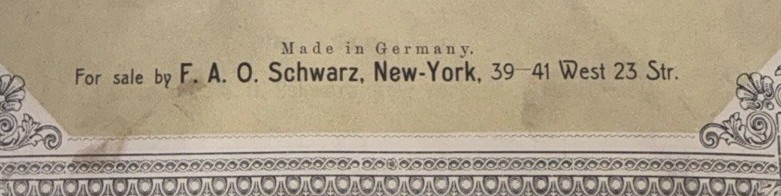
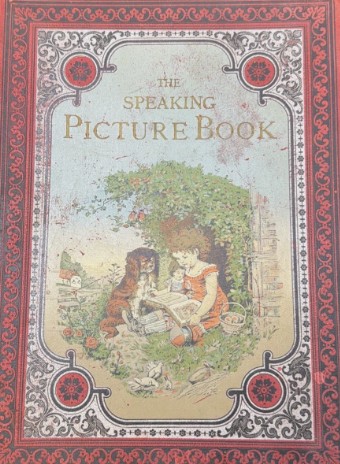
Note that: The Speaking Picture Book published by F.A.O.
Schwarz, New York, around 1893–95 - and later " The Speaking Toy Book", represents an American edition intended for
the U.S. market. Despite being distributed by F.A.O. Schwarz, a prominent
American toy retailer, this book was still manufactured in Germany. It aligns
with the original production methods and design created by Theodor Brand in
Sonneberg.
Indeed, at least some Schwarz copies stated"Made in Germany, For sale by F.A.O. Schwarz, New York."
In England, the publisher was H. Grevel & Co. - An old ad (1882) for this book in the UK states:" H. Gebhardt, located at 10, Coleman St., London, E.C. - Sole Agent for the United Kingdom." The designation "sole agent" indicates that the company was responsible for the exclusive distribution and sales of this particular book within the UK. This role typically involves marketing, sales, and distribution, rather than the actual publishing or production of the book.
Grevel edition:
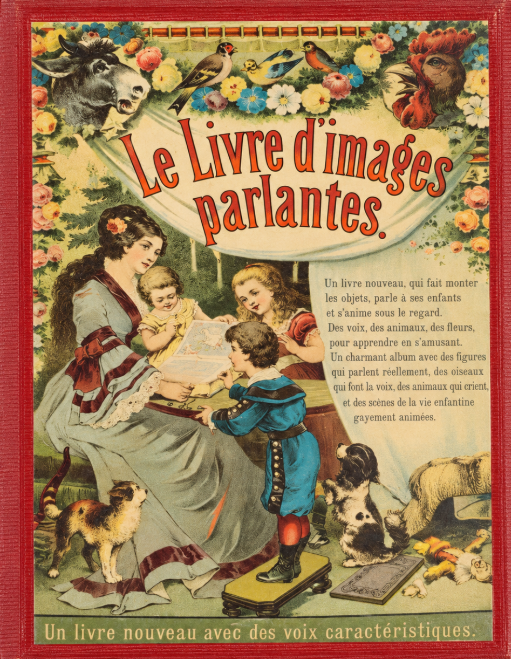
The French title
is
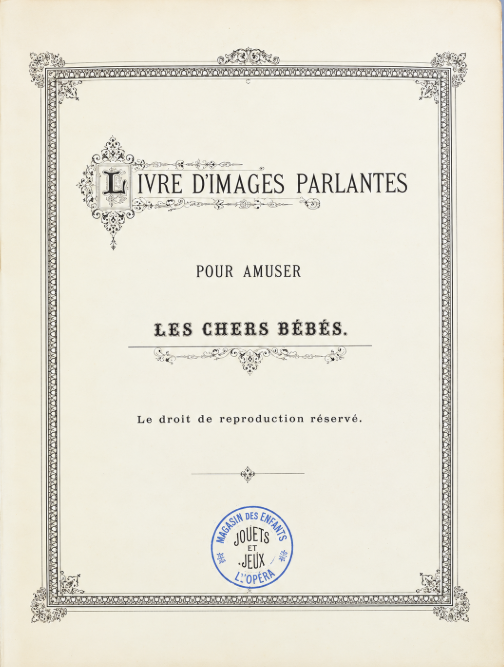
Le Livre d'images parlantes. Published by Kratz-Boussac, Paris French Edition and the CK-B Attribution: The French edition, Le Livre d’images parlantes does not identify a publisher on its title page. The Morgan Library & Museum, however, catalogs its copy as [Paris: CK-B, ca. 1880], noting specifically that it's book’s cover bears the imprint although the title page does not. CK-B is associated with Henri-Othon Kratz-Boussac, whose Paris concern marketed patented inventions and toys under the K-B Paris name; contemporary bibliographical sources also associate Kratz-Boussac with Le Livre d’images parlantes. Jacques Desse describes this French version as printed and assembled in Nuremberg, c.1885, by an unidentified publisher. Meanwhile, the Strasbourg collection attributes its example to Kratz-Boussac. Thus, while the title page itself is anonymous, It is probable that the French issue can be attributed to CK-B (Kratz-Boussac), Paris, on the basis of surviving imprinted copies and institutional cataloging.
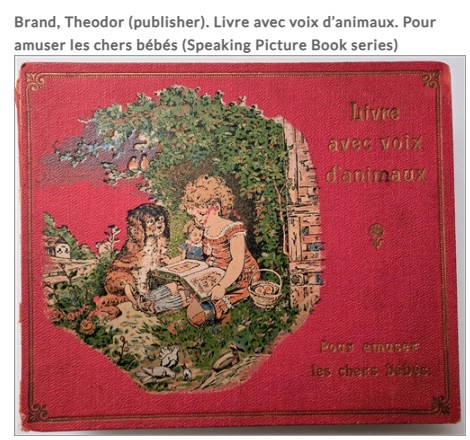
We have also seen another title in French: Livre Avec Voix D’animaux - an older ornate Art Nouveau one and a later smaller red cover one (similar to The Speaking Toy Book) - both published by Brand
A later French Title Livre avec voix d’animaux. Pour amuser les chers bébés. [Germany, ca. 1911]. French-language edition is shown here. Rare French edition 1911This smaller format was developed for broader export markets, and its English counterpart was issued as The Speaking Toy Book in the early 20th century.
The Dutch title is Het Sprekende Prentenboek.
Initially published in 1880 by Sijthoff from Leiden, the book was later sold to
D. Bolle from Rotterdam, who released a different edition under his own imprint
in November 1881. The Dutch version differed significantly from the original
German edition. It featured six plates instead of the original eight and
included only two cords to pull, reducing the number of sounds compared to the
original nine. This version is often described as a "poor substitute"
for the more elaborate edition produced by Theodor Brand in Sonneberg. These
adaptations aimed to make the book more affordable, but in doing so, much of
the richness and interactive features of the German edition were lost. The image below is
Courtesy of: Nationaal Archief, via Het Geheugen Source URL:Het sprekend prentenboek
As of this update,we have been unable to locate a Spanish
edition. Collectors, please chime in
😊
Design and Functionality
The Sprechende Bilderbuch was not a traditional book
but rather a blend of book and toy. The majority of its structure was taken up
by a wooden box containing mechanical components, with only a small section
dedicated to written text and illustrations. Each sound was generated by a
small bellows mechanism that was activated by pulling a string. When the string
was released, the air was pushed out by a spring, creating realistic animal
sounds through various modulating tools. The pull strings often featured handles made of bone or ivory, and the covers were typically bound in high-quality red cloth with stamped gold lettering
The original German book consisted of nine double-page spreads. On each spread, the left-hand page featured an illustration, while the right-hand page presented a short poem. A horizontal line printed on the page indicated which string should be pulled to activate the corresponding sound. Each illustration was explicitly paired with the poem on the facing page. Along the margins, small arrows pointed directly to the appropriate pull-tab, guiding the reader to trigger the sound at precisely the intended moment in the narrative.
The 9 voices included:
Rooster, Donkey, Lamb, Bird's Nest,Cow, Cuckoo, Goat, Mama, Papa The sides of the book appear to be a thick stack of gilded pages, but was actually a three-dimensional wooden casement decorated with ornate carvings painted in gold. These carvings served a dual purpose: they were aesthetically lavish and acted as acoustic vents for the sound to escape.
Theodor Brand simply called his company by his name - here is his logo: (Note Logo varied with International Editions)
Development and Evolution
The earliest editions of Das Sprechende Bilderbuch combined simple, child-friendly verses—likely written by Theodor Brand’s mother—with illustrations by the painter J. Gottfried Franz (1845–1905). These first versions were deliberately straightforward in both content and presentation. Their color lithographs were produced by the renowned Art-Anstalt von E. Hochdanz in Stuttgart, reflecting the high production values associated with Brand’s earliest releases.
As the book evolved, both its literary and visual ambitions expanded. By the 16th edition, published around 1906, the intended audience had clearly broadened. The emphasis shifted away from short children’s rhymes toward a more substantial anthology of poems and narrative texts. Contributions now came primarily from well-known contemporary authors, including Johannes Trojan (1837–1915), Pauline Schanz (1828–1913), and Frieda Schanz (1859–1944). This transformation marked a deliberate effort to reposition the book from a purely juvenile novelty toward a more sophisticated family entertainment.
Design developments followed a dual trajectory. On the one hand, illustrations and layouts became increasingly elaborate, often reflecting the Art Nouveau aesthetic that dominated the early twentieth century. On the other hand, Brand also introduced simplified formats aimed at reaching a wider and more cost-conscious market. A notable example is the smaller, landscape-format edition titled Bilderbuch mit Tierstimmen. Zur Unterhaltung für die kleine Welt (“Picture Book with Animal Voices for Entertainment for the Little World”), identified as the 17th edition and published around 1907. This version featured simpler illustrations and a reduced number of sound mechanisms, making it both more accessible and more affordable. Its drawstrings activated the sounds of the cuckoo, sheep, birds’ nest, kitten, goat, and rooster. Two sizes were offered: a smaller format measuring approximately 22 × 18 cm with six sounds, and a larger version at 31 × 25 cm featuring nine sounds.
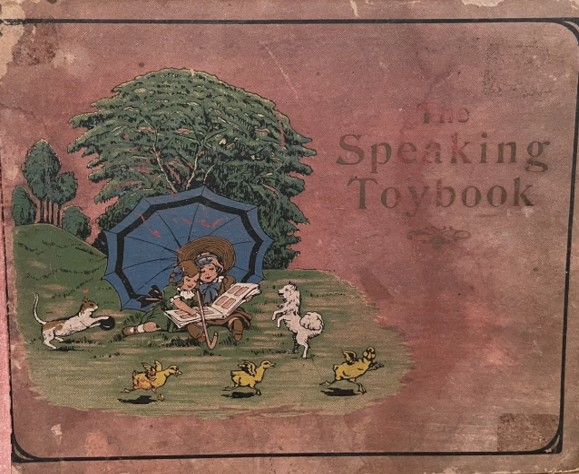
Parallel to these domestic developments, Das Sprechende Bilderbuch was also adapted for international markets. An English-language export version titled The Speaking Toy Book, characterized by a red cloth binding with gold lettering and chromolithographed cover art, was produced specifically for English-speaking audiences. While this format has often been associated with a later export phase after 1910, contemporary American trade advertising complicates this assumption.
A Frederick A. Stokes Company advertisement published in The Book Buyer (vol. 10, p. 563) in 1893 already promotes a Speaking Toy Book featuring mechanically produced animal and infant sounds identical to those described in Brand’s invention. This evidence demonstrates that the title The Speaking Toy Book—using “Toy” rather than “Picture”—was in circulation in the United States by the early 1890s. Rather than contradicting the later export chronology, the advertisement indicates that American distribution under a localized title began earlier than previously assumed, likely through licensed publication or distribution arrangements with Frederick A. Stokes Company in New York.
The later history of the book’s production, ownership, and technological adaptation after Brand’s death is discussed below in the Legacy and Aftermath section.
Marketing and Reception
The Sprechende Bilderbuch was widely praised for its
innovative combination of art, literature, and mechanical sound. An article
from
Illustrirte Zeitung (Volume 73, 1879) described it as a
"masterpiece" of Thuringian craftsmanship, bringing simple
illustrations and texts to life with authentic sounds. The book served as both
an educational tool and a source of entertainment, making it popular among
children and adults alike. It was originally advertised for children from one
to four years old.
The English edition, introduced in 1879, was advertised in
various publications like
Papierzeitung (Volume 4, Page 691, 1879). An
ad described the book as a "highly original novelty" featuring nine
distinct voices. The book was sold in elegant wooden cases priced at M. 10.50,
with significant pre-orders from wealthy customers.
In the lead-up to Christmas 1880, Johannes Trojan, a German
writer and editor, published an anonymous laudatory essay in the
"National-Zeitung" about
Das Sprechende Bilderbuch (The
Speaking Picture Book). His review likely contributed to the book's significant
sales during that period. Trojan praised the authenticity of the sounds,
particularly those of the cuckoo, cow, and nestlings, noting the effort
invested in their production. His positive review in a prominent publication
like the "National-Zeitung" likely enhanced the book's popularity
during the holiday season.
According to Buch- und Kunst-Katalog (compiled by
Adolph Russell, 1881), the German edition sold 1,000 copies within the first
eight weeks of release, showcasing its immediate popularity.
The Sprechende Bilderbuch was available in two
formats: a more affordable version in cardboard and a deluxe edition in an elaborately carved wooden case.
According to Deutsches Familienblatt (1880), the prices
were as follows: (Images from vintagepopupbooks.com)
Cardboard
version
: 10 Marks See this early version on right and a later cardboard version on left. See early transcribed at bottom of article
3rd edition with original wooden box - Image from the vintagepopupbooks.com collection. Inquire at [email protected]
These editions were marketed as luxury items, especially the
version in the wooden case, which was considered an elegant and durable gift.
An advertisement from
Papierzeitung (Volume 4, Page 691, 1879)
highlighted the craftsmanship of the book, emphasizing its unique combination
of art, literature, and mechanical sounds, making it a premium product for
affluent families.
*Note the inside back of the wooden box - the text consists of ads for their other products. We have translated the text for both the front and the back at the end of this article after the reference section.
Technical Details of Sound Mechanisms
In the late nineteenth century, the production of Das Sprechende Bilderbuch (The Speaking Picture Book) in Sonneberg, Germany relied on a highly specialized division of labour within the regional toy industry. Two distinct crafts were involved in the manufacture of sound-producing mechanisms: Balgmacher (bellows makers) and Stimmenmacher (voice makers). Bellows makers produced pressure-driven components primarily used in simple sound toys and so-called “bellows animals,” whereas voice makers were responsible for the far more complex pulling voice mechanisms employed in dolls and speaking picture books. The manufacture of such articulated pulling voices was geographically restricted, with Sonneberg and nearby Judenbach forming the principal centres capable of producing mechanisms suitable for book-based applications.
Early manufacturers of mechanical voices in the region included the mechanic Hensold of Neustadt and the Sonneberg modeller Christoph Motschmann. In 1857, Motschmann received a patent from the Ministry in Meiningen for a Mama/Papa voice mechanism for dolls. This invention represented an important step beyond simple sound imitation, as it enabled mechanical devices to approximate articulated human speech, significantly enhancing both realism and commercial appeal.
The pulling voice mechanisms used in speaking picture books operated through a controlled pull-and-release cycle. When the user pulled a string or knob, a miniature bellows expanded and drew air into the system. Upon release, the bellows was compressed—either by gravity or by a return spring—forcing air through internal sound-producing elements. Different animal sounds, such as those of a cuckoo, donkey, or goat, were generated by directing the airflow through metal reeds and perforated pipes of varying dimensions. Pitch and timbre were determined by the geometry of the air channel and the vibration characteristics of the reed.
For articulated sounds such as Mama and Papa, the mechanism incorporated a funnel-like articulation tract. During a single compression cycle of the bellows, the airflow was briefly interrupted in a controlled sequence, producing a two-syllable effect that approximated spoken language. In the speaking picture book, these voice mechanisms were housed within a hollow wooden box concealed inside the book block. Individual pull knobs were assigned to specific illustrations, while the box itself functioned as a resonating chamber, projecting sound outward through decorative openings along the book’s edge.
The mechanical sophistication of these pulling voice systems has attracted later scholarly attention within acoustic and phonetic research. In particular, Hoffmann and Mehnert’s study of the Kesselsche Stimm-Mechaniken, presented at the DAGA 2007 conference, examined the construction, acoustic behaviour, and historical significance of comparable mechanical voice devices used in dolls and toys. Their work situates the speaking picture book within a broader lineage of complex pre-electronic sound technologies, distinguished by mechanically controlled articulation rather than simple noise production.
Among Sonneberg voice makers, Hugo Hölbe emerges as the most prominent figure from the late nineteenth to the early twentieth century. His workshop produced a wide range of pulling and pressure voices for dolls, animals, and display objects, many of which are preserved in museum collections today. Although no surviving documentation explicitly attributes the voice mechanisms of Brand’s speaking picture books to Hölbe, his documented output corresponds closely in type, complexity, and period to those employed in such books, making his involvement plausible within the established manufacturing landscape of Sonneberg.
Collectibility
Haining, Peter (1979). Movable Books: An
Illustrated History
. New English Library Ltd. States:
‘The piece de resistance of any collection of movables, or
toy books for that matter, is surely The Speaking Picture Book (c. 1893), an
item of such charm and fascination that even the most blasé modern parents or
their children can hardly fail to be captivated by it. Stored in an ordinary
brown cardboard box, this ‘Special Book with Picture, Rhyme, and Sound for
Little People’ is a delight to handle, eye-catching in appearance, and quite
remarkably authentic in the sounds it produces.’
The book was produced in limited quantities, especially in
its original format with a wooden box. The fragility of the bellows mechanism
and the materials used (wood, fabric, and paper) mean that few intact copies
have survived. Over the years, many editions were lost, damaged, or
disassembled, making complete, functioning examples exceedingly rare.
Additionally, the British Library holds a copy of The
Speaking Picture Book
in its collection, indicating its recognized
importance in the history of children's literature and movable books. The
library notes that the book is "a rare and delightful example of a late
19th-century interactive children's book."
Legacy and Aftermath
Following Brand's death in 1911, his widow managed the business until 1919, when it was sold to Georg Möller, a prominent toy manufacturer and exporter.
After Theodor Brand's company was sold to Georg Möller in 1919. (wife Bernhardine, née Wachter) He was located at Robertstr. 34-36, in Sonneberg (a famous German toy-making town, known as the "kingdom of dolls,"or the “world capital of toys” until World War I.). Production of Das Sprechende Bilderbuch continued under Möller’s management. Möller, a prominent toy manufacturer and exporter, maintained the established formats of the book until 1929. This period saw the continued success of the book, although the designs and production methods likely reflected Möller’s influence and adaptations for changing markets.
Compared to earlier pre-war editions, books produced during the Möller period often show simplified bindings and updated illustration styles, reflecting both post-war economic constraints and changing tastes in children’s publishing. Heavier cloth boards and gilt stamping gave way to paper-over-board covers with cloth spines, while imagery became softer, more informal, and aligned with early interwar representations of childhood. Such late survivals are significantly underrepresented in institutional collections, as their cheaper construction and everyday use resulted in low survival rates, making examples like this important evidence for the continued adaptation of nineteenth-century toy-book technologies into the interwar period.
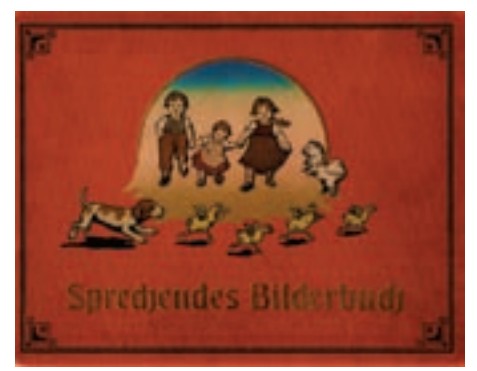
This English edition copy was possibly produced by Moller in the 1920's. It had new text and illustrations. We have seen a german editon with the same cover art titled Sprechendes Bilderbuch
Another interesting 1920s or earlier variant in German - also with the new text and illustrations appeared in Antiquariat Sabine Keune, Katalog 40: Kinderbücher. L’Experience du Bonheur, Frühjahr/Sommer 2008, listed as item 164. Duisburg, Germany. Reproduced here for educational and research purposes.
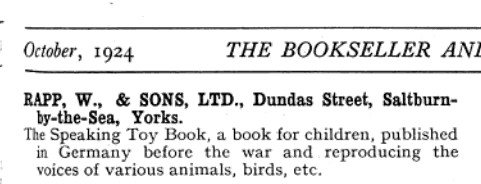
Note: Evidence of the book’s continued circulation after the First World War appears in British trade literature. The Bookseller and the Stationery Trades’ Journal (1924) lists The Speaking Toy Book as “a book for children, published in Germany before the war and reproducing the voices of various animals, birds, etc.” The entry names Rapp, W. & Sons, Ltd., of Saltburn-by-the-Sea, suggesting that the firm acted as a distributor or retailer within the British market rather than as a publisher. This reference demonstrates that the speaking book remained commercially visible in Britain well into the 1920s. By this stage, the work had reached approximately twenty editions; a copy of the 19th edition is preserved today in the Children’s and Young Adult Book Department of the Berlin State Library, catalogued under the shelfmark 53 BB 500584 R :
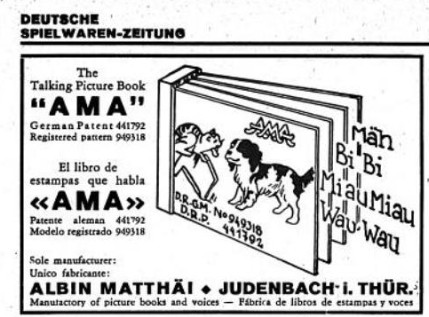
By the late 1920s, additional manufacturers, such as Albin Matthäi(AMA)in Judenbach, began producing similar sound picture books. Albin began
producing sound picture books, securing additional patents in 1928 to simplify
the manufacturing process. Albin Matthäi’s company, founded by his father Carl
Friedrich Bernhard Matthäi, initially focused on crafting sound mechanisms for
toys, dolls, and picture books. These new, cost-effective designs replaced the
earlier slide mechanisms with printed sound devices, which were inserted
between two cardboard pages. The sound was emitted through a hole aligned with
the illustration. This format remained in production well into the early 1960s. Under Matthai
Sound was generated by pull-string mechanisms enclosed between cardboard layers and released through a hole placed at the relevant point in the illustration.
Example of Matthai ad from “Deutsche Spielwaren-Zeitung.” Vol. 22, 1930, p. 47. Google Books.
Albin Matthäi’s company, founded by his father Carl
Friedrich Bernhard Matthäi, initially focused on crafting sound mechanisms for
toys, dolls, and picture books. By 1928, the company expanded, employing around
12 workers and producing novelty sound items and voice cards. Their products
reached international markets, with exports to Great Britain, Denmark,
Australia, and beyond. However, the Great Depression led to a gradual decline
in demand.
Following World War II, under East Germany’s socialist
regime, the company was restructured into a cooperative. Despite these changes,
they continued producing talking picture books until approximately 1965.
REFERENCES:
Hofmann, Ernst. The “Talking Picture Book” and Its Inventor Theodor Brand. TUDpress Study Texts on Language Communication, vol. 92. Dresden: TUDpress, 2018.
Hoffmann, Rüdiger. “Voices for Toys – First Commercial Spin-offs in Speech Synthesis.” In Proceedings of HSCR 2015. International Speech Communication Association (ISCA), 2015. https://www.isca-archive.org/hscr_2015/hoffmann15b_hscr.pdf.
(This entry consolidates the two duplicate HSCR 2015 listings.)
Hoffmann, Rüdiger, and Dieter Mehnert. “Die Kesselschen Stimm-Mechaniken.” In Proceedings of DAGA 2007 – 33. Deutsche Jahrestagung für Akustik, Stuttgart, 19–22 March 2007.
Illustrirte Zeitung. Vol. 73 (1879): 477.
Papierzeitung. Vol. 4 (1879): 691.
Buch- und Kunst-Katalog. Compiled by Adolph Russell. Leipzig, 1881.
Sonneberg address book listing for Georg Möller, toy manufacturer (“Puppenfabrikant”), Robertstraße 34. Digitised by Humboldt-Universität zu Berlin (Goobi platform)..
Haining "Movable Books", New English Library, 1979, p. 136.
*Translations of the German edition of the Speaking Picture Book title page and the inside front and back of its wooden box. From the vintagepopupbooks.com collection:
Title Page of the Book itself:
The Speaking Picture Book. A new visual medium in image, verse, and sound. For the entertainment
of the little world.
Third Edition.
(TB logo with an open book)
This picture book
has also been published in English, French, Dutch, and Spanish
and can be obtained through all book and toy stores.
Wooden box – inside front :
Third Edition. The Speaking Picture Book. Combination of Picture Book with Human and Animal Voices. Patented.
The intention of the publishers of this book is, in addition
to entertainment, to provide an educational benefit for early childhood.
Free from excess, which confuses a child's eye; from wit and caricature, which
are still beyond their understanding, this picture book is meant to create a
double bond between mother, child, and the animals—educational and entertaining
for the little ones, refreshing even for older children.
May The Speaking Picture Book in this spirit find
frequent use and benefit, remaining and staying in German households as
a welcome play companion!
Additionally, English, French, and Spanish editions have
been published.
The Speaking Picture Book is available both in a fine cardboard box and
in an elegant wooden case with a lock, and can be obtained through all book and
toy stores.
For Use.
The strings are generally to be pulled moderately quickly until resistance is
felt. The string for the cuckoo sound should be pulled somewhat faster and also
allowed to glide back in the same way. Through use, the best way to produce
each voice will easily be learned.
Pulling the strings with excessive force must be avoided.
The book should be protected as much as possible from dust, etc., and therefore
always kept in its envelope.
Inside the back of the wooden box:
The inside back page serves as an advertisement for other
toys and games produced by the same publisher. It highlights additional
products such as the "new Hurrah-Scheibe" (target game) and
"Buch-Schach" (book-chess set), describing their features and practicality.
This includes an ad for their chess set:
Latest from the publisher of the "Speaking Picture
Book": (Indispensable for every chess player.)
Book=Chess
(Patented.) A practical supplement to every chess book.
Foldable, simultaneously a chessboard and figure container,
→ with fine stone pieces. ←
Most convenient pocket size. Most charming gift item, due to
its exquisite,
unique design (Embossed Calico cover with delightful title image in gold
and black embossing) and sturdy, practical structure. Especially suitable for
traveling, for playing in a train car, on a ship, during maneuvers, etc.,
an ornament for every reading table and bookshelf.
Available in every major book and toy store and identifiable
by the vignette:
(TB logo with open book)
AD FOR ANOTHER TOY:
Translation (English):
Mechanism very solid and simple.
Design appealing and practical. Description enclosed.
Available through all book and toy stores.
(With and without foldable crossbow.)
AD FOR A SOLIDER TOY:
Translation (English):
Latest from the publisher of A unique gift for boys aged 9–12 years, successful entertainment even for
adults.
Upon a bullseye shot, a finely dressed soldier (in relief) jumps out from
behind the screen and shouts loudly and clearly, "Hurrah."
( Note: The "Hurrah" Game was a target game designed for all ages. It featured a target approximately 18 inches tall and 12 inches wide. When the bull's-eye is hit by a ball or arrow, a figure at the top springs forward and enthusiastically exclaims "Hurrah!" in a realistic manner. The game came in a cardboard box and was sold in sets.)
AD FOR A HURRAH DISK
Also published by the publisher of the Speaking Picture
Book:
The new Hurrah Disk.
(Legally protected.)
IMAGE IN THE MIDDLE:
The image in the middle of the page features a target-like
design, with concentric circles resembling a bullseye. Above the bullseye,
there is a soldier-like figure (or possibly a toy figure) depicted saluting or
raising one hand. Around the bullseye, the word "Hurrah!" is
prominently displayed in a banner-style design. The lower portion of the target
is surrounded by decorative elements, including illustrations of toys,
household objects, or scenes that add a sense of context.
This image directly relates to the accompanying text, as the
text discusses "Die neue Hurrah-Scheibe" (The New Hurrah-Disc), which
appears to be a novelty or toy mechanism likely designed for entertainment,
possibly a target-shooting game. The "Hurrah!" inscription and the
image of the soldier suggest a theme of celebration or triumph. Based on the
description of mechanisms and accessories, this could be an interactive feature
of a toy or game, where hitting the target or activating a specific mechanism
would produce a sound or visual effect such as the exclamation
"Hurrah!".
EARLY CARDBOARD COVER TRANSCRIPTION
THE SPEAKING PICTURE-BOOK.
COMBINATION OF A PICTURE-BOOK WITH HUMAN AND ANIMAL SOUNDS.
Patented
in GREAT-BRITAIN, UNITED STATES, GERMANY, AUSTRIA a. o.
The aim of the editors of this new book is besides amusement, an educational one for prime age.
Free from surfeit which is misleading the eye of the child, from wit and caricature still alien to the understanding of the same, this picture-book is to present a collection of dialogues between mother, child and animal, both instructive and entertaining for children and amusing for the adult.
May therefore this picture-book find use in many families and prove to be a constant friend and play-fellow of the same.