The Speaking Picture Book (Das Sprechende Bilderbuch) Includes the publisher-issued cardboard box, rarely found intact, with a printed label on the lid.
Theodor Brand, Sonnenberg, Germany, [circa 1889]. Early Tenth Edition.
Description:
Large oblong quarto. Original red cloth boards decoratively stamped in gilt and black with beveled edges and brass cornerpieces, housed in the original wooden sound box, with eight functioning ivory-handled pull cords. Complete with the original publisher’s cardboard box bearing the printed label “Speaking Picture Book.”
Contains 8 exquisite chromolithographed plates, each paired with a verse and operated by a corresponding pull-string bellows that reproduces animal sounds. Sounds include the cuckoo, rooster, goat, cow, dog, baby birds, cat, and lamb.
Condition:
Near Fine. All eight bellows present and fully functional with clear, remarkably well-preserved sounds—a rarity in books of this kind. One ivory pull professionally replaced using an original from another period example. Inner pages clean and bright with no writing, foxing, or tears. Spine and hinges intact with only minor wear at the extremities.
The outer cardboard box—seldom found with these books—is complete, though worn at the edges with corner splits and surface soiling consistent with age. Label fully legible.
Collector’s Notes:
This is one of the earliest known tenth edition copies of The Speaking Picture Book to appear on the market in recent years. Even more exceptional is the survival of both the original wooden housing and the scarce cardboard shipping box, referenced in an 1882 publisher advertisement offering the book in "cardboard case or elegant wooden box." Most extant copies lack either or both components.
It's original cardboard box included with this copy : 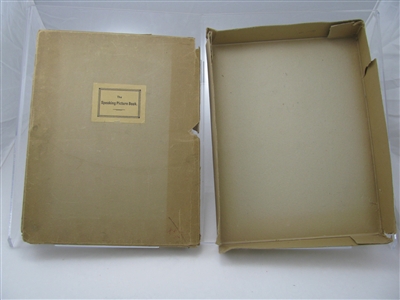
Collector's Corner:The Speaking Picture Book is thought to be the earliest interactive sound book.
The earliest editions came in either a cardboard box or a hand-carved wooden box.
Almost all SPB's seen on the market are without their original cardboard or wooden case.
Vintagepopupbooks.com has one each - with its cardboard box and its wooden box available to view on this site.
To see our offering with the original wooden box see our other book listings
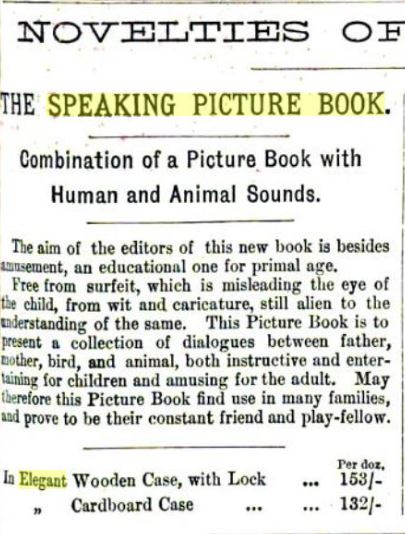
The ad copy below is from Perry & Co's monthly illustrated price current Volume 15, 1882 page 141
THE SPEAKING PICTURE BOOK.
Combination of a Picture Book with Human and Animal Sounds.
The aim of the editors of this new book is besides amusement, an educational one for primal age.
Free from surfeit, which is misleading the eye of the child, from wit and caricature, still alien to the understanding of the same. This Picture Book is to present a collection of dialogues between father, mother, bird, and animal, both instructive and entertaining for children and amusing for the adult. May therefore this Picture Book find use in many families, and prove to be their constant friend and play-fellow.
In Elegant Wooden Case, with Lock ... Per doz. 153/-
Cardboard Case ............................. 132/-
Learn more in our in-depth research article on this site detailing the historical background of The Speaking Picture Book.
Quick Bio:
The Speaking Picture
Book was first produced in Nuremberg, Germany, by publisher
Theodore Brand, the book’s inventor. Brand obtained a German patent for the
book in 1878, and a British patent followed a year later. In addition to the
German edition, English, French and Spanish editions were published.
According to
deadmedia.org, “This Victorian toy,
primitive though it is, is probably still the best synthetic speech toy to
reach the market, and was certainly the predecessor of the Vocoder and of
modern electronic voice synthesizers.”
‘The piece de resistance of
any collection of movables, or toy books for that matter, is surely The
Speaking Picture Book (c. 1893), an item of such charm and fascination that
even the most blasé modern parents or their children can hardly fail to be captivated
by it. Stored in an ordinary brown cardboard box, this ‘Special Book with
Picture, Rhyme, and Sound for Little People’ is a delight to handle,
eye-catching in appearance, and quite remarkably authentic in the sounds it
produces.’
(Peter Haining, Movable Books An Illustrated History,
New English Library Ltd., 1979)