MILTON BRADLEY'S THE HISTORISCOPE: A PANORAMA & HISTORY OF AMERICA
With Original Crank, Original Lecture Papers, and Original Box
Springfield, Massachusetts: Milton Bradley & Co., circa 1880
An exceptionally complete example of Milton Bradley's celebrated Historiscope: A Panorama & History of America, one of the most ambitious and historically important educational panorama toys produced in nineteenth-century America.
The Historiscope consists of a continuous hand-colored lithographed panoramic strip, measuring approximately 144 inches (12 feet) in length, mounted on original wooden rollers and housed within its original theater-form viewing box. Operated by means of the original metal crank key (present here), the panorama presents a chronological visual history of America through 24 vividly hand-colored scenes ( a few of them shown in images), beginning with Native American life and early European exploration, progressing through colonial settlement and the American Revolution, and concluding with the surrender of Cornwallis at Yorktown in 1781.
What distinguishes this example is its remarkable state of completeness. In addition to retaining the original viewing apparatus and crank, this Historiscope also includes the original printed 8 page "Historiscope Lecture" papers, intended to be read aloud during the presentation. These scarce lecture sheets transformed the Historiscope from a mere amusement into a complete Victorian educational performance experience, allowing families to stage a narrated historical exhibition in the home decades before the advent of motion pictures.
The original lecture includes the humorous introductory remarks of "Prof. Easelpalette," detailed narration for the historical scenes, and concluding instructions for presenting the exhibition. Surviving examples of the Historiscope frequently lack these ephemeral components, making their presence here especially noteworthy.
Contents:
Original theater-form viewing box
Original top and bottom box sections
Complete hand-colored panoramic strip (approximately 144 inches)
Original crank key
Original printed "Historiscope Lecture" papers
Dimensions of box: approximately 8¼ × 5½ × 2⅜ inches.
Condition:
Very good overall condition. The panorama remains bright and colorful. The box exhibits expected age-related wear consistent with use and survival over nearly 150 years. Please review all photographs carefully, as they constitute part of the description.
The Historiscope occupies an important position in the history of visual entertainment, educational publishing, panorama exhibitions, and pre-cinema media. Complete examples retaining their original instructional materials are increasingly difficult to obtain.
A rare opportunity to acquire one of America's most iconic nineteenth-century educational and optical amusements in an unusually complete state of preservation.
Note: Video shown for demonstration purposes only and depicts another example of the Milton Bradley Historiscope in operation. The item offered for sale is shown in the still photographs. The video is a wonderful presentation by Director of Education Stacia Smith at the American Revolution Institute.
Collector's Corner:
(Historical interest only — item available for sale described above)
The Historiscope occupies a fascinating position between fine art and popular culture. Many of its scenes were adapted from celebrated paintings, engravings, and chromolithographs familiar to nineteenth-century audiences, transforming works of fine art into a form of mass-produced educational entertainment. Rather than documenting the past itself, the Historiscope preserves the way nineteenth-century Americans chose to remember and commemorate their national history. It represents an important stage in the history of moving images. Like the thaumatrope, phenakistoscope, zoetrope, and magic lantern, it offered audiences a form of visual storytelling that was simultaneously static and dynamic, episodic yet immersive.
Description of the scenes and the lecture:
(This descripton incorporates historical research and interpretive information published by the American Revolution Institute of the Society of the Cincinnati: "The Historiscope by Milton Bradley & Co.", including discussion of the panorama scenes, accompanying lecture, and the role of the Historiscope in nineteenth-century historical education. Additional information was consulted from the American Revolution Institute's video presentation, The Historiscope: A Complete Panorama of America and from The Huntington Library's discussion of the Historiscope as an early educational panorama toy.)
The Historiscope presents a sweeping visual narrative of American history through twenty-four hand-colored lithographed scenes arranged on a continuous panorama. The first half of the exhibition traces the discovery and settlement of America, beginning with Christopher Columbus and proceeding through such iconic episodes as the exploration of the Mississippi River, Henry Hudson's discovery of the Hudson River, the founding of Jamestown, Pocahontas saving Captain John Smith, the landing of the Pilgrims, William Penn's treaty with Native Americans, and the famous Charter Oak of Connecticut. Many of these scenes were adapted from well-known nineteenth-century historical paintings and engravings that would have been immediately recognizable to contemporary audiences.
The remaining twelve scenes shift to the American Revolution, presenting the events and personalities that nineteenth-century Americans regarded as the defining moments of the nation's founding. Familiar scenes include the Boston Tea Party, the Battles of Lexington and Concord, the Battle of Bunker Hill, the hardships endured at Valley Forge, the capture of Major John André, and the surrender of Lord Cornwallis at Yorktown. Several of these compositions were derived from celebrated historical artworks, including works by artists such as John Trumbull and Asher B. Durand, whose images helped shape popular memory of the Revolution.
Equally fascinating are the scenes that were widely celebrated during the nineteenth century but have largely faded from modern historical memory. The panorama includes the failed American assault on Quebec and the Battle of Fort Sullivan (later Fort Moultrie), events remembered at the time for the heroism of figures such as General Richard Montgomery and Sergeant William Jasper. Also represented is General Israel Putnam's dramatic escape at Horseneck, a celebrated episode of Revolutionary folklore frequently illustrated in nineteenth-century prints. The inclusion of the Bunker Hill Monument, completed in 1842, further demonstrates that the Historiscope was intended not merely to recount historical events, but to present the nineteenth century's own understanding and commemoration of America's past.
Viewed today, the Historiscope offers more than a visual history lesson. It serves as a remarkable window into how Americans of the late nineteenth century understood their national origins, transforming historical memory into a theatrical, educational, and interactive experience for the Victorian parlor.
he Historiscope Lecture: A Victorian Home Performance Script
Among the most fascinating and elusive components of the Historiscope is the original eight-page printed lecture that accompanied the panorama. Far more than a simple guide to the images, the lecture functioned as a complete performance script, intended to be delivered by a child or family member while the panorama slowly unfolded before an audience.
The publishers encouraged presenters to memorize the text rather than read it directly, explaining that doing so would better impress the historical facts upon the memory. Once the lecture became familiar, children were encouraged to prepare their own original presentations and take turns conducting the exhibition. The instructions even suggested enhancing the performance with short musical selections played on the piano to accompany the various scenes, transforming the Victorian parlor into a miniature historical theater.
The lecture itself reveals much about how nineteenth-century Americans understood their national history. The transition from colonial America to the Revolutionary era, for example, is introduced with the lighthearted remark: "We will now return to Boston to attend a little tea party." The Battles of Lexington and Concord are described as "a most spirited representation of the first blow for liberty," while the suffering endured by Washington's army at Valley Forge is recounted in vivid and emotional terms. The dramatic escape of General Israel Putnam at Horseneck is similarly celebrated, with Putnam described as having "put spurs to his horse and plunged down a precipice" to evade British pursuit.
Throughout the lecture, historical instruction is balanced with humor and theatricality. The narrator periodically breaks the fourth wall, acknowledges the limitations of the performance, and injects humorous observations intended to entertain the audience as much as educate them. The conclusion is particularly charming, with the lecturer admitting that the presentation, "although perhaps somewhat dry, will not do one of you any harm if you remember every word of it," before recommending further study in contemporary histories of the United States—provided, of course, that the latest issue of the New York Ledger is unavailable.
The survival of the original Historiscope Lecture is especially significant because it demonstrates that the Historiscope was conceived not merely as a toy, but as a fully immersive educational and theatrical experience. Combining moving images, historical narrative, performance, humor, and audience participation, it stands today as one of the most sophisticated examples of nineteenth-century American educational entertainment and an important precursor to later forms of visual storytelling and popular media.
About the Publisher: Milton Bradley (1836–1911)
Few names are more revered in the history of American toys and games than Milton Bradley (1836–1911). Although remembered today primarily for board games, Bradley was one of nineteenth-century America's most innovative creators of educational amusements. A draftsman, lithographer, educator, and entrepreneur, he believed that play could serve as a powerful tool for learning and moral development. Bradley was also deeply interested in the educational value of color and later developed standardized color systems, educational papers, crayons, and instructional manuals for schools. The vivid hand coloring of the Historiscope reflects his broader commitment to aesthetic education. As James J. Shea observed in It's All in the Game: The Life and Times of Milton Bradley (1960), "The impulse to serve was as strong in Milton Bradley as the desire to sell."
After establishing a successful lithography business in Springfield, Massachusetts, Bradley entered the toy and game industry with the publication of The Checkered Game of Life in 1860. Influenced by the educational philosophy of Friedrich Froebel and the American kindergarten movement, Bradley expanded his interests beyond games into educational materials and visual learning devices. The Historiscope: A Panorama and History of America represents the culmination of these interests, combining art, history, mechanics, and pedagogy in a single object.
Beautifully illustrated and mechanically ingenious, the Historiscope transformed the nineteenth-century parlor into a miniature theater. Through a continuous hand-colored panorama, children and adults alike experienced a visual narrative of American history while participating in a shared educational performance. The accompanying lecture encouraged children not merely to view the scenes, but to memorize, perform, and even compose their own historical narratives.
Today, the Historiscope is recognized as an important example of pre-cinema visual culture, alongside devices such as the thaumatrope, phenakistoscope, magic lantern, and peepshow. It occupies a unique position at the intersection of toy history, educational history, panorama studies, Americana, and the history of moving images. More than a toy, the Historiscope was a Victorian multimedia experience—one that transformed historical education into theatrical performance.
Collect All Six of Milton Bradley's Nineteenth-Century Panoramas
Milton Bradley & Company produced six unique moving panorama toys during the 19th century. These inventive parlor amusements combined theatrical presentation, narrative history, and hand-colored lithography—each designed as both entertainment and education for American households. Collectors and historians regard them as important artifacts of post-Civil War toy culture and early visual storytelling.
-
The Myriopticon: A Historical Panorama of the Rebellion (Civil War Scenes, 1866)
Bradley’s first panorama and perhaps the most historically significant, depicting 22 scenes from the American Civil War.
-
The Historiscope: A Panorama & History of America (1868)
A patriotic toy presenting key moments from American history, such as the landing of the Pilgrims, Revolutionary War battles, and the signing of the Declaration of Independence. This was a broader national history counterpart to the Civil War-specific Myriopticon.
-
Panorama of The Visit of Santa Claus to the Happy Children (1873)
A festive holiday-themed panorama showing Santa Claus delivering gifts and children at play. This was one of Bradley’s most charming entries, reflecting the era’s growing emphasis on Christmas as a domestic celebration.
-
Bradley's Historiscope (1882)
A revised and simplified version of the earlier Historiscope. While less elaborate, it remained educational and retained much of the patriotic theme of the original 1868 version.
-
The Menagerie and Aquarium (1882)
A two-sided panorama housed in a rolling “cage on wheels,” with zoo animals depicted on one side and fish swimming on the other. A delightful toy blending natural history with mechanical ingenuity.
-
Bible Panorama (1893)
A religiously themed panorama illustrating scenes from the Bible, intended to provide moral instruction alongside entertainment.
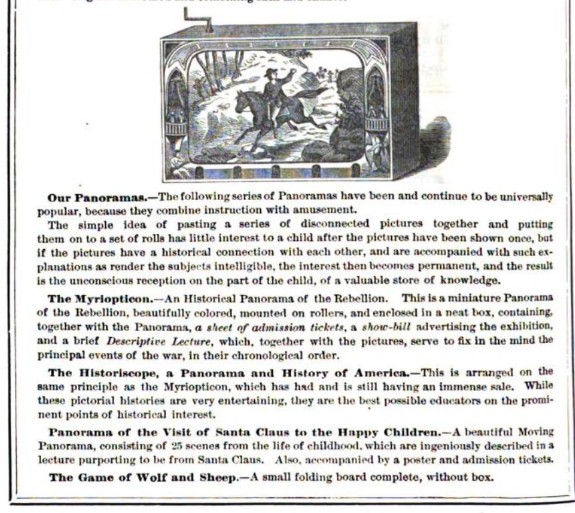
The image below is an 1873 ad for Milton Bradley first 3 panoramas.” In The Uniform Trade List Annual, p. 18, F. Leypoldt & Co., 1873. Available on Google Books
References
Balzer, Dick. "Toy Panoramas." Dick Balzer Collection. Accessed June 29, 2026.
https://www.dickbalzer.com/Toy_Panoramas.669.0.html
Brammer, Robert, and Nathan Dorn. "The Myriopticon, A Historical Panorama of the Rebellion." In Custodia Legis: Law Library of Congress Blog, April 14, 2017.
https://blogs.loc.gov/law/2017/04/the-myriopticon-a-historical-panorama-of-the-rebellion/
Brownlee, Peter John, Sarah Burns, Diane Dillon, Daniel Greene, and Scott Manning Stevens. Home Front: Daily Life in the Civil War North. Chicago: University of Chicago Press, 2013.
"The Civil War in Art: Teaching and Learning through Chicago Collections." Accessed June 29, 2026.
https://civilwarinart.org
Huhtamo, Erkki. Illusions in Motion: Media Archaeology of the Moving Panorama and Related Spectacles. Cambridge, MA: MIT Press, 2023.
———. "The Moving Panorama: A Media-Archaeological Approach." Unpublished manuscript, 2002. Available via gebseng.com.
The Huntington Library, Art Museum, and Botanical Gardens. "A Look at the Historiscope." Verso. Accessed June 29, 2026.
https://www.huntington.org/watch-read-listen/verso/look-historiscope
Marten, James. "History in a Box: Milton Bradley's Myriopticon." The Journal of the History of Childhood and Youth 2, no. 1 (Winter 2009): 3–7.
https://doi.org/10.1353/hcy.0.0042
McClintock, Inez. Toys in America. Washington, D.C.: Public Affairs Press, 1961.
Milanick, Margaret Fairgrieve. "Big Ideas in Little Boxes: Nation-building in Three Nineteenth-Century American Parlor Games by Milton Bradley & Company." In Buying & Selling Civil War Memory in Gilded Age America, edited by James Marten and Caroline E. Janney, 189–205. Athens: University of Georgia Press, 2021.
———. Big Ideas in Little Boxes: Nation Building in Three Nineteenth-Century American Parlor Games by Milton Bradley & Company. PhD diss., University of Missouri–Columbia, 2020.
Peterson, Jennifer Lynn. "The Historiscope and the Milton Bradley Company: Art and Commerce in Nineteenth-Century Aesthetic Education." Getty Research Journal 6 (2014): 175–184.
https://doi.org/10.1086/675800
Shea, James J. It's All in the Game: The Life and Times of Milton Bradley. New York: G. P. Putnam's Sons, 1960.
"The Toys of War." The New York Times, February 27, 2014.
The Old Farmer's Almanack. 1866 ed., p. 59.
"Milton Bradley Panoramas." In The Uniform Trade List Annual, 18. New York: F. Leypoldt & Co., 1873. Available via Google Books.
Yale Center for British Art. "Milton Bradley's Myriopticon." Collection record. Accessed June 29, 2026.
https://collections.britishart.yale.edu/catalog/orbis:6766745