The Movable Picture Books of J. F. Schreiber: Beyond Meggendorfer
An annotated working checklist of non-Meggendorfer movable and interactive publications, approximately 1865–1954.
By Jo Tisinger | VintagePopUpBooks.com October 2026
The German publishing firm J. F. Schreiber, established in Esslingen in 1831, is perhaps best known among collectors of movable books for its celebrated publications by Lothar Meggendorfer. Less widely recognized is the firm's extensive production of movable and three-dimensional picture books by other artists, some dating from well before its association with Meggendorfer.
These publications demonstrate a remarkable variety of paper-engineering techniques, including pull-tab mechanisms, folding transformations, revolving pictures, layered theatrical scenes, and elaborate stand-up constructions.
The following checklist brings together known J. F. Schreiber movable books excluding those by Lothar Meggendorfer, which have already been extensively documented elsewhere.
The checklist was compiled through research in contemporary exhibition catalogs, nineteenth-century reviews, publishers' advertisements, historical library collections, specialist bibliographies, and surviving copies. Publication dates, illustrator attributions, and descriptions of movable mechanisms have been compared across available sources wherever possible. A detailed list of the principal references and research materials appears in the References and Bibliography section below.
Where available, entries include publication dates, artists, descriptions of the movable mechanisms, and other bibliographic details. As some titles appeared in multiple editions and others remain poorly documented, this checklist should be regarded as a developing reference rather than a definitive bibliography. Additional information and corrections are welcome.
-
Schreiber's Grosses Puppentheater — Schreiber's Great Puppet Theater. Approximately 1864–1865. Original illustrations: Carl von Häberlin. One of Schreiber's earliest mechanical picture books, featuring hand-colored illustrations operated by pull-tabs. A Swedish edition of 1866 contains nine movable plates. A revised German edition appeared around 1890 as Grosses Puppentheater. Ein lustiges (auf dem Einband lebendiges) Bilderbuch, publisher number 39, with six chromolithographed movable illustrations redrawn by Paul Hermann Wagner and ten original short comedies. The revised edition also has supplementary black-and-white illustrations by Lothar Meggendorfer; its principal movable illustrations, however, are Wagner’s. The Swedish edition of 1866 was co-published in Esslingen and Stockholm by J. F. Schreiber and L. Lamm under the title Stor utomordentlig Kasper-Teater med manga lefvande kolorerade gubbar.
-
Nehmt's zu Herzen! — Take It to Heart! Approximately 1865. Illustrations: Carl von Häberlin. A moral transformation book containing six illustrated plates with twelve contrasting compositions. Its mechanisms transform one scene into another to illustrate children's behavior and its consequences. The 1883 review records a fourth edition and an original price of 3 marks.
-
Neues Verwandlungs-Bilderbuch — New Transformation Picture Book. Approximately 1875. Original lithographic drawings: Wilhelm von Breitschwert. Six chromolithographed transformation pictures with folding flaps that change the illustrations. The scenes humorously depict children's adventures and mischief, including Pride Comes Before a Fall, The Great Dragon, and The Unmasked Ghost. A second edition is documented around 1880. The surviving catalog descriptions reviewed so far do not securely establish a publisher number, complete collation, or the remaining three scene titles; these are therefore not supplied.
-
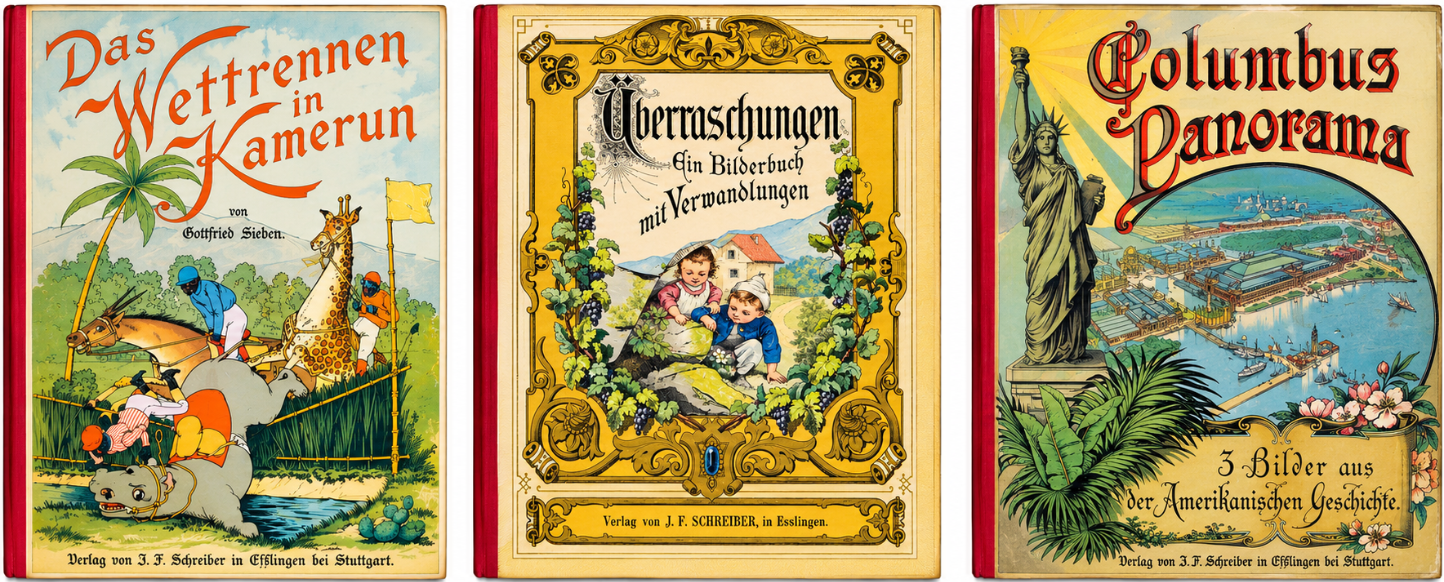
Überraschungen. Ein Bilderbuch mit Verwandlungen — Surprises: A Picture Book with Transformations. First documented by 1877. Illustrator: not established. A transformation picture book incorporating folding illustrations. The exact title and subtitle appear in the 1877 Nuremberg exhibition catalog under J. F. Schreiber. A surviving copy contains six transformations. The Staatsbibliothek zu Berlin digitizes a copy whose cover reads Ueberraschungen and whose title page reads Neue Ueberraschungen. This establishes title variation within at least one surviving copy, but does not by itself establish whether the 1877 catalog entry represents a separate edition or work; comparison of the six scenes and publication evidence remains necessary.
-
Neue Ueberraschungen — New Surprises. 1877. Original lithographic drawings: Wilhelm von Breitschwert. Six color-lithographed double pictures with folding transformations depicting humorous scenes of childhood. The title page explicitly credits Breitschwert for the original lithographic drawings. The book is described in an 1883 review as containing six double pictures illustrating children's activities. Original price: 2 marks.
-
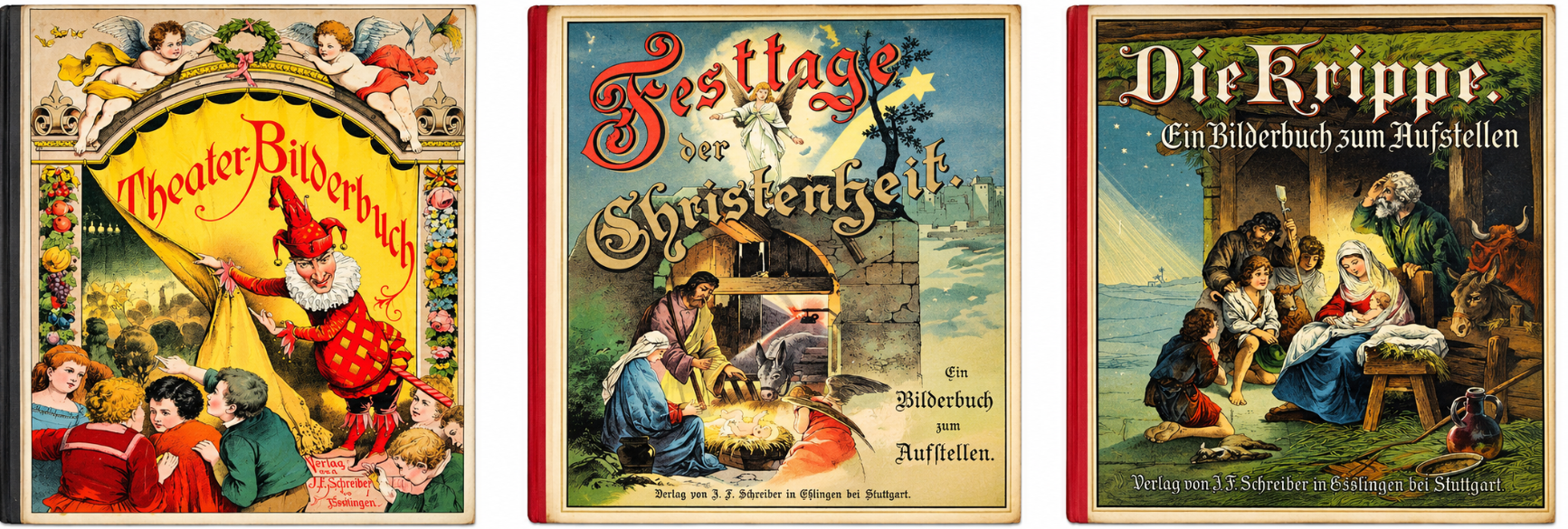
Theater-Bilderbuch. Vier Scenen für das Kinderherz — Theater Picture Book: Four Scenes for Children's Hearts. First edition, 1878. Text: Franz Bonn; illustrator not established. Four chromolithographed theatrical constructions, each with four scenic layers in a theater frame and a foreground orchestra of child musicians (angels in the Christmas scene), depicting Christmas Eve, the Three Wise Men, Hansel and Gretel, and Little Red Riding Hood. The scenes open to form miniature theaters and are accompanied by dramatic verses or dialogue. A second edition is recorded in 1882, a third improved edition in 1883, and a fourth edition in 1888, although these edition dates warrant comparison against surviving title pages.
-
Lebende Bilder. Vier perspectivische Scenen zur Ergötzung und Freude der Kinderwelt — Living Pictures: Four Perspective Scenes for the Amusement and Delight of Children. Approximately 1880. Text: Franz Bonn; illustrator not identified. Four theatrical scenes that open into three-dimensional settings. The four scenes are Die Menagerie, Im Circus, Das Kasperltheater, and Vor dem Tore. The puppet theater has a rear revolving disc to change its stage settings; Vor dem Tore depicts children playing on five spatial levels before a village backdrop.
-
Klipp-Klapp! Heitere Verwandlungen zur Ergötzung der Kleinen — Clip-Clap! Merry Transformations for the Amusement of Little Ones. Approximately 1880. Illustrations: C. Beisel. Six chromolithographed double pictures with folding picture strips that transform the central illustrations. The scenes depict humorous childhood activities, including kite flying. Two plates are signed Beisel. Geisenheyner catalog no. 80 describes the publication as exceptionally rare.
-
Schreibers Kasperlespiele — Ziehfiguren / Kasperltheater — Schreiber's Punch-and-Judy Theatre: Pull Figures. Approximately 1880 (date provisional). Illustrator: not established. Four hand-colored lithographed figure sheets, Schreiber plate numbers 581, 582, 587, and 588. The figures were intended to be cut out, mounted on wood, and animated by thread, in the manner of articulated jumping jacks (Hampelmänner). Two figure sequences, designated B and C, are reported under the same plate numbering. Included as an interactive Schreiber paper publication; the exact packaging, issue date, and completeness of surviving sets require verification.
-
Zerlegbare Abbildungen des inneren Theils des Menschen — Dissectible Illustrations of the Internal Parts of the Human Body. 1880. Author: Theodor Eckardt; illustrator not identified. Published as Volume VIII of Bilder zum Anschauungs-Unterricht für die Jugend. Contains a large color-lithographed anatomical illustration with movable folding sections revealing the internal organs, muscles, ribs, and respiratory system. Accompanied by explanatory text. Geisenheyner catalog no. 256 identifies it as a first and only edition. Related nonmechanical publication: Eckardt's Der Bau des menschlichen Körpers. Anatomische Beschreibung des Menschen (1879) contains 24 anatomical plates, including five folding plates. It is not counted separately because the available description does not establish comparable movable anatomical layers.
-
Grosse Menagerie. Heute und jeden Tag, so oft man's sehen mag — Great Menagerie. Approximately 1882, with later versions. Illustrator: not established. An elaborate three-dimensional animal picture book featuring six pop-up scenes and, in an early version, six additional hand-colored wood-engraved plates. In an early version, folding transformations change animals in natural settings into animals displayed in cages. Later editions, including an accordion-format version around 1887, employ different illustrations and constructions. Several materially different versions are documented. An early issue contains six hand-colored wood-engraved plates in addition to six colored pop-up plates. The circa-1887 accordion version depicts Die Tierbändigerin, Am Aquarium, Die Schlangenbändigerin, Allerlei Raubtiere und Affen, Der kluge Elefant, and Am Affenkäfig; it includes a further bird-and-ape plate on the inside back cover. Geisenheyner records multiple different constructions under the same title.
-
Allerneuestes Theaterbilderbuch — The Very Latest Theater Picture Book. 1883. Text: Isabella Braun; illustrations: Paul Hermann Wagner. Full subtitle: Ein plastisches Bilderbuch mit beweglichen Figuren in 4 Aufzügen. Nebst einleitenden Versen und vier Lustspielen für die liebe kleine Jugend. Four elaborate chromolithographed theatrical scenes, each with three or four scenic layers and movable figures, accompanied by introductory verses and four plays. The illustrations represent the seasons through springtime, a country outing, apple picking, and Christmas. Publisher number 27.
-
Auf und Ab! Ein Bilderbuch mit Verwandlungen für die liebe Jugend — Up and Down! A Transformation Picture Book for Young People. Documented by 1883; a surviving edition is dated approximately 1889. Illustrator: unidentified. The later copy contains eight chromolithographed illustrations, four with three-part pull-operated venetian-blind transformations (Jalousiebilderbuch). The backs of the plates show related scenes with verses, including Frühjahr, Morgen, Winter, and Abend. Geisenheyner describes an extraordinarily rare first and probably only edition, not traced in standard bibliographies; the circa-1889 dating follows a back-cover advertisement for a book published in 1889. Subjects include the seasons and different times of day. The 1883 reviewer lists Auf und ab among Schreiber's transformation books at a price of 1.50 marks. The relationship between the early reference and the surviving later edition has not been fully established.
-
Die Krippe. Ein Krippen-Bilderbuch zum Aufstellen — The Nativity: A Nativity Picture Book for Standing Up. 1888. Illustrations attributed to Paul Hermann Wagner. A three-part, three-dimensional Nativity construction featuring layered chromolithographed biblical scenes, including the Holy Family, shepherds, and the Adoration of the Magi. An English-language version, The Crib, was marketed in the 1890s. Later facsimile editions preserve the original construction.
-
Das Wettrennen in Kamerun — The Race in Cameroon. 1890. Illustrations: Gottfried Sieben (1856–1918). A rare chromolithographed stand-up panorama consisting of eight accordion-folded sections with mounted movable figures. The illustrations depict a humorous animal race, with riders mounted on animals including a giraffe, elephant, and hippopotamus, while caricatured Cameroonian spectators cheer from the sidelines. The illustrations include stereotyped representations of African people, reflecting the racial attitudes and colonial imagery prevalent in European popular publications of the late nineteenth century. Sieben was an Austrian illustrator and caricaturist who contributed to Der Floh and Wiener Caricaturen. A contemporary announcement in the Börsenblatt für den Deutschen Buchhandel of October 16, 1890, describes the book as an Aufstell-Bilderbuch, containing two colored plates with four movable figures. Original price: 2.50 marks. A surviving copy is documented in a Venator & Hanstein auction catalog.
-
Buffalo Bill's Wilder Westen. Ein Bilderbuch zum Aufstellen für Kinder — Buffalo Bill's Wild West. 1891. Artist: not established. Six chromolithographed stand-up illustrations in a leporello (accordion-folded) panorama, approximately 33 × 24.5 cm. The pictures depict dramatic scenes from the American West and the popular Wild West entertainments associated with Buffalo Bill.
-
Columbus-Panorama. Drei Bilder aus der amerikanischen Geschichte — Columbus Panorama: Three Pictures from American History. 1892. Illustrator: not established. Three chromolithographed stand-up historical scenes depicting episodes associated with Christopher Columbus. The layered constructions create perspective and depth. A contemporary trade listing records the original price as 3.50 marks.
-
Festtage der Christenheit. Ein Bilderbuch zum Aufstellen — Festivals of Christianity: A Stand-Up Picture Book. Approximately 1893. Illustrator: not identified. Three biblical tableaux constructed from layered chromolithographed paper and arranged as a triptych. Two distinct 1893 versions are documented, the second explicitly marked “II” on its cover; the separate constructions should be compared as distinct issues. One depicts the Adoration of the Magi, Resurrection, and Pentecost; another depicts the Adoration of the Magi, Entombment, and Last Supper. Geisenheyner separately catalogs Versions I and II, both approximately 25 × 33.5 cm; the latter bears “II” on its cover. The two versions have different biblical scenes and should not be conflated.
-
Karl Hagenbecks Tier-Zirkus — Carl Hagenbeck's Animal Circus. 1894. Illustrations: Friedrich Specht. Six elaborate three-dimensional circus scenes featuring trained animals, including bears, elephants, tigers, and lions. Additional chromolithographed plates illustrate the circus program and orchestra. The book unfolds to create a theatrical animal circus.
-
Das zuckerige Häuschen oder Hänsel und Gretel — The Sugary Little House, or Hansel and Gretel. Approximately 1894 (Geisenheyner, dating from a publisher advertisement for Lebendes Affentheater, 1893; Krahé suggests 1876 and Ries 1890). Illustrator: not securely established; NOT the Meggendorfer-illustrated pull-tab adaptation. Schreiber publisher number 126. An outline-shaped (Umrißbilderbuch) edition die-cut along the top and right margins to follow the gingerbread-house silhouette. A standard rectangular edition bearing the same number was also issued. The Geisenheyner catalog cautions that the illustrations of this silhouette version are often mistakenly attributed to Lothar Meggendorfer; his illustrations belong to a separate pull-tab adaptation, excluded here. Later reworkings by other artists should not be conflated with this 1894 edition.
-
Auf dem Lande — In the Countryside. 1896. Text: Cornelie Lechler; illustrator not identified. A perspective picture book incorporating five scenic compositions constructed from six connected chromolithographed layers. The scenes depict rural activities, including poultry feeding, shepherding, farm work, and milking. Pulling the connected layers apart creates a telescoping perspective effect. Publisher number 249. Geisenheyner describes six chromolithographed plates connected at all four corners by small paper strips, forming a telescoping Teleorama-like perspective: painting girl, boy feeding poultry, shepherd, farmer with a startled horse, milking maid, and river landscape.
-
Am Meeresstrande. Ein Aufstellbilderbuch mit lustigen Versen — At the Seashore: A Stand-Up Picture Book with Humorous Verses. 1896. Verses: Cornelie Lechler; illustrator not established. A separate Schreiber stand-up picture book documented in a bibliography of Cornelie Lechler's publications. Its title explicitly identifies it as an Aufstellbilderbuch, or stand-up picture book. The number of scenes and their construction remain to be established through examination of a surviving copy.
-
Im zoologischen Garten. Ein Bilderbuch zum Aufstellen — At the Zoological Garden: A Stand-Up Picture Book. Approximately 1896–1899. Illustrations: Paul Hermann Wagner. Publisher number 62. A leporello measuring approximately 31 × 22.5 cm, comprising eight accordion-folded leaves, with six three-dimensional zoo constructions among its chromolithographed illustrations. Two or three pierced scenic layers stand before each background, creating a physical depth of approximately 7 cm. Described by Geisenheyner as a first and only edition, it is also mentioned in an 1899 contemporary review. A handwritten price/date notation, “(18)96/1.65,” on a surviving copy suggests a possible date of 1896; other bibliographies assign approximately 1899.
-
Amanda das Wundermädchen — Amanda the Wonder Girl. Advertised by 1901. Illustrator and text author: not established. A combinatorial transformation book containing sixteen colored illustrations and advertised as allowing 36,000 possible transformations. A surviving copy is cataloged by the Staatsbibliothek zu Berlin as approximately 1910, but Schreiber's October 1901 publisher advertisement establishes an earlier publication date.
-
Der Bau des menschlichen Körpers. Anatomisch zerlegbares Modell des männlichen Körpers — The Structure of the Human Body: Dissectible Model of the Male Body. Approximately 1905. Author and illustrator: not identified. A color-lithographed anatomical model with multiple folding layers revealing the internal structures of the male body. Accompanied by explanatory text. Schreiber publisher number 1040.
-
Anatomisch zerlegbares Modell der werdenden Mutter — Dissectible Anatomical Model of the Expectant Mother. Approximately 1905. Author and illustrator: not identified. A color-lithographed anatomical model containing movable layers illustrating the pregnant female body. Issued with explanatory text. Publisher number 1016a.
-
Das Ohr des Menschen in zerlegbaren Abbildungen — The Human Ear in Dissectible Illustrations. Third edition, approximately 1908. Credited author: F. Werner; illustrator not identified. An anatomical teaching book containing a chromolithographed plate with numerous folding sections revealing the internal structure of the ear. The date of the first edition remains to be established.
-
Der Kopf des Menschen in zerlegbaren Abbildungen — The Human Head in Dissectible Illustrations. Approximately 1910. Credited author: Emil Ergo; illustrator not identified. Two color-lithographed anatomical plates, one incorporating folding sections that reveal the internal structure of the head. Accompanied by explanatory text. A surviving first-edition copy is documented in the Geisenheyner catalog.
-
Des Kindes liebste Tiere — The Child's Favorite Animals. Approximately 1910. Illustrator and text author: not established. An early accordion-format stand-up animal picture book. Its exact series designation requires verification from an original cover; it should not be conflated with the later Stehauf-Bilderbücher series. Six accordion-connected cardboard panels contain color-lithographed illustrations with animal figures that stand upright when opened. Publisher number 202. A surviving copy documented by Auktionshaus Mehlis bears a publisher's sample stamp.
-
Das Pferd. Sein Bau und die Tätigkeit seiner Organe — The Horse: Its Structure and the Functions of Its Organs. 1911. Author: Richard Klett; illustrator not identified. A veterinary anatomical publication containing five colored plates, one incorporating movable folding sections, together with numerous text illustrations explaining the anatomy and physiology of the horse.
-
Der Mensch in zerlegbaren Abbildungen. Wie es in unserem Körper aussieht und wie seine Organe arbeiten — The Human Body in Dissectible Illustrations: What Our Body Looks Like Inside and How Its Organs Work. Eighth edition, approximately 1912. Credited author: P. Ebenhöch; illustrator not identified. Contains a chromolithographed anatomical model with numerous folding sections and explanatory text for school and home instruction. The date of the original edition has not been established.
-
Das Auge des Menschen in zerlegbaren Abbildungen — The Human Eye in Dissectible Illustrations. Fourth edition, approximately 1915. Credited name: Securio; illustrator not identified. Two chromolithographed anatomical plates containing folding sections illustrating the internal structures of the human eye. Accompanied by explanatory text.
-
Atlas der Anatomie des Menschen — Atlas of Human Anatomy. Fifth edition, 1919. Cataloged under A. Baur and O. Frey; illustrators not identified. A scientific and educational atlas containing 29 chromolithographed plates, numerous additional illustrations, and a layered human-body model with lift-up sections. Part of a three-volume educational series that also included atlases of disease and public hygiene.
-
Der menschliche Körper (Mann und Weib) in 54 farbigen anatomischen Tafeln und zerlegbaren Modellen — The Human Body: Man and Woman, in 54 Colored Anatomical Plates and Dissectible Models. 1926, with a documented 1927 issue. Credited author/editor: Hans Crämer; anatomical illustrations: Franz Kotzian. A large-format anatomical atlas containing sixteen main color plates depicting male and female anatomy, accompanied by smaller dissectible anatomical illustrations housed in pockets inside the covers. The folding models reveal muscles, organs, nerves, blood vessels, and skeletal structures. Described in Geisenheyner catalog no. 288. Contemporary references document an atlas and associated text volume. The 1926 and 1927 dates should be treated as an edition or issue question rather than separate books.
-
Der weibliche Körper in 28 farbigen anatomischen Tafeln und zerlegbaren Modellen — The Female Body in 28 Colored Anatomical Plates and Dissectible Models. Approximately 1926–1927. Credited author/editor: Hans Crämer; anatomical illustrations: Franz Kotzian. A separately issued female anatomical atlas related to Der menschliche Körper (Mann und Weib). It includes ten principal anatomical plate positions, some with folding sections, together with smaller dissectible models identified as plates XI–XXVIII. The Geisenheyner catalog documents an early issue from approximately 1926, while surviving trade records describe a 1927 issue. Catalog no. 289. Some illustrative material is shared with the combined atlas.
-
Jumbo — Jumbo. 1927 (dated from publisher advertisements in a surviving copy). Text/illustrations attributed to Karl Rohr. Schreiber publisher number 191 (recorded from a physical copy by vintagebooks.de). A die-cut silhouette picture book shaped like an elephant, telling in verse the adventures of a young elephant called Klein-Jumbo. 18 pages, approximately 27.5 × 20 cm, with color and black-and-white illustrations; the front cover has relief embossing. A French-language edition appeared from Editions L.R.D.L. in Strasbourg as Jumbo (interior title L’Éléphant: Jumbo). The 1927 date rests on the publisher’s back-list advertisements; later undated issues should not be ruled out.
-
Wer fährt mit? — Who Wants a Ride?. 1927 (date to verify). Text/illustrations attributed to Karl Rohr. Schreiber number 193 (reported). A die-cut silhouette picture book in the shape of a locomotive, depicting various means of transportation, including bicycle, automobile, motorcycle, tram, cable railway, railway station, watering cart, sailing ship, ocean steamer, airplane, airship, and balloon. Nine leaves, each illustration accompanied by a longer explanatory verse. Geisenheyner describes it as a first edition; see Klotz, Bilderbücher II, 4712/22.
-
Fritz und Franz — Fritz and Franz. 1928, with a documented 1949 postwar reissue. Text/illustrations attributed to Karl Rohr. Schreiber number 146 (reported). A die-cut silhouette picture book shaped like a chimney sweep, contrasting the soot-covered chimney-sweep apprentice with a flour-covered baker’s boy. The 1949 Schreiber no. 146 issue is eight leaves, approximately 29 × 18.5 cm, die-cut as a chimney sweep along its top and right edges. Geisenheyner describes it as a postwar edition and cites Rühle 1734 for the 1928 issue. In the story the chimney-sweep apprentice and baker’s boy eventually become friends and build a radio together.
-
Aschenbrödel — Cinderella. 1929. Text: Hans Karl Meixner; illustrations: Ferdinand Staeger. Schreiber number 111; six leaves, approximately 26 × 20.5 cm. Geisenheyner calls it the first edition in this form with Staeger’s illustrations. The inside back cover advertises Schreiber die-cut picture books. Die-cut outline (Umrißbilderbuch) picture book; the shaped cover depicts Cinderella assisted by doves as she sorts peas. Distinct from Schreiber’s later mechanical Aschenputtel (1953) and from any Meggendorfer publications.
-
Rotkäppchen — Little Red Riding Hood. 1929. Text: Hans Karl Meixner; illustrations: Marie Ellmann-Weihern (as named by Geisenheyner; original credit to be checked). Schreiber number 110. Die-cut outline (Umrißbilderbuch) picture book; the cover silhouette depicts Little Red Riding Hood leaving her mother’s house. Distinct from the theatrical Theater-Bilderbuch scene and other Schreiber fairy-tale pop-ups.
-
Zehn kleine Hasen und ihre Erlebnisse — Ten Little Rabbits and Their Adventures. Movable edition, 1935. Illustrations: Gertrud Kopp-Römhildt. Thirteen colored illustrations and a revolving disc that changes the pictures visible through an opening. The original 1930 publication was a conventional picture book; the 1935 edition introduced the movable feature. Publisher number 34b.
-
Zehn kleine Heinzelmännchen, die bauten sich ein Haus — Ten Little Brownies Who Built a House. Approximately 1935. Illustrations: Gertrud Kopp-Römhildt. Eleven colored illustrations and a revolving disc incorporated into the front cover. Turning the wheel changes the tradesman appearing through the windows and doorway of the illustrated house. Publisher number 78.
-
Wenn die Osterglocken läuten — When the Easter Bells Ring. Approximately 1936 (dating provisional). Illustrations: Karl Rohr. Publisher number 70. An earlier Sütterlin-script issue related to Bei den Osterhäslein (no. 70a). A stiff-paper-wrapper issue (Original-Hartbroschur) of 14 pages, with seven full-page color illustrations and accompanying Sütterlin-script verses. The front cover has a large die-cut archway, with a bell and rabbit figure physically attached inside so they are visible through the opening. Its mechanical cover construction differs substantially from the hinged cabinet-door and egg-shaped openings of Bei den Osterhäslein; therefore listed separately as a distinct issue/construction.
-
Bei den Osterhäslein. Ein heiteres Hasen-Buch — Among the Easter Bunnies: A Merry Rabbit Book. Approximately 1937. Illustrations: Karl Rohr. Publisher number 70a; seven leaves, approximately 27.5 × 20 cm, in half-linen binding (Halbleinwandband). An Antiqua-script reissue related to Wenn die Osterglocken läuten (no. 70), but featuring a materially different interactive cover: hinged cabinet-like doors and egg-shaped die-cut openings revealing rabbit characters. Included as an interactive cover novelty rather than a conventional pop-up. The two cover constructions are cataloged separately; their exact edition relationship remains subject to examination of copies.
-
Märchen — Fairy Tales. 1937 (Geisenheyner; Keune gives approximately 1938). Illustrator: Richard Friese; text: Ellen Fechner. Four chromolithographed pop-up fairy-tale scenes from the Brothers Grimm: Sleeping Beauty, Tom Thumb, Little Red Riding Hood, and Hansel and Gretel. Part of Schreiber's Stehauf-Bilderbücher series. Publisher number 320; later issue number 190, separately documented in the Geisenheyner catalog; the date of that issue remains uncertain.
-
Im Zoo — At the Zoo. 1937 provisionally (a specialist listing reports copyright 1937; Geisenheyner and Keune reportedly date the first edition approximately 1939). Illustrator: Richard Friese; text: Ellen Fechner. Four pop-up zoo scenes featuring elephants and a hippopotamus, feeding the carnivores, a monkey enclosure, and giraffes with a zebra. Publisher number 321; later issue number 191.
-
Kaufladen und Puppenhaus — Shop and Dollhouse. 1937. Illustrator: Edith Heise; text: Ellen Fechner. Four pop-up interiors depicting a shop, doll's kitchen, dining room, and bedroom. Part of the Stehauf-Bilderbücher series. Publisher number 322; later edition number 193.
-
Von Hasen und Hasenkindern — Of Rabbits and Their Young. 1938. Illustrator: Mary Leuschner; text: Ellen Fechner. Four pop-up scenes featuring rabbit children at school, at work, and engaged in Easter activities. A later Afrikaans edition, Hasies, appeared through another publisher.
-
Frohe Fahrt! — Happy Travels! 1938. Illustrations attributed to Mary Leuschner; text: Ellen Fechner. The illustration attribution has not been independently confirmed from an original copy. Four chromolithographed pop-up transportation scenes depicting an airport, river recreation with a steamboat, automobile racing, and railway travel. Publisher number 324; later edition number 195.
-
Deutsche Soldaten — German Soldiers. 1938. Illustrator: Richard Friese; verses: Hans Karl Meixner. Four pop-up military scenes depicting activities of the German armed forces. Published during the National Socialist period, with military imagery and accompanying patriotic verses. Publisher number 325.
-
Ferien fern der Stadt — Vacation Far from the City. 1938. Illustrations: Irmgard Kerckhoff; verses attributed to Josef Scheidt. A J. F. Schreiber Stehauf-Bilderbücher title published in Esslingen, identified in multiple antiquarian listings. The precise publisher number, number of pop-up scenes, and their subjects have not yet been established from a complete copy.
-
Hallo! meine Eisenbahn! — Hello, My Railway! 1939. Illustrator: Richard Friese; text: Ellen Fechner. Four pop-up railway scenes showing a locomotive depot, railway station, loading of goods wagons, and a railway tunnel. Publisher number 326; reissued in 1949 as number 1104.
-
Hallo – mein Auto! — Hello, My Automobile! 1939. Illustrations: Georg Josefowski; verses: Walter Andreas. A Schreiber Stehauf-Bilderbücher publication containing approximately eight pages and pop-up constructions. Publisher number 327. Identified in a Christian Hesse auction catalog (2017). Its four pop-up scenes are Der neue Wagen (The New Car), Die Autobahn (The Highway), An der Tankstelle (At the Gas Station), and Garage und Werkstatt (Garage and Workshop). A surviving copy is reported from the Schreiber publisher’s sample archive. Landscape format, approximately 15.5 × 24 cm.
-
Ich bin der neue Zuckerhase / Der neue Zuckerhase — I Am the New Sugar Hare / The New Sugar Hare. 1939 untitled issue and 1951 titled edition. Author/illustrator attributed to Doris Lautenschlager. Schreiber publisher numbers 123 (1939, issued anonymously and without a printed title; Ich bin der neue Zuckerhase is a catalog-supplied title) and 194 (1951, titled Der neue Zuckerhase). A die-cut silhouette Easter picture book. The 1939 die-cut edition has 8 leaves and a red illustrated cover; the 1951 edition has 10 leaves and a white illustrated cover. The underlying Zuckerhase work originated in 1890, illustrated by Thekla Brauer with verses by Agnes Brauer; the 1939 version was reillustrated. Klotz reportedly misattributes the later editions to Thekla Brauer.
-
Märchenland-Wunderland — Fairy-Tale Land–Wonderland. Approximately 1949. Illustrations: Irmgard Kerckhoff; verses: Josef Scheidt. Four chromolithographed theatrical pop-up scenes opening at the fore-edge; five stiff cardboard leaves including the cover. A Schreiber Stehauf-Bilderbücher publication, publisher number 0117. The scene subjects require confirmation from a complete copy. A surviving copy is described as approximately 23.5 × 16.5 cm, in half-linen binding; publisher number 0117 remains reported rather than independently confirmed from a photographed imprint.
-
Im Reich der Märchen — In the Realm of Fairy Tales. 1949. Illustrator: Irene von Bergner; text attributed to Josef Scheidt. A rare upright-format Schreiber pop-up (approximately 24 × 17 cm), with scenes opening in the book’s fore-edge area and fairy-tale text arranged to either side. Four colored theatrical pop-ups depicting Snow White, Cinderella, The Brave Little Tailor, and Mother Holle. Publisher number 0120.
-
Im Tierpark — At the Animal Park. 1949. Illustrator: Richard Friese; text: Josef Scheidt. An accordion-format picture book with four three-dimensional zoo scenes, including animal cages and enclosures. Publisher number 0121.
-
Ein Besuch auf dem Lande — A Visit to the Countryside. 1949. Illustrator: Georg Josefowski; text: Arthur Wagner. Four pop-up scenes depicting summer holidays on a farm, a cowshed, apple harvesting and pig feeding, and a horse paddock. Publisher number 0126.
-
Das wandelbare Bilderbuch — The Changeable Picture Book. 1950. Creators: Willy Prosche and Ferdinand Seitz. Eight colorful scenes with rotating-wheel (volvelle) mechanisms that change the pictures. Schreiber publisher number 128, as reported in a specialist catalog (not yet checked against an original copy). The number 6894 cited elsewhere is a Mück bibliographic reference, not Schreiber’s publisher number.
-
Vier Märchen — Four Fairy Tales. Approximately 1951. Illustrator: Richard Friese; text attributed to Josef Scheidt. Four pop-up illustrations of Grimm fairy tales, with three tales identified in the Geisenheyner description: Aschenputtel (Cinderella), Der Wolf und die sieben Geißlein (The Wolf and the Seven Little Goats), and Tischlein, deck dich (The Wishing Table). Although four pop-up pictures are described, the fourth subject is not confirmed. The Geisenheyner catalog warns that the illustrator attribution in Mück 6642 is incorrect; verify the credit from an original copy. Publisher number 184.
-
Fussball und anderer Sport — Football and Other Sports. 1951. Illustrator: Rosemarie Wendel; text attributed to Josef Scheidt. Four pop-up sporting scenes depicting football, tennis, horse racing, and ice skating. Publisher number 0182.
-
Aschenputtel — Cinderella. 1953. Illustrators: Charlotte Baron-Raabe and Edith Heise. An interactive fairy-tale book with three illustrated layers that slide beneath a retaining strip to form a three-dimensional scene. The cut-out front cover frames the resulting construction. Publisher number 183. Geisenheyner records six leaves, approximately 18.5 × 25.5 cm. The first three die-cut illustrated leaves tuck under a strip inside the front cover, creating three curved scenic layers.
-
Eine Fahrt ins Zwergenland — A Journey to Dwarf Land. 1954. Illustrator: Margot Riebeth; text: Hans Lamparter. Seven illustrated scenes and three sheets containing 99 detachable figures intended to be inserted into slots in the pictures. A construction and activity picture book rather than a conventional automatic pop-up. Publisher number 186.
-
Mein Puppenhaus — My Dollhouse. Date, illustrator, publisher number, and mechanism: not yet verified. Listed provisionally among possible Schreiber interactive publications. Its identity must be distinguished from Kaufladen und Puppenhaus and from unrelated books titled Das Puppenhaus.
-
Hurra wir ziehen um! — Hooray, We Are Moving! Date, illustrator, publisher number, and mechanism: not yet verified. A proposed Schreiber checklist addition, retained as an unverified entry until a publisher imprint, catalog record, or surviving copy establishes the publication and its movable construction.
Bibliographic Note
This annotated checklist records 65 working entries for J. F. Schreiber movable and interactive publications, excluding works principally designed or illustrated by Lothar Meggendorfer. It includes movable picture books, transformations, theater books, die-cut silhouette books, paper figures, anatomical models, and activity books. Schreiber also published heat-activated mechanical cardboard models known as Ofenbilder, but these are not included where the known design is attributable to Meggendorfer. Die-cut books are identified as such and not inaccurately described as having internal movable mechanisms.
Text authors and illustrators are distinguished where possible. Dates and publisher numbers remain provisional where only antiquarian or secondary evidence is available. Different issues of the same work may have materially different constructions, bindings, titles, or collations.
Überraschungen and Neue Ueberraschungen remain separately listed pending a comparison of their contents. Mein Puppenhaus and Hurra wir ziehen um! remain unverified candidate Schreiber publications and are included in the working count, not certified as authenticated books. Schreibers Kasperlespiele sheets are counted together as one interactive paper publication.
The 1939 Zuckerhase was published without a printed title; Ich bin der neue Zuckerhase is a supplied catalog designation. The original 1890 Der Zuckerhase, illustrated by Thekla Brauer with verses by Agnes Brauer, is recorded as the precursor to the later reillustrated editions. It is not counted separately because the available description does not establish a qualifying movable or die-cut construction for that original issue. The circa-1953 Das zuckerige Häuschen variants are also recorded as related editions, not counted as additional titles.
Kinder, da staunt Ihr! Lustiges Verwandlungs-Bilderbuch is excluded because the identified edition was published by Jos. Scholz, Mainz. Meggendorfer-designed or illustrated Schreiber works, including the Meggendorfer pull-tab adaptation of Das zuckerige Häuschen, are excluded.
The checklist is a developing reference rather than an exhaustive or fully authenticated census. The heat-powered Altweiber-Mühle (approximately 1891) is excluded because the available specialist description attributes the design to Lothar Meggendorfer, notwithstanding its Schreiber imprint.
Note on Schreibers Stehauf-Bilderbücher (1937–1953)Although several titles from J. F. Schreiber's Stehauf-Bilderbücher (Stand-Up Picture Books) series are included in the present checklist, the complete series was considerably larger. These innovative books featured paper constructions that unfolded into three-dimensional scenes when opened, depicting fairy tales, animals, childhood activities, and, in some wartime editions, militaristic and Nazi-era imagery. An important bibliographic study is Theo Gielen's illustrated article on Schreibers Stehauf-Bilderbücher, published in Aus dem Antiquariat, no. 3 (June 2006), pp. 183–201. A contemporary account in Movable Stationery (vol. 14, no. 4, November 2006, p. 7) reports that Gielen documents 38 German-language titles published between 1937 and 1953, together with variant editions and translations into at least eight foreign languages. His research identifies the series' paper engineer and examines its wartime publication history, limited commercial success, and eventual discontinuation. Gielen also documents two English-language series published by J. F. Schreiber: Schreiber's Plastical Picture Books (1950) and Schreibers Pop-up Books (1953), each comprising four titles. His appended bibliography provides an important reference for identifying individual publications and distinguishing their editions and international variants. The original article has not yet been consulted directly for the present checklist.
Source and verification notes
Descriptions draw on Geisenheyner catalogs 83, 86, and 88; contemporary publisher advertisements and reviews; institutional holdings; and documented antiquarian copies. Details derived solely from secondary descriptions are identified as attributed, approximate, or unconfirmed where appropriate.
References and Bibliography
Contemporary Publications and Historical Sources
Nuremberg Exhibition Catalog (1877). Contemporary exhibition catalog documenting J. F. Schreiber's Ueberraschungen. Ein Bilderbuch mit Verwandlungen. Digitized exhibition catalog.
Langthaler, Johann (1883). Review published in Theologisch-praktische Quartalschrift, vol. 36, pp. 786–805, particularly pp. 803–805. An important contemporary account of Schreiber's mechanical picture books, including transformation books and their publication details. Original review.
Die Gartenlaube (1899). Contemporary discussion of illustrated and movable books issued by J. F. Schreiber, including Christmas publications. Digitized original publication, p. 831.
Börsenblatt für den Deutschen Buchhandel (nineteenth and early twentieth centuries). Contemporary German book-trade announcements and publisher advertisements documenting Schreiber publications, including entries from 1890, 1892, and 1901. Individual issue dates and page references are supplied at the relevant checklist entries.
Specialist Bibliographies and Antiquarian Catalogs
Klotz, Aiga. Kinder- und Jugendliteratur in Deutschland 1840–1950: Gesamtverzeichnis der Veröffentlichungen in deutscher Sprache. 7 vols. Stuttgart: J.B. Metzler, 1990–2013. Supplemented by: Klotz, Aiga. Illustrierte Kinder- und Jugendliteratur im deutschsprachigen Raum 1820–1965: Verzeichnis der Veröffentlichungen in deutscher Sprache. Stuttgart: J.B. Metzler, 2013. The standard retrospective bibliography of German children's literature, cited throughout the present checklist by volume and entry number (e.g., Klotz, Bilderbücher I, 636/2). Where Klotz records are incomplete or incorrect for Schreiber titles, this is noted.
Antiquariat Winfried Geisenheyner (2014). Bilderbücher für Kinder, Schule und Haus des Verlages J. F. Schreiber, Esslingen: Sammlung Dr. Stefan Breitschwerdt. Catalog 83, with an introduction by Dr. Sebastian Schmideler. An extensively illustrated specialist catalog documenting Schreiber's movable books, stand-up constructions, transformation books, die-cut publications, and anatomical models, including edition and publisher-number distinctions. Complete illustrated catalog (PDF).
Antiquariat Winfried Geisenheyner. Catalog 86. Additional descriptions of historical movable and transformation picture books, including Auf und Ab! and its Venetian-blind mechanism. Complete catalog (PDF).
Antiquariat Winfried Geisenheyner. Catalog 88. Further antiquarian documentation, including Neues Verwandlungs-Bilderbuch and related Schreiber publications. Complete catalog (PDF).
Antiquariat Michael Keune. Catalog 42. Specialist catalog of historical children's picture books with detailed descriptions of Schreiber movable and interactive titles, including die-cut publications and publisher-number identifications. Complete catalog (PDF).
Gielen, Theo. Private numbered checklist of J. F. Schreiber movable and interactive books, cited in specialist antiquarian catalogs as "Gielen" with entry numbers (e.g., Gielen 17, Gielen Schreiber 19a). Related published contributions: articles in Movable Stationery (Movable Book Society quarterly); "De nieuwe rijschool. Een beweegbaar prentenboek," De Boekenwereld 24 (2008), no. 3, pp. 145–158.
Rühle, Otto. Kommentierte Bibliographie von Struwwelpetriaden und Max-und-Moritziaden. 2 vols. Osnabrück: H. Th. Wenner, 2007–2019. Although its primary scope is Struwwelpeter and Max-und-Moritz imitations, this bibliography documents Schreiber die-cut titles among its numbered entries and is cited by entry number (e.g., Rühle 1734) where relevant.
Haining, Peter. Movable Books: An Illustrated History. London: New English Library, 1979. 141 pp. The standard English-language survey of the movable-book field, covering folding, revolving, dissolving, mechanical, scenic, panoramic, dimensional, and pop-up formats.
Schmideler, Sebastian. "Die Bilderfabrik — Der Verlag J.F. Schreiber in Esslingen." In: Enklar, J., Ester, H., and Tax, E. (eds.), "Studien über Kinder- und Jugendliteratur" im europäischen Austausch von 1800 bis heute. Duitse Kroniek/Deutsche Chronik, Vol. 60, pp. 285–303. Würzburg: Königshausen & Neumann, 2016.
Gielen, Theo. Article concerning Schreibers Stehauf-Bilderbücher. Aus dem Antiquariat, no. 3 (June 2006), pp. 183–201. Discussed in Movable Stationery, vol. 14, no. 4 (November 2006), p. 7. Exact article title not yet verified.
Specialist antiquarian and auction records. Catalog descriptions and documented surviving copies offered by Reiss & Sohn, Christian Hesse, and other specialist dealers and auction houses, used as supplementary evidence for edition comparisons, mechanical constructions, illustrations, publisher numbers, and physical descriptions. Individual sale references are recorded at the relevant checklist entries.
Libraries, Digitized Collections, and Institutional Resources
Staatsbibliothek zu Berlin. Historical movable-book digitization project, documenting German movable, transformation, and pop-up books, including publications by J. F. Schreiber. Digitization project bibliography (PDF).
Staatsbibliothek zu Berlin. Digitized copy of Ueberraschungen / Neue Ueberraschungen, with original lithographic drawings credited to Wilhelm von Breitschwert. An important primary source for examining the title-page variation and six transformation scenes. Digitized book.
Universitätsbibliothek Johann Christian Senckenberg, Frankfurt am Main. Historical children's-book collections, including a digitized record of Nehmt's zu Herzen! Useful for bibliographic identification and comparison of surviving editions. Digital library record.
Bibliographic Method
This checklist draws upon contemporary publisher advertisements, nineteenth-century reviews, surviving copies, institutional collections, and specialist antiquarian catalogs. The multi-volume bibliography by Aiga Klotz serves as the standard retrospective reference and is cited by entry number throughout; where Klotz records are incomplete or incorrect for Schreiber titles, this is noted. Publication dates, illustrator attributions, publisher numbers, and descriptions of mechanical constructions have been compared across sources wherever possible.
Contemporary records and surviving title pages are preferred when establishing publication history. Dates assigned by later catalogs are identified as approximate where appropriate. Different editions or constructions published under the same title are distinguished when sufficient evidence is available.
Works principally designed or illustrated by Lothar Meggendorfer are excluded from the checklist, although references to his publications may occasionally be necessary to clarify historical attributions or distinguish similarly titled works.
|

