Fairy Tale Panorama (Märchen-Panorama)
Berlin: Adolf Sala, ca. 1890–1895. English-language edition. The Deluxe Music Edition in Original Box.
Large illuminated scrolling panorama ("Wandelpanorama"), the deluxe edition incorporating the original built-in musical movement, original cloth curtain operated by pull-string, continuous transparent scrolling panorama with original glassine backing, original side wings and the removable interlocking proscenium, all housed in its original pictorial box. Accompanied by a museum-quality facsimile of the exceedingly rare original English text booklet reproduced directly from an original surviving example.
Overall dimensions set up approximately 39 × 32.5 × 10 cm (as issued).
Case with mounted chromolithographed pictorial label on lid. Closed case measures approximately 33 × 40 cm (13 × 15¾ inches).
The original operating crank is no longer present. The original English booklet is absent but accompanied by an archival-quality facsimile faithfully reproduced from an original example specifically for this panorama.
Condition
See photos. The panorama remains in very good overall condition with bright original chromolithography throughout. The original side wings and the removable interlocking proscenium pediment are both in excellent structural condition, fitting together securely exactly as intended. The original side wings are present but have separated from the main theatre body at the cloth hinges, a common issue with these large Victorian cardboard theatres, and would benefit from rehinging with period-style brown binding cloth. The original cloth curtain raises and lowers with help going down by its pull-string. The transparent scrolling panorama retains its original intact glassine backing, allowing the scenes to be dramatically illuminated from behind exactly as designed.. The original illustrated box survives with expected wear from age, the box top is missing one short side and the bottom box has one short side split on the sides.It retains it's ability to house the theater. The original operating crank is no longer present. The original English booklet is absent but is accompanied by a museum-quality facsimile reproduced directly from an original surviving example, allowing the panorama to be presented and enjoyed exactly as intended. The music box - without crank to turn pictures smoothly we did not test. The cylinder and comb are intact without rust. The end of the shaft has a slot (as many Sala panoramas do), the scroll can almost certainly be operated with a flat-blade screwdriver or another temporary tool without placing undue stress on the mechanism.
Description
Among the most elaborate and visually impressive optical toys of the late nineteenth century, Adolf Sala's Fairy Tale Panorama transformed the Victorian parlor into a miniature theatre in which beloved fairy tales unfolded through a continuously moving illuminated panorama.
Unlike ordinary toy theatres that relied upon interchangeable scenery, Sala described his invention as a Wandelpanorama—literally a "changing" or "moving panorama." As the operator turned the mechanism, a long illustrated scroll passed behind the stage opening, creating a seamless visual narrative that anticipated many principles later employed by motion pictures.
Rather than presenting isolated scenes, the Fairy Tale Panorama invited families to experience an entire theatrical performance complete with narration, moving scenery, music, curtains, and dramatic lighting.
The English Edition
This example is the scarce English-language edition issued under the title Fairy Tale Panorama.
Unlike the German edition titled Märchen-Panorama, every printed element—including the title, instructional booklet, and narration—was translated into English for the British and export market.
The accompanying booklet instructed owners:
"The Fairy Tale Panorama should be managed by two Persons, one to manipulate the Panorama, the other to recite the Text appertaining to the pictures." It further advised: "Turn the pictures slowly while the Text is being recited. To heighten the illusion, Sala recommended presenting the performance in a darkened room with a light placed behind the transparent pictures. To heighten the effect, the performance should take place in the evening, the room being kept in darkness and a light placed behind the pictures.
When daylight viewing was necessary, the booklet instructed that the theatre be placed with its back toward the window so that light could shine through the transparent scenery.
The booklet also notes that the Fairy Tale Panorama was issued in two editions—one with music and one without.
The Deluxe Music Edition
This example is the deluxe version incorporating the original built-in music box.
Contemporary Sala catalogues offered the Fairy Tale Panorama in two versions:
No. 4310 — without music
No. 4311 — with built-in musical accompaniment
The present example corresponds to No. 4311, the more expensive luxury edition.
As the panorama unfolds, the musical movement accompanies the changing scenery, producing one of the most sophisticated domestic optical entertainments of the period. Music Box here is untested.
The Theatre
The theatre itself is remarkably elaborate.
The lithographed side wings fold outward to reveal elegantly dressed children seated inside theatre boxes awaiting the performance.
When folded closed, the reverse of the wings depicts the theatre curtains still shut while the orchestra has already begun playing—a charming detail suggesting the audience has arrived moments before the performance begins.
A removable pediment locks across the top of the proscenium, stiffening the structure while creating an ornate theatrical façade.
An original cloth curtain, raised and lowered by its pull-string, allows the operator to begin and conclude the performance exactly as in a nineteenth-century theatre.
Transparent Scenery
Unlike ordinary printed toy theatres, Sala printed the scrolling panorama on transparent material backed by delicate glassine, allowing light to pass through the illustrations. When illuminated from behind, the colors become dramatically brighter while shadows and depth are enhanced, transforming the theatre into a miniature illuminated stage.
This surviving example retains its original glassine backing, an exceptionally fragile component that was frequently damaged or discarded during use.
Fairy Tales
The panorama presents several of Europe's best-loved fairy tales, including:
Little Red Riding Hood
Snow White
Hansel and Gretel
The accompanying English booklet (facsimile) supplies the narration in verse, allowing a second participant to read each story while the scenery slowly advances across the stage.
Historical Importance
Sala's contemporary catalogue describes the Fairy Tale Panorama as:
"Ein neues transparentes Wandelpanorama..." or, "A new transparent changing panorama."
The catalogue further states that it was constructed: "(à la Afrikareise)" meaning that it employed the same ingenious scrolling mechanism previously used in Sala's celebrated Journey to Africa (Afrikareise) panorama Cyclorama.
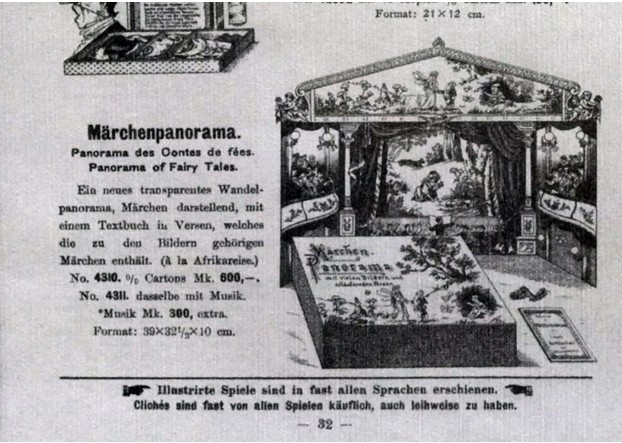
Adolf Sala ranks among the most important German manufacturers of nineteenth-century optical toys and moving panoramas. His illuminated theatres were among the most expensive and technically ambitious children's entertainments of their era.
Because of their size, delicate construction, transparent scrolling scenery, glassine backing, cloth curtain, mechanical components, and frequent use by children, complete surviving examples are genuinely uncommon. Examples retaining the original box are considerably scarcer still, while the deluxe music edition is encountered far less frequently than the standard version. The inclusion of a faithful facsimile of the original English performance booklet allows this remarkable optical theatre to be appreciated today exactly as its makers intended over 130 years ago.
Collector's Corner:
Other Sala Theaters (information only, not included in sale) :
The following illustrations are reproduced from an original A. Sala trade catalogue issued around the turn of the twentieth century. More than a simple price list, the catalogue provides a remarkable overview of the firm's extensive range of educational games, optical toys, paper theatres, moving panoramas, and luxury paper products. It documents the breadth of Sala's production at the height of the company's success, when its beautifully designed paper entertainments were exported throughout Europe in German, English, and French editions. For collectors today, these catalogues serve as invaluable primary sources, preserving images, descriptions, dimensions, and original prices for many of Sala's rarest productions, including examples that seldom survive intact.
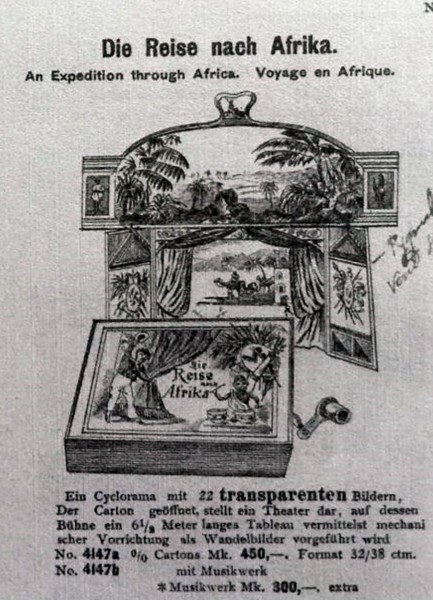
Die Reise nach Afrika (Journey to Africa). This remarkable transparent cyclorama predates the Fairy Tale Panorama and introduced the scrolling mechanism that would become one of A. Sala's signature innovations. Contemporary catalogues later described the Fairy Tale Panorama as being made "à la Afrikareise"—on the same mechanical principle.
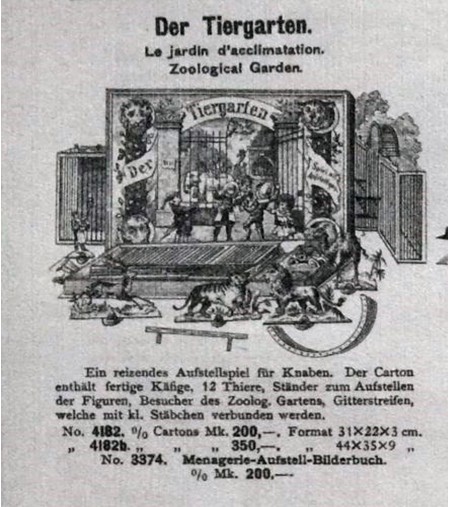
Der Tiergarten (The Zoological Garden). The trilingual title—German, French, and English—illustrates A. Sala's thriving international export business, allowing the same toy to be marketed throughout Europe and beyond.
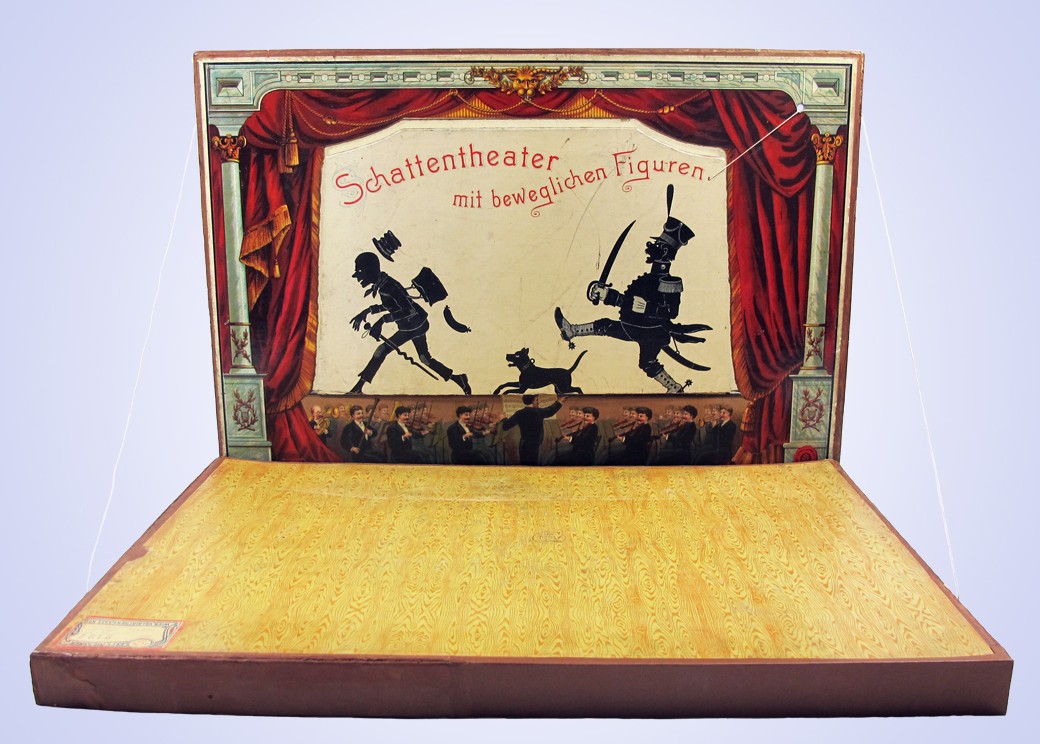
Schattentheater mit beweglichen Figuren (Shadow Theatre with Moving Figures). A. Sala, Berlin, ca. 1900. (Not in catalog)
Image provided by the excellent Optical Toy website: https://www.optical-toys.com
An elaborate boxed shadow theatre in which the hinged case unfolds to form a fully decorated proscenium stage using the same art as Fairy Tale Panorama. In this case there is no cloth curtain but a carboard curtain that lifts up. The set contains multiple silhouette figures. More photos can be seen here :
https://maxglauner.com/2022/04/25/schattentheater-lange-schatten-eines-kinderspiels/
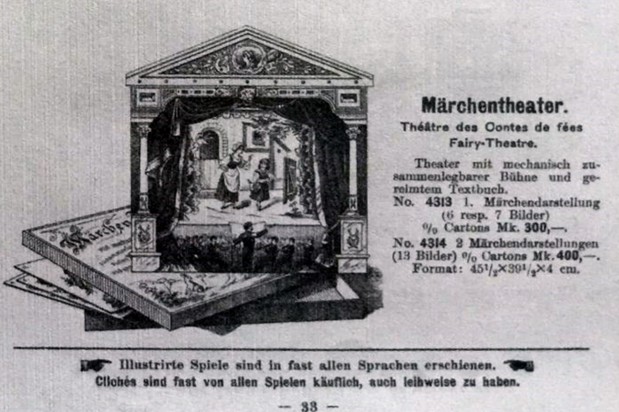
Märchentheater (Fairy Theatre). Building upon the success of the Fairy Tale Panorama, A. Sala's Fairy Theatre represents the next stage in the company's development of theatrical paper entertainments. Rather than presenting a single scrolling panorama, it combined interchangeable fairy-tale performances, a mechanically operated moving backdrop, and a printed text booklet within an elaborate proscenium theatre, creating one of the most sophisticated Victorian paper theatres produced in Germany. Like many of Sala's finest productions, it was issued in German, French, and English for the international market.
A. Sala, Berlin:
Germany's Master of Optical Toys and Paper Engineering
Image: Advertisement for A. Sala, Berlin, from Adress-Buch Deutscher Export-Firmen (Berlin: Ernst Siegfried Mittler und Sohn, 1884), 226. This multilingual advertisement, printed in French and Spanish, promoted A. Sala's luxury paper factory and educational products to foreign markets. It describes the firm as a manufacturer of luxury paper goods (Fabrique de Papeterie de Luxe / Fábrica de papel de lujo), cardboard novelties and toys, and educational materials based on the Fröbel method. The advertisement also emphasizes Sala's export business, listing chromolithographs, greeting cards, writing papers, and educational paper products, illustrating the company's extensive international trade by the late nineteenth century.
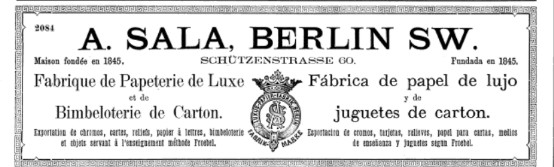
Founded in Berlin in 1845 by the Italian-born entrepreneur Antonio Pietro Vincenz Sala, A. Sala grew from a luxury paper factory and lithographic publishing house into one of Germany's foremost manufacturers of educational games, optical toys, moving panoramas, and illustrated paper novelties during the second half of the nineteenth century. Renowned for exceptional craftsmanship and brilliant chromolithography, the firm's productions rank today among the finest examples of Victorian paper engineering.
From Luxury Papers to Educational Toys
Originally established as a Luxuspapierfabrik (Luxury Paper Factory), the company produced embossed papers, greeting cards, decorative lithographs, children's books, and finely printed novelty items. As advances in color lithography made increasingly elaborate paper products possible, Sala expanded into educational games, mechanical toys, and optical entertainments. By the 1880s the firm had become one of Germany's leading manufacturers of family games and paper novelties.
The company's mastery of chromolithography became one of its defining strengths. Rich colors, precise registration, ingenious die-cut construction, and mechanical innovation distinguished Sala's products from those of many competitors and remain hallmarks prized by collectors today.
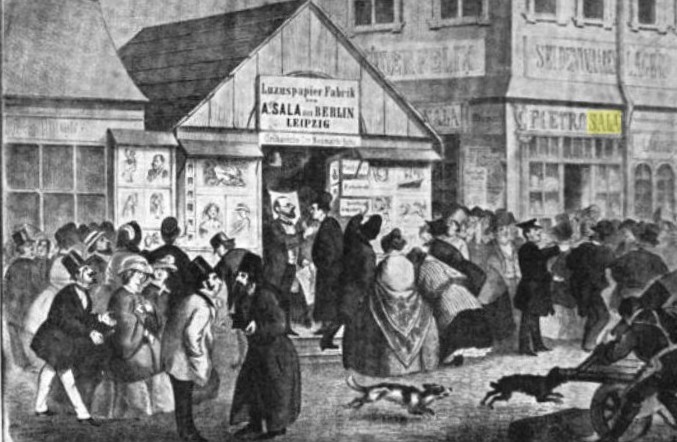
Image: Nineteenth-century illustration depicting the company's sales depot at the famous Leipzig Trade Fair around 1865. Above the entrance hangs the sign "Luxuspapier-Fabrik A. Sala – Berlin – Leipzig," inviting merchants and visitors into a world of beautifully printed paper goods, educational toys, games, and optical novelties. The Leipzig Trade Fair was the principal marketplace of nineteenth-century Europe, attracting buyers from across Germany and far beyond. For A. Sala, maintaining a prominent presence there helped transform what began as a Berlin luxury paper factory into one of Europe's leading manufacturers of educational games, optical toys, moving panoramas, and paper theatres. It was here that many retailers likely encountered Sala's ingenious creations for the first time before carrying them to homes and shops throughout Europe. One can almost imagine the excitement surrounding the little storefront. Well-dressed ladies, businessmen in top hats, curious children, and shoppers crowd the entrance while colorful lithographs and paper novelties fill the display windows. Dogs dart through the bustling street as horse-drawn carts pass by, capturing the energy and optimism of one of Europe's greatest commercial marketplaces. From: Julius Böhme, Ankündigung der Niederlage der Berliner Luxuspapierfabrik von A. Sala auf der Leipziger Messe (Announcement of the Leipzig sales depot of the Berlin luxury paper factory A. Sala at the Leipzig Trade Fair), ca. 1865. Reproduced in Das Plakat: Mitteilungen des Vereins der Plakatfreunde (Berlin, 1918), fig. 107, p. 209.
Play with a Purpose
Rather than producing toys solely for amusement, Sala embraced the educational ideals championed by Friedrich Fröbel, founder of the kindergarten movement. The company's games were designed to develop observation, reasoning, dexterity, imagination, and visual understanding while remaining engaging family entertainments.
This philosophy helped establish Sala as one of Germany's most respected educational toy manufacturers during the late nineteenth century.
An International Reputation
Sala products were marketed well beyond Germany.
Many games, panoramas, and optical toys were issued in German, English, and French, reflecting the firm's extensive export trade. Improvements in rail transportation and international shipping allowed Sala's productions to reach homes throughout Europe and overseas.
The English-language Fairy Tale Panorama represents one of these export editions, specially produced for English-speaking markets.
The Famous "Red Seal" Games
During the early twentieth century the company introduced its celebrated "Spiele mit Rotsiegel" ("Games with the Red Seal") trademark.
The distinctive red seal quickly became associated with high-quality German educational games. Earlier products typically bear the firm's crowned AS trademark accompanied by the words Luxus-Papier-Fabrik Berlin, while later productions feature the familiar red seal emblem recognized by collectors today.
Optical Toys and Moving Panoramas
Among Sala's most ambitious creations were its illuminated moving panoramas.
These remarkable optical entertainments—including the Journey to Africa (Afrikareise), Fairy Tale Panorama (Märchen-Panorama), and other scrolling panoramas—combined chromolithography, transparent artwork, moving scenery, theatrical staging, narration, music, and ingenious mechanical design into immersive home performances decades before the arrival of motion pictures.
Contemporary catalogues describe the Fairy Tale Panorama as a transparent Wandelpanorama, literally a "moving" or "changing panorama." The catalogue further explains that it was constructed "à la Afrikareise," indicating that it employed the same successful scrolling mechanism previously used in Sala's celebrated Journey to Africa panorama.
Viewed in a darkened room with light shining through the transparent scenes, these panoramas created an extraordinary illusion of illuminated theatrical storytelling unlike any ordinary toy theatre of the period.
Masterpieces of Chromolithography
Collectors today regard Sala among the finest German chromolithographic publishers of the Victorian era.
The firm's productions are admired for their brilliant printing, sophisticated paper engineering, and mechanical ingenuity. Whether producing board games, paper theatres, panoramas, or optical toys, Sala consistently achieved a level of quality that places the company among the premier European manufacturers of the nineteenth century. Surviving examples retaining their original boxes, mechanical components, and accessories are especially prized for their rarity and exceptional craftsmanship.
The Sala Family
A. Sala remained under family ownership for four generations, growing from a small Berlin luxury paper factory into one of Germany's foremost manufacturers of educational games, optical toys, and paper entertainments.
Following the death of founder Antonio Pietro Vincenz Sala in February 1878, management passed first to his widow, Louise Sala (née Jollet), while their son Fortunato Sala became the firm's procurator. Louise served as sole proprietor beginning in 1880 before Fortunato assumed ownership in 1882, expanding the business with the creation of the Fabrik Fröbel'scher Lehrmittel und Spiele (Factory for Fröbel Educational Materials and Games).
On 1 January 1884, Fortunato was joined by his cousin, Adolf Vincenz Richard Sala, whose name appears on many of the firm's most celebrated games, optical toys, and moving panoramas. Together they guided the company through its golden age, dramatically expanding production while exporting Sala's beautifully printed paper goods throughout Europe and beyond.
Following Adolf's death in February 1908, the partnership was dissolved and Fortunato once again became sole proprietor. He continued to lead the company for more than three decades, introducing the celebrated "Spiele mit Rotsiegel" ("Games with the Red Seal") trademark and overseeing Sala's transition into the twentieth century. Fortunato remained head of the firm until his death in 1941, by which time A. Sala had become one of Germany's best-known manufacturers of educational games, optical toys, and paper novelties.
Later Years
Although A. Sala survived both World Wars, the company never fully regained the artistic innovation and manufacturing quality that characterized its nineteenth-century productions.
Economic hardship following the First World War reduced production, while the changing political and economic climate of the 1930s altered the character of many of its games. Manufacturing continued after the Second World War, and the Sala name remained in use into the late twentieth century before the company was ultimately acquired by the Berlin packaging firm Schwerdtle & Schantz in 1986. The Sala name continued to appear on selected products into the early 1990s before finally disappearing.
Legacy
Today, A. Sala's surviving productions are recognized as some of the finest examples of nineteenth-century German paper engineering. Their combination of artistic design, educational purpose, ingenious mechanics, and superb chromolithography places them among the most desirable Victorian optical toys and paper entertainments.
References
Berlin Adressbuch. Various years, 1845–1908. Berlin: Königliche Hauptstadt Berlin.
Berlin Gewerbe-Ausstellung. Amtlicher Katalog der Berliner Gewerbe-Ausstellung 1896. Berlin, 1896.
Daniel Crouch Rare Books. The Name of the Game. Catalogue 41. London: Daniel Crouch Rare Books, 2025.
Deutsche Digitale Bibliothek. "A. Sala." Accessed July 19, 2026. https://www.deutsche-digitale-bibliothek.de/.
Fröbel Museum. Friedrich Fröbel Museum Archives. Keilhau, Germany. https://froebel-museum.de/.
Marlborough Rare Books. Fun and Games. Catalogue 79. London: Marlborough Rare Books, 2020.
Wikipedia contributors. "A. Sala." Wikipedia, The Free Encyclopedia. Accessed July 19, 2026. https://de.wikipedia.org/wiki/A._Sala
Blochmann, Annemarie. Schattentheater: Eine Anleitung zur Herstellung von beweglichen und unbeweglichen Figuren. Ravensburg: Otto Maier Verlag, ca. 1955
Adress-Buch Deutscher Export-Firmen. Berlin: Ernst Siegfried Mittler und Sohn, 1884.
Patentblatt: Herausgegeben von dem Kaiserlichen Patentamt. Berlin: Carl Heymanns Verlag, 1895.
Patent und Industrie: Monatsschrift für Patentwesen, Industrie und Handel. Berlin, 1889.
Neues Adreßbuch für Berlin und seine Vororte. Berlin: Julius Straube, 1896.
Nachweisung der im Deutschen Reiche gesetzlich geschützten Warenzeichen. Berlin: Carl Heymanns Verlag, 1888.